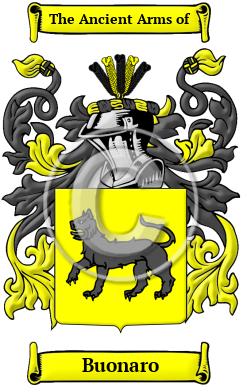
| ![Show Contents]() Buonaro History, Family Crest & Coats of Arms Buonaro History, Family Crest & Coats of Arms
Etymology of BuonaroWhat does the name Buonaro mean? From the historical and enchanting Italian region of Tuscany emerged a multitude of noble families, including the distinguished Buonaro family. During the Middle Ages, as populations grew and travel between regions became more frequent, the people of Tuscany found it necessary to adopt a second name to identify themselves and their families. The process of adopting fixed hereditary surnames was not complete until the modern era, but the use of hereditary family names in Italy began in the 10th and 11th centuries. Italian hereditary surnames were developed according to fairly general principles and they were characterized by a profusion of derivatives coined from given names. Although the most common type of family name found in Tuscany is the patronymic surname, which is derived from the father's given name, the nickname type of surname is also frequently found. Nickname surnames were derived from an eke-name, or added name. They usually reflected the physical characteristics or attributes of the first person that used the name. The surname Buonaro is a name for a fortunate person having derived from the words buon, which means good, and anno, which means year, combined to mean good year. Early Origins of the Buonaro familyThe surname Buonaro was first found in Pisa, where in 1130 a Bonanno was a prominent intellectual. Bonanno who was a painter, sculptor, and architect, and who is famous for the bronze doors of the Cathedral in Pisa which he finished in the 12th century. Another of his accomplishments is the leaning tower at Pisa, which he constructed with Gugliemo Tedesco in 1174. Early History of the Buonaro familyThis web page shows only a small excerpt of our Buonaro research. The years 1545, 1638, 1723 and 1800 are included under the topic Early Buonaro History in all our PDF Extended History products and printed products wherever possible. Buonaro Spelling VariationsItalian surnames come in far more variations than the names of most other nationalities. Regional traditions and dialects are a decisive factor in this characteristic. For example, northern names tend to end in "o", while southern in "i". Also important, but not unique to Italy, was the fact that before dictionaries and the printing press most scribes simply spelled words according to their sounds. The predictable result was an enormous number of spelling variations. The recorded spellings of Buonaro include Bonanno, Bonanni, Buonanno, Buonanni, Bonano, Bonan and many more. Early Notables of the Buonaro familyGiacomo Bonanno was Baron of Canicatti, and was a famous author; Pietro Bonanno was the first Prince of Roccafiorita and was Baron of Castelmare; Giacomo Bonanno was the first Bishop of Patti, and was also Archbishop of Monreale. Rinaldo Bonanno was an architect and sculptor in- Messina in 1545...
Another 49 words (4 lines of text) are included under the topic Early Buonaro Notables in all our PDF Extended History products and printed products wherever possible. Migration of the Buonaro familyIn the immigration and passenger lists a number of early immigrants bearing the name Buonaro were found: Frank Bonanno, who arrived in New York city in 1898, Tony Bonannot, who was a soldier, naturalized in Arkansas in 1918, as well as Autmino Bononio, who was naturalized in Louisiana in 1874..
 |