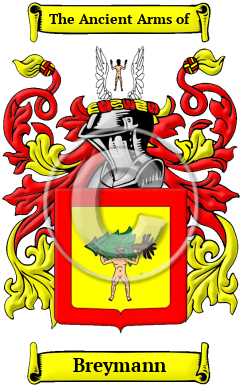
| ![Show Contents]() Breymann History, Family Crest & Coats of Arms Breymann History, Family Crest & Coats of Arms
- Origins Available:
Germany
Etymology of BreymannWhat does the name Breymann mean? The name Breymann comes from the Rhineland, an ancient region of Germany. In pre-medieval times, the Germans used only one name, but later they were forced by a growing population to adopt hereditary surnames; so as to remain distinct from the many others of the same first name. Local names were often chosen. They originally indicated land ownership, and frequently carried the prefix von, meaning "of" or "from," which is often taken as an indication of aristocratic lineage. Breymann was a name for some one lived beside a marshy region. The surname Breymann originally derived from the Old German word Brede which referred to a marsh. Breymann is a topographic surname, a type of local name given to a person who resided near a physical feature such as a hill, stream, church, or type of tree. Early Origins of the Breymann familyThe surname Breymann was first found in the Rhineland, where the name emerged in mediaeval times as one of the notable families of the region. From the 13th century on, the surname was identified with the great social and economic evolution which made this territory a landmark contributor to the development of the nation. The name derives from the word "Brede," which describes an area of marshy land; Breymann or Breymeyer are variations of Bredemann or Breymeyer. Early History of the Breymann familyThis web page shows only a small excerpt of our Breymann research. Another 92 words (7 lines of text) covering the years 1793 and 1794 are included under the topic Early Breymann History in all our PDF Extended History products and printed products wherever possible. Breymann Spelling VariationsMany cultural groups lived in the German states in medieval times. Each had its own dialect and traditions, and unique variations of popular names. Low German, which is similar to contemporary Dutch, was spoken in Westphalia. German names are characterized by additions such as regional suffixes and phrases that tell something about the origin or background of its original bearer. Further contributing to the variation in German names was the fact that there were no spelling rules in medieval times: scribes recorded names according to their sound. The recorded spelling variations of Breymann include Breymann, Breyman, Breymeyer, Breymeier, Breymaier, Breimann, Breiman, Braymann and many more. Early Notables of the Breymann family- the four sons of a Breymann, a bailiff in the town Salder, all of whom were ennobled in the late 18th century
| Breymann migration to the United States | + |
Between the 17th and 20th centuries, hundreds of thousands of Europeans came to North America, and many Rhinelanders were among them. They had many various reasons for making the choice: to escape poverty and persecution, for adventure, and for the opportunity to own their own land. Ellis Island, one of the main American immigration centers, saw many settlers as they moved on to the states of Pennsylvania, Ohio, Texas, Illinois, California, and New York. In Canada, they found homes in Ontario, and on the great plains of the Midwestern provinces. The Breymann were among of the early German families that came to North America:
Breymann Settlers in United States in the 18th Century- Johann Christian Breymann, who arrived in Winterhill, Massachusetts in 1778
- Joh Christ Breymann, who arrived in America in 1778 1
- Wilhelm Breymann, who landed in Long Island in 1781 1
Breymann Settlers in United States in the 19th Century- Joh Bern Heinr Breymann, who landed in America in 1836 1
| Contemporary Notables of the name Breymann (post 1700) | + |
- Dr. Wolfgang Breymann, Department of Mathematics at ETH-Zentrum (Swiss Federal Institute of Technology), Switzerland
- Filby, P. William, Meyer, Mary K., Passenger and immigration lists index : a guide to published arrival records of about 500,000 passengers who came to the United States and Canada in the seventeenth, eighteenth, and nineteenth centuries. 1982-1985 Cumulated Supplements in Four Volumes Detroit, Mich. : Gale Research Co., 1985, Print (ISBN 0-8103-1795-8)
 |