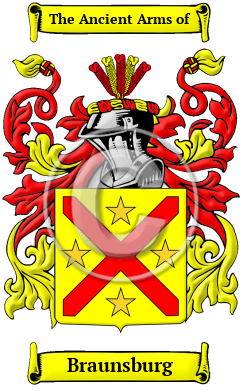
| ![Show Contents]() Braunsburg History, Family Crest & Coats of Arms Braunsburg History, Family Crest & Coats of Arms
- Origins Available:
Germany
Etymology of BraunsburgWhat does the name Braunsburg mean? The name Braunsburg comes from Prussia, a historic region that originally encompassed the coastal lands of the southeast Baltic, but over time expanded to include much of Poland and the majority of Germany. In pre-medieval times, these Prussians used only one name, but later they were forced by a growing population to adopt hereditary surnames so that they would remain distinct from the many others with the same first name. Local names were often chosen. They originally indicated land ownership, and frequently carried the prefix von, meaning "of" or "from", which is often taken as an indication of aristocratic lineage. Braunsburg was a name for some one lived on or near a mountain. There are also numerous places in Germany named Braunsberg or Braunberg. Braunsburg is a topographic surname, which is a local surname that was given to a person who resided near a physical feature such as a hill, stream, church, or type of tree.The name was derived from the Old German words berc, or burg, which meant mountain. and the word brun, which meant brown. Early Origins of the Braunsburg familyThe surname Braunsburg was first found in the kingdo of Prussia at the town of Braunsberg. The castle of Braunsberg was built by the Teutonic Knights in 1241, and the town was founded ten years later. Destroyed by the Prussians in 1262, it was restored in 1279. 1 The earliest record of the family was Bruno II of Isenburg-Braunsberg was the Count of Isenburg-Braunsberg from 1210 until 1255. Later, Bruno III of Isenburg-Braunsberg, was Count of Isenburg-Braunsberg from 1255 until 1278 and William I of Isenburg-Braunsberg, was Count of Isenburg-Braunsberg from 1327 until 1383. In 1338 William was raised to an Imperial Count. Isenburg-Braunsberg was the name of a state of the Holy Roman Empire, based near the hill Braunsberg (near Anhausen in modern Rhineland-Palatinate, Germany). Braunsberg is a 346 m high limestone massif in Hainburg an der Donau, Austria, on the shore of the Danube. Early History of the Braunsburg familyThis web page shows only a small excerpt of our Braunsburg research. Another 69 words (5 lines of text) are included under the topic Early Braunsburg History in all our PDF Extended History products and printed products wherever possible. Braunsburg Spelling VariationsMany cultural groups lived in the German states in medieval times. Each had its own dialect and traditions, and unique variations of popular names. Low German, which is similar to contemporary Dutch, was spoken in Westphalia. German names are characterized by additions such as regional suffixes and phrases that tell something about the origin or background of its original bearer. Further contributing to the variation in German names was the fact that there were no spelling rules in medieval times: scribes recorded names according to their sound. The recorded spelling variations of Braunsburg include Braunsberg, Braunsbergg, Braunsberge, Braunsbergh, Braunsburg, Braunsburgg, Braunsburgh, Brownsberg, Brownsbergg, Brownsberge, Brownsburg, Brownsburgg, Brownsburger, Brownsberger, Brownsburgger, Brownsbergger, Brawnsberg, Brawnsbergg, Brawnsberger, Brawnsburg and many more. Early Notables of the Braunsburg familyMore information is included under the topic Early Braunsburg Notables in all our PDF Extended History products and printed products wherever possible. Migration of the Braunsburg familyThe state of Prussia was a great influence on the shape of modern Germany. After the Second World War, Prussia's land was divided among the Soviet Union, Poland, East Germany and West Germany and the state was abolished. Some Prussians remained in those countries after the war, while many others migrated to North America in search of a new start. Philadelphia was their primary point of entry to the United States, after which many of them moved on to Ohio, Texas, Illinois, California, New York, and Maryland. A large number of Prussians also migrated to Ontario and the prairie provinces as United Empire Loyalists. Analysis of immigration records has shown some of the first Braunsburgs to arrive in North America, and among them were: Johann Georg Braunsberg, who arrived in Philadelphia in 1750 and other individuals who arrived on the eastern seaboard of the United States in the 18th and 19th centuries..
- Smith, George (ed), Dictionary of National Biography. London: Smith, Elder & Co., 1885-1900. Print
 |