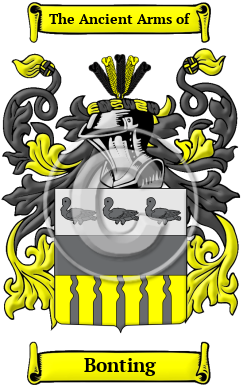
The surname Bonting was first found in Prussia, where the name Bunting contributed greatly to the development of an emerging nation, and which would later play a large role in the tribal and national conflicts of the area. Over time, the family branched into many houses where family members continued to play a significant role in the local social and political affairs.
Early History of the Bonting family
This web page shows only a small excerpt of our Bonting research. Another 74 words (5 lines of text) covering the years 1545, 1581, 1606 and 1768 are included under the topic Early Bonting History in all our PDF Extended History products and printed products wherever possible.
Bonting Spelling Variations
In the medieval era, many different cultural groups lived in the German states. There are thus many regional variations of German surnames from that era. Westphalians spoke Low German, which is similar to modern Dutch. Many German names carry suffixes that identify where they came from. Others have phrases attached that identify something about the original bearer. Other variations in German names resulted from the fact that medieval scribes worked without the aid of any spelling rules. The spelling variations of the name Bonting include Bunting, Bünting, Bunt, Buntz, Buntting, Buntingg, Buntinge, Bunnting, Buntinng, Bunding, Buenting, Buentting, Bonting and many more.
Early Notables of the Bonting family
Heinrich Bünting (1545-1606) a German Protestant pastor and theologian. He is best known for his book of woodcut maps titled Itinerarium Sacrae Scripturae (Travel book through Holy Scripture) first published in 1581 which included Bünting's... Another 35 words (2 lines of text) are included under the topic Early Bonting Notables in all our PDF Extended History products and printed products wherever possible.
Loading...
Loading...
Loading...
Loading...
Migration of the Bonting family
The state of Prussia was a great influence on the shape of modern Germany. After the Second World War, Prussia's land was divided among the Soviet Union, Poland, East Germany and West Germany and the state was abolished. Some Prussians remained in those countries after the war, while many others migrated to North America in search of a new start. Philadelphia was their primary point of entry to the United States, after which many of them moved on to Ohio, Texas, Illinois, California, New York, and Maryland. A large number of Prussians also migrated to Ontario and the prairie provinces as United Empire Loyalists. Analysis of immigration records has shown some of the first Bontings to arrive in North America, and among them were: Samuel Bunting who arrived in New Jersey in 1678; Samuel Bunting who settled in Pennsylvania in 1725; William Bunting who arrived at New York in 1795; Matthew Bunting who arrived in Delaware in 1813.