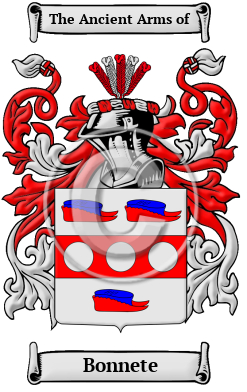
| ![Show Contents]() Bonnete History, Family Crest & Coats of Arms Bonnete History, Family Crest & Coats of Arms
- Origins Available:
France
Germany
Etymology of BonneteWhat does the name Bonnete mean? The name Bonnete evolved in ancient Germany in the state of Bavaria. It is a patronymic name. Patronymics are derived from the given name of the father of the bearer. Names derived from the name of the mother of the bearer, which are less common, are called metronymic names. Patronymic names were generally formed from traditional, German given names, rather than the names of saints or biblical figures, as is the custom in many other European cultures. Bonnete comes from the Latin personal name Bonitus, a derivative of the word bonus, which means good. The name was originally a French occupational name for a milliner, or a nickname for a wearer of unusual headgear, derived from the Old French word bonnet, which means bonnet or hat. However, the name spread to Bavaria during the 16th and 17th centuries, a period of widespread European migration. The Bonnete family emerged as a noble family in Bavaria and it had numerous distinguished branches. Furthermore, the Bonnete family become noted for its involvement in the social, economic and political development of the region. Early Origins of the Bonnete familyThe surname Bonnete was first found in Bavaria, where the name Bonnet was closely identified in early mediaeval times with the feudal society of early European history. The name would later emerge as a noble family with great influence, having many distinguished branches, and become noted for its involvement in social, economic and political affairs. Early History of the Bonnete familyThis web page shows only a small excerpt of our Bonnete research. Another 50 words (4 lines of text) covering the years 1720, 1743, 1754 and 1793 are included under the topic Early Bonnete History in all our PDF Extended History products and printed products wherever possible. Bonnete Spelling VariationsIn the medieval era, many different cultural groups lived in the German states. There are thus many regional variations of German surnames from that era. Westphalians spoke Low German, which is similar to modern Dutch. Many German names carry suffixes that identify where they came from. Others have phrases attached that identify something about the original bearer. Other variations in German names resulted from the fact that medieval scribes worked without the aid of any spelling rules. The spelling variations of the name Bonnete include Bonnet, Bonnett, Bonett, Bonnette, Bonette and many more. Early Notables of the Bonnete familyCharles Bonnet (1720-1793), Swiss naturalist and philosophical writer. Although he chose law as his profession, his first love was natural science, publishing several works in the field, most notably "Traite d'insectologie" (1743) and "Recherches...
Another 34 words (2 lines of text) are included under the topic Early Bonnete Notables in all our PDF Extended History products and printed products wherever possible. Migration of the Bonnete familyEuropean migration to North America began in the mid-17th century and continued unabated until the mid-20th. Many Bavarians made the long trip to escape poverty or persecution based on their religious beliefs. The chance for tenant farmers to own their own land was also a major drawing card. They settled all across the United States in Pennsylvania, Texas, New York, Illinois, and California. Many came to Canada also, settling in Ontario and the prairie provinces. Analysis of immigration records has shown some of the first Bonnetes to arrive in North America, and among them were: Pierre Bonnet who arrived in Canada in 1643; Claude Bonnet who settled in Louisiana, and Daniel Bonnet and his wife Jeanne Couturier who arrived in New York State in 1700-1701.
 |