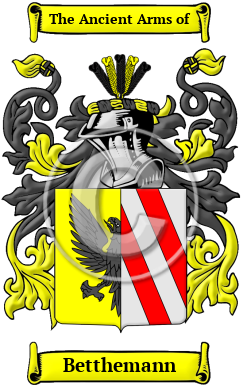
| ![Show Contents]() Betthemann History, Family Crest & Coats of Arms Betthemann History, Family Crest & Coats of Arms
- Origins Available:
Germany
Etymology of BetthemannWhat does the name Betthemann mean? The name Betthemann comes from the Rhineland, an ancient region of Germany. In pre-medieval times, the Germans used only one name, but later they were forced by a growing population to adopt hereditary surnames; so as to remain distinct from the many others of the same first name. Local names were often chosen. They originally indicated land ownership, and frequently carried the prefix von, meaning "of" or "from," which is often taken as an indication of aristocratic lineage. Betthemann was a name for some one lived in the Rhineland. The Betthemann family emerged during the feudal era, when the Rhineland was controlled by feudal lords and princes. Early Origins of the Betthemann familyThe surname Betthemann was first found in the county of Nassau, where the name could be considered to make a great early contribution to the feudal society which became the backbone of early development in Europe. The earliest known instance of the name dates back to 1430, when Jurgen Bethke is recorded in the "Urkundenbuch der Stadt Oldenburg," the Oldenburg registry. The name became prominent in local affairs and branched into many houses which played important roles in the savage tribal and national conflicts, each group seeking power and status in an ever changing territorial profile. Chronicles suggest that the most ancient branch of the family can be traced to the Netherlands, which they left during the religious strife of the Thirty Year's War for the region of Nassau. The founding father of the prominent Nassau branch is taken to be Simon Moritz Bethmann (d.1725,) who was an administrator in the government of the Prince of Nessau-Weilburg. It was his son, Johann Philipp Bethmann (1715-1793) who founded the renowned bank of Frankfurt, the Bethmann Brothers. Early History of the Betthemann familyThis web page shows only a small excerpt of our Betthemann research. Another 225 words (16 lines of text) covering the years 1652, 1701, 1715, 1721, 1782, 1793, 1823, 1827, 1829, 1842, 1849 and 1858 are included under the topic Early Betthemann History in all our PDF Extended History products and printed products wherever possible. Betthemann Spelling VariationsMany cultural groups lived in the German states in medieval times. Each had its own dialect and traditions, and unique variations of popular names. Low German, which is similar to contemporary Dutch, was spoken in Westphalia. German names are characterized by additions such as regional suffixes and phrases that tell something about the origin or background of its original bearer. Further contributing to the variation in German names was the fact that there were no spelling rules in medieval times: scribes recorded names according to their sound. The recorded spelling variations of Betthemann include Bethman, Bethemann, Betheman, Bettheman, Betthemann, Bethmman, Bethke, Berthe, Bethe, Bethge and many more. Early Notables of the Betthemann familyAnother 47 words (3 lines of text) are included under the topic Early Betthemann Notables in all our PDF Extended History products and printed products wherever possible. Migration of the Betthemann familyBetween the 17th and 20th centuries, hundreds of thousands of Europeans came to North America, and many Rhinelanders were among them. They had many various reasons for making the choice: to escape poverty and persecution, for adventure, and for the opportunity to own their own land. Ellis Island, one of the main American immigration centers, saw many settlers as they moved on to the states of Pennsylvania, Ohio, Texas, Illinois, California, and New York. In Canada, they found homes in Ontario, and on the great plains of the Midwestern provinces. The Betthemann were among of the early German families that came to North America: Johann Ludwig Bethmann, who came to Philadelphia, Pa. in 1774; Heinrich Bethge, who settled in America after fighting in the Revolutionary War, G. Adolph Bethge, who sailed from Hamburg to New York in 1850.
 |