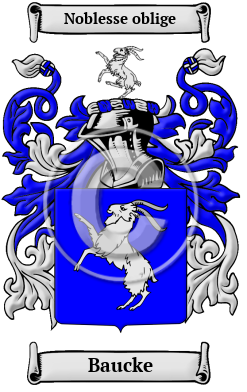
The surname Baucke was first found in Alsace and Franconia, where the name could be considered to have made a great early contribution to the feudal society which became the backbone of early development of Europe. The name became prominent in local affairs and branched into many houses which played important roles in the savage tribal and national conflicts, each group seeking power and status in an ever changing territorial profile. The Bock branch of Strasbourg enjoyed prestige in this city; Cunz Bock was knighted by King Albrecht I of Germany in 1298, and his descendant Georg Jacob was leader of the city in 1587. Sigmund von Bock was Bishop of Cammin in Pomerania in 1446.
Early History of the Baucke family
This web page shows only a small excerpt of our Baucke research. Another 98 words (7 lines of text) covering the years 1314, 1498, 1554, 1695, 1731, 1748 and 1794 are included under the topic Early Baucke History in all our PDF Extended History products and printed products wherever possible.
Baucke Spelling Variations
Spelling variations of this family name include: Bock, Bocke, Boch, Boche, Bauck, Baucke, Bauch, Bauche, Bokke and many more.
Early Notables of the Baucke family
Nicolaus Bock, who was a chancellor and emissary for the election of the Emperor in Frankfurt in 1314. Hieronymus Bock (Latinised Hieronymus Tragus; c. 1498-1554) was a German botanist, physician, and Lutheran minister who began the transition from medieval botany to the modern scientific worldview by arranging plants... Another 47 words (3 lines of text) are included under the topic Early Baucke Notables in all our PDF Extended History products and printed products wherever possible.
Loading...
Loading...
Loading...
Loading...
Migration of the Baucke family
Some of the first settlers of this family name or some of its variants were: a number of Bocks, who landed from 1730 to 1769 in Philadelphia, such as Georg Peter Bock in 1754; Johann Heinrich Bock in 1744; and Leonhard Bock in 1731.
The motto was originally a war cry or slogan. Mottoes first began to be shown with arms in the 14th and 15th centuries, but were not in general use until the 17th century. Thus the oldest coats of arms generally do not include a motto. Mottoes seldom form part of the grant of arms: Under most heraldic authorities, a motto is an optional component of the coat of arms, and can be added to or changed at will; many families have chosen not to display a motto.
Motto: Noblesse oblige
Remove Item
WARNING!
Removing this item from your shopping cart will remove your associated sale items.
Are you sure you want to delete this item from your shopping cart?