| ![Show Contents]() Bartholomae History, Family Crest & Coats of Arms Bartholomae History, Family Crest & Coats of Arms
Etymology of BartholomaeWhat does the name Bartholomae mean? A multitude of prestigious family names, such as the surname Bartholomae, were formed in the lands which became the modern state of Germany, which is renowned for its beauty, industry, and economic power. However, in the medieval era, Germany was fragmented and inhabited by numerous Barbarian tribes, who fought amongst themselves for control of the land. At this time, the surname Bartholomae emerged throughout the German territories. Early Origins of the Bartholomae familyThe surname Bartholomae was first found in Germany, where the name Barthelemin was anciently associated with the tribal conflicts of the area. They declared allegiances to many nobles and princes of early history, lending their influence in struggles for power and status within the region. They branched into many houses, and their contributions were sought by many leaders in their search for power. Early History of the Bartholomae familyThis web page shows only a small excerpt of our Bartholomae research. Another 92 words (7 lines of text) covering the years 1585, 1741, 1765, 1766, 1768, 1770, 1776, 1777 and 1808 are included under the topic Early Bartholomae History in all our PDF Extended History products and printed products wherever possible. Bartholomae Spelling VariationsMany cultural groups lived in the German states in medieval times. Each had its own dialect and traditions, and unique variations of popular names. Low German, which is similar to contemporary Dutch, was spoken in Westphalia. German names are characterized by additions such as regional suffixes and phrases that tell something about the origin or background of its original bearer. Further contributing to the variation in German names was the fact that there were no spelling rules in medieval times: scribes recorded names according to their sound. The recorded spelling variations of Bartholomae include Bathelemin, Bartholomai, Barthlemin, Barthelemmin, Barthelemmen, Barthelemen, Barthelme and many more. Early Notables of the Bartholomae familyFrançois Hippolite Barthelemon, born at Bourdeaux July 37, 1741, "was the son of a French government officer and an Irish lady. He commenced life as an officer in the Irish brigade, but being induced by the Earl of Kelly, a well-known amateur composer, to change his profession for that of music, he became one of the most distinguished violinists of his time. In 1765 he came to England, and was engaged as leader of the opera band. In 1766 he produced at the King's Theatre a serious opera called 'Pelopida,' and in the same year married Miss Mary Young, a niece...
Another 163 words (12 lines of text) are included under the topic Early Bartholomae Notables in all our PDF Extended History products and printed products wherever possible.
| Bartholomae migration to the United States | + |
In the immigration and passenger lists were a number of people bearing the name Bartholomae
Bartholomae Settlers in United States in the 18th Century- Joh Nicolaus Bartholomae, who landed in Pennsylvania in 1753 1
- Adam Bartholomae, who landed in Pennsylvania in 1754 1
- Joh Bartholomae, who arrived in America in 1783 1
Bartholomae Settlers in United States in the 19th Century- Andreas Bartholomae, who landed in Texas in 1845 aboard the ship "Joh. Derhardt" 1
- Mrs. Bartholomae, German who arrived in Galveston, Texas in 1845 aboard the ship "Joh. Derhardt"
- Miss Bartholomae, German who arrived in Galveston, Texas in 1845 aboard the ship "Joh. Derhardt"
- Mr. Charles Bartholomae, German who arrived in Galveston, Texas in 1845 aboard the ship "Joh. Derhardt"
| Contemporary Notables of the name Bartholomae (post 1700) | + |
- David J. Bartholomae (1947-2023), American scholar in composition studies, Professor of English and former Chair of the English Department at the University of Pittsburgh
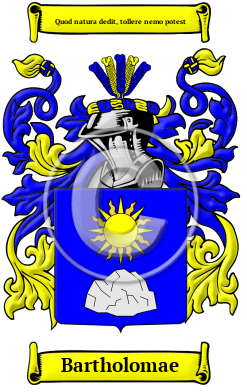
The motto was originally a war cry or slogan. Mottoes first began to be shown with arms in the 14th and 15th centuries, but were not in general use until the 17th century. Thus the oldest coats of arms generally do not include a motto. Mottoes seldom form part of the grant of arms: Under most heraldic authorities, a motto is an optional component of the coat of arms, and can be added to or changed at will; many families have chosen not to display a motto.
Motto: Quod natura dedit, tollere nemo potest
Motto Translation: Which is safer, because it is better
- Filby, P. William, Meyer, Mary K., Passenger and immigration lists index : a guide to published arrival records of about 500,000 passengers who came to the United States and Canada in the seventeenth, eighteenth, and nineteenth centuries. 1982-1985 Cumulated Supplements in Four Volumes Detroit, Mich. : Gale Research Co., 1985, Print (ISBN 0-8103-1795-8)
 |