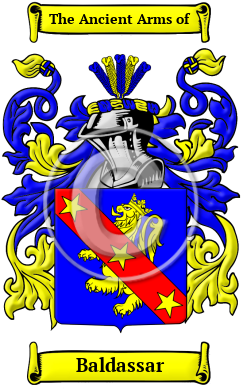
| ![Show Contents]() Baldassar History, Family Crest & Coats of Arms Baldassar History, Family Crest & Coats of Arms
Etymology of BaldassarWhat does the name Baldassar mean? The distinguished surname Baldassar can be traced back to the ancient and beautiful region of Lombardy. Although people were originally known only by a single name, it became necessary for people to adopt a second name to identify themselves as populations grew and travel became more frequent. The process of adopting fixed hereditary surnames was not complete until the modern era, but the use of hereditary family names in Italy began in the 10th and 11th centuries. Italian hereditary surnames were developed according to fairly general principles and they were characterized by a profusion of derivatives coined from given names. The most common type of family name found in the region of Lombardy is the patronymic surname, which is derived from the father's given name. During the Middle Ages, Italians adopted the patronymic system of name-making because it perfectly complemented the prevailing Feudal System. In Italy the popularity of patronymic type of surname is also due to the fact that during the Christian era, people often named their children after saints and biblical figures. The surname Baldassar came from the Germanic word baltha, which means gallant, bold. Early Origins of the Baldassar familyThe surname Baldassar was first found in the city of Cremona, which lies just south of Milan. The earliest records of the family lie here with the Baldesio family in the 8th century. Early History of the Baldassar familyThis web page shows only a small excerpt of our Baldassar research. The years 1160, 1281, 1296, 1298, 1343, 1507, 1550, 1553, 1579, 1585, 1624, 1650, 1683, 1695 and 1703 are included under the topic Early Baldassar History in all our PDF Extended History products and printed products wherever possible. Baldassar Spelling VariationsItalian surnames have a surprising number of forms in comparison with other European surnames because they reflect the regional variations and the many dialects of the Italian language, each of which has its distinctive features. For example, in Northern Italy the most standard Italian surname suffix is "I", whereas in Southern Italy the most typical surname suffix is "O". Sardinian is very different from other forms of Italian and in fact, it is considered to be its own distinct language. Additionally, spelling changes frequently occurred because medieval scribes, church officials, and the bearers of names, spelled names as they sounded rather than according to any specific spelling rules. As a consequence of the major changes in the Italian language and in the local spellings of Italian surnames that occurred over the course of history, there are numerous variations for the surname Baldassar. These spelling variations include Baldo, Baldi, Baudi, Baudo, Bauda, De Baudi, Debaudi, Baldelli, Baldella, Baldetti, Balde, Baldini, Baldin, Baldinotti, Balducci, Baldocci, Baldoni, Baldizzone, Baldacchi, Baldaco, Baldacchino, Baldecchi, Baldacci, Baldassi, Baldasso, Baldas, Baldassini, Baldasseroni, Baldassarini, Baldana, BaldaChina, Baldassin, Baldazzi, Baldani, Baldan, Baldaro, Baldari, Baldesi, Baldrati, Baldironi, Baudino, Baudinelli, Bauduccio, Baudone, Baudizzone, Baudacci, Baudassi, Baudasso and many more. Early Notables of the Baldassar family- Valerio Baldassari (c.1650-1695), an Italian painter of the Baroque period
- Pietro Baldassare or Baldassari, a Baroque composer, possibly born in Rome or Brescia, Italy about 1683
Migration of the Baldassar familyDiscovered in the immigration and passenger lists were a number of people bearing the name Baldassar: Albina Baldassi, aged 23, who arrived at Ellis Island from Italy, in 1911; Angelo Baldassi, aged 27, who arrived at Ellis Island from Codroipo, Italy, in 1923.
 |