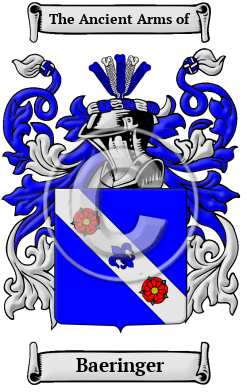
| ![Show Contents]() Baeringer History, Family Crest & Coats of Arms Baeringer History, Family Crest & Coats of Arms
- Origins Available:
Germany
Etymology of BaeringerWhat does the name Baeringer mean? The prestigious family surname Baeringer originated in the territory that eventually became the German state of Prussia. In the 19th century, this state was virtually unrivalled militarily, and its rapid industrial growth made it a contender for economic superiority in Europe as well. However, in the medieval era, Prussia was fragmented and inhabited by numerous barbarian tribes, who fought amongst themselves for control of the land. The borders of the barbarian kingdoms, which were established after the fall of the Roman Empire, changed repeatedly. The region that came to be known as Prussia was roughly divided between the territories of Brandenburg-Prussia, West Prussia and East Prussia. The Baeringer family emerged in Brandenburg-Prussia, which is essentially the birthplace of modern Germany. By the 19th century, Brandenburg-Prussia had incorporated East Prussia, West Prussia and many other German territories. Moreover, in the late 19th century, it led the German states in the unification of Germany. Early Origins of the Baeringer familyThe surname Baeringer was first found in Prussia, where the name Beringer became noted for its many branches within the region, where each house acquired a status and influence which was envied by the princes of the region. In their later history the name became a power unto themselves and were elevated to the ranks of nobility as they grew into this most influential family. Early History of the Baeringer familyThis web page shows only a small excerpt of our Baeringer research. Another 131 words (9 lines of text) covering the years 1707 and 1806 are included under the topic Early Baeringer History in all our PDF Extended History products and printed products wherever possible. Baeringer Spelling VariationsMany cultural groups lived in the German states in medieval times. Each had its own dialect and traditions, and unique variations of popular names. Low German, which is similar to contemporary Dutch, was spoken in Westphalia. German names are characterized by additions such as regional suffixes and phrases that tell something about the origin or background of its original bearer. Further contributing to the variation in German names was the fact that there were no spelling rules in medieval times: scribes recorded names according to their sound. The recorded spelling variations of Baeringer include Beringer, Berringer, Beringher, Beringger, Berenger, Berengher, Berengger, Baringer, Baeringer, Barringer, Baerringer, Baringher, Baeringher, Baringger, Baeringger, Barenger, Baerenger, Barengher, Baerengher, Barengger and many more. Early Notables of the Baeringer familyMore information is included under the topic Early Baeringer Notables in all our PDF Extended History products and printed products wherever possible. Migration of the Baeringer familyPrussia played an extremely influential role in shaping modern German history. It remained a part of Germany until after the Second World War. Prussia was divided among the Soviet Union, Poland, East Germany and West Germany. Many Prussians became residents of these new countries after the War, and many migrated to other parts of Germany or Europe, as well as to North America. In the United States, the majority of settlers landed in Philadelphia, and moved on to Ohio, Texas, Illinois, California, New York, and Maryland. Many German settlers also migrated to Canada, particularly to Ontario and the Prairies. Amongst the settlers in North America with this distinguished name Baeringer were Conrad Beringer who arrived in New York City in 1710; Mary Elizabeth Berringer arrived in Salisbury, North Carolina in 1724; Elias Beringer settled in Philadelphia, Pa. in 1738.
 |