| ![Show Contents]() Openheims History, Family Crest & Coats of Arms Openheims History, Family Crest & Coats of Arms
Etymology of OpenheimsWhat does the name Openheims mean? The ancient German region of the Rhineland was the original home of the ancestors of the Openheims surname. Openheims was a local name, a type of hereditary surname that identified people by the places where they lived. Landowners were the first to use local names, and they often attached the prefix "von", meaning "of" or "from," to the surname. Often, the use of "von" was a mark of aristocratic birth. Local names are by far the most common style of German hereditary surname. Openheims was a name for someone who lived in the region of Oppenheim in the town of Hesse, between Mainz and Worms. Openheims is a topographic surname, which was given to a person who resided near a physical feature such as a hill, stream, church, or type of tree. Habitation names form the other broad category of surnames that were derived from place-names. They were derived from pre-existing names for towns, villages, parishes, or farmsteads. Other local names are derived from the names of houses, manors, estates, regions, and entire counties. Early Origins of the Openheims familyThe surname Openheims was first found in the Rhineland, where the name Oppenheim was closely identified in early mediaeval times with the feudal society that became prominent throughout Europe. The name later emerged as a noble family with great influence, having many distinguished branches that become noted for their involvement in social, economic and political affairs. Early History of the Openheims familyThis web page shows only a small excerpt of our Openheims research. Another 82 words (6 lines of text) covering the year 1867 is included under the topic Early Openheims History in all our PDF Extended History products and printed products wherever possible. Openheims Spelling VariationsOne can encounter great variation in the spelling of surnames: in early times, spelling in general, and thus the spelling of names was not yet standardized; and later, spellings would change with branching and movement of families. Variations of the name Openheims include Oppenheim, Openheim, Oppennheim, Opennheim, Oppenheime, Oppenheimm, Oppenheimer and many more. Early Notables of the Openheims familyMore information is included under the topic Early Openheims Notables in all our PDF Extended History products and printed products wherever possible. Migration of the Openheims familyHundreds of thousands of Europeans, including many Rhinelanders, made the voyage to North America between the 17th and 20th centuries. It was an escape from religious persecution and poverty and also an opportunity for people to start over and own their own land. Most landed at Ellis Island, off New York before moving on to the states of Pennsylvania, Ohio, Texas, Illinois, and California. Some also landed in Canada and settled in Ontario, while others headed west to the prairie provinces. A study of passenger and immigration lists has shown a number of people bearing the name of Openheims, or one of its variants, reaching North America shores very early: J. Dieterich Oppenheim, who settled in Philadelphia, Pa. in 1753; H. Oppenheim, who came to Charleston, South Carolina, in 1828; B. Oppenheim, who came to San Francisco in 1851.
The motto was originally a war cry or slogan. Mottoes first began to be shown with arms in the 14th and 15th centuries, but were not in general use until the 17th century. Thus the oldest coats of arms generally do not include a motto. Mottoes seldom form part of the grant of arms: Under most heraldic authorities, a motto is an optional component of the coat of arms, and can be added to or changed at will; many families have chosen not to display a motto.
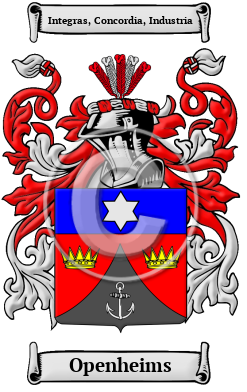
Motto: Integras, Concordia, Industria
 |