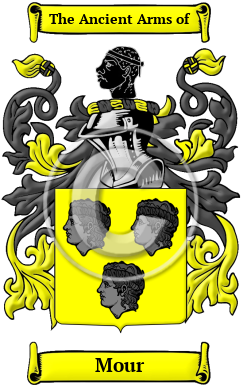
| ![Show Contents]() Mour History, Family Crest & Coats of Arms Mour History, Family Crest & Coats of Arms
Etymology of MourWhat does the name Mour mean? The origins of the German name Mour lie within the Austrian empire. Within this region, hereditary surnames began to be adopted after the 12th century, and names that were derived from localities became increasingly widespread. Local surnames originally denoted the proprietorship of the village or estate. When coupled with the German preposition von, which means from or of, local names can indicate that the initial bearer of the name was an aristocrat. However, in modern times, the preposition is frequently dropped from surnames of this type. The Mour family originally lived in the modern state of Austria. Early Origins of the Mour familyThe surname Mour was first found in Austria and the Rhineland, where the name became noted for its many branches within the region, each house acquiring a status and influence which was envied and enrolled by the princes of the region. In their later history the family became a power unto themselves and were elevated to the ranks of nobility as they grew into this most influential family. Early History of the Mour familyThis web page shows only a small excerpt of our Mour research. Another 221 words (16 lines of text) covering the years 1299, 1557, 1613, 1627, 1665, 1704, 1801, 1806, 1824, 1879 and 1901 are included under the topic Early Mour History in all our PDF Extended History products and printed products wherever possible. Mour Spelling VariationsOne can encounter great variation in the spelling of surnames: in early times, spelling in general, and thus the spelling of names was not yet standardized; and later, spellings would change with branching and movement of families. Variations of the name Mour include Mohr, More, Morher, Mohrer, Mor, Moor and others. Early Notables of the Mour familyJ.C.B. Mohr, who founded a well-known publishing house in 1801. Karl Friedrich Mohr (1806-1879) was the leading scientific pharmacist of his time in Germany. He invented various new analytical processes and the "Mohr's balance" for determining specific weights...
Another 37 words (3 lines of text) are included under the topic Early Mour Notables in all our PDF Extended History products and printed products wherever possible.
| Mour migration to the United States | + |
After the First World War, Austria became a republic. The Treaty of Versailles broke up the empire in 1919 and many of the Sudeten Germans were incorporated into the new nation of Czechoslovakia. In the 20th century, many Austrians migrated to other parts of Germany or Europe, as well as to North America. In the United States, the majority of settlers landed in Philadelphia, and moved on to Ohio, Texas, Illinois, California, New York, and Maryland. Many German settlers also migrated to Canada, particularly Ontario and the Prairies. Amongst the settlers in North America with this distinguished name Mour were
Mour Settlers in United States in the 19th Century- Miss Catherine Mour, aged 15, British settler who arrived in New York aboard the ship "Cynosure" in 1863
- Miss Saphrina Mour, aged 10, British settler who arrived in New York aboard the ship "Cynosure" in 1863
 |