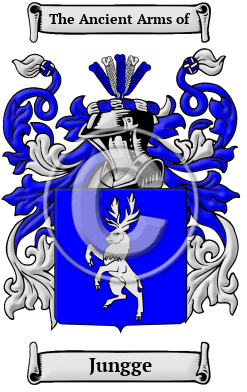
| ![Show Contents]() Jungge History, Family Crest & Coats of Arms Jungge History, Family Crest & Coats of Arms
- Origins Available:
Germany
Etymology of JunggeWhat does the name Jungge mean? The ancestral home of the Jungge family is in the German province of Bavaria. Jungge is a German nickname surname. Such names came from eke-names, or added names, that described their initial bearer through reference to a physical characteristic or other attribute. Jungge is a name for a young person or the junior member of a family or community, being derived from the German word "jung," which means "young" as in "young man." The root name Jüngling is typically Anglicized as Juengling, Jungling, Yuengling, Yungling, and Yingling. Early Origins of the Jungge familyThe surname Jungge was first found in Bavaria, where this family name became a prominent contributor to the development of the district from ancient times. Always prominent in social affairs, the name became an integral part of that turbulent region as it emerged to form alliances with other families within the Feudal System and the nation. The name "Jung" (English: Young) had the original meaning of "junior," an addition to a name which would reflect the bearer's status or age, as well as distinguish him or her from the father, or "senior." Early History of the Jungge familyThis web page shows only a small excerpt of our Jungge research. Another 74 words (5 lines of text) covering the years 1740 and 1817 are included under the topic Early Jungge History in all our PDF Extended History products and printed products wherever possible. Jungge Spelling VariationsOne can encounter great variation in the spelling of surnames: in early times, spelling in general, and thus the spelling of names was not yet standardized; and later, spellings would change with branching and movement of families. Variations of the name Jungge include Jung, Juenger, Jungg, Junge, Jungge, Jungher, Jungblut, Jungbauer, June, Deyoung, Young, Jungbluth, Jungblud, Deshong, Jonker, Junker, Jungling, Jüngling and many more. Early Notables of the Jungge familyMore information is included under the topic Early Jungge Notables in all our PDF Extended History products and printed products wherever possible. Migration of the Jungge familyThe great European flow of migration to North America, which began in the middle of the 17th century and continued into the 20th century, was particularly attractive to those from Bavaria who wished to escape either poverty or religious persecution. For many Bavarian tenant farmers, the chance to own their own land was a major incentive. So the widespread colonization of the United States began in 1650, when many immigrants from Germany settled in pockets in Pennsylvania, Texas, New York, Illinois, and California. In Canada, German settlement centered in Ontario and the prairie provinces. Among those of this surname listed in various historical records were: Johannes Jung, who arrived in New York State in 1710; Johan Henrich Jung, who settled in Philadelphia in 1732; Christian Jungling, who immigrated to Philadelphia in 1734.
 |