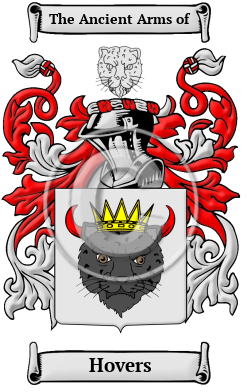
| ![Show Contents]() Hovers History, Family Crest & Coats of Arms Hovers History, Family Crest & Coats of Arms
- Origins Available:
Germany
Etymology of HoversWhat does the name Hovers mean? Nestled between the Rhine and Wesser rivers is the ancient German region of Westphalia. Westphalia, the home of the name Hovers. Hereditary surnames were adopted in this region after the 12th century, and surnames were derived from localities were common. Local surnames originally denoted the proprietorship of the village or estate. When coupled with the German preposition von, which means from or of, local names can indicate that the initial bearer of the name was an aristocrat. The Hovers family originally lived on a farmstead. The name Hovers is derived from the Old German and German word hof, which means settlement, farm or court. Early Origins of the Hovers familyThe surname Hovers was first found in Westphalia, where the family contributed greatly to the development of an emerging nation. The name probably stems from the German word "Hof" meaning "court." Early History of the Hovers familyThis web page shows only a small excerpt of our Hovers research. Another 359 words (26 lines of text) covering the years 1378, 1440, 1629, 1662, 1684, 1773 and 1829 are included under the topic Early Hovers History in all our PDF Extended History products and printed products wherever possible. Hovers Spelling VariationsOne can encounter great variation in the spelling of surnames: in early times, spelling in general, and thus the spelling of names was not yet standardized; and later, spellings would change with branching and movement of families. Variations of the name Hovers include Hof, Hoff, Hoffe, Hofer, Hoefer, Hoeffer, Hoffer, Hofle, Hoefe, Hofler, Hoefler, Hofner and many more. Early Notables of the Hovers familyMore information is included under the topic Early Hovers Notables in all our PDF Extended History products and printed products wherever possible. Migration of the Hovers familyMany Germans emigrated across the Atlantic to seek better lives in North America. This great migration began in the middle of the 17th century and continued into the 20th century. Resettlement was particularly attractive to those from Westphalia as a means of escape from poverty and religious persecution. For many Westphalian farmers, the chance to own one's own land was also a major incentive. The process of the widespread colonization of the United States began in 1650, when many immigrants from Germany settled in pockets in Pennsylvania, Texas, New York, Illinois, and California. In Canada, German settlements centered around Ontario and the Prairie provinces. Among them were: Lorentz Hoff, who sailed to America in 1730; Gideon Hoffer sailed to Pennsylvania in 1732; Hans Jacob Hoff, who sailed to Pennsylvania in 1733; Conrad Hoffler to Pennsylvania in 1751.
 |