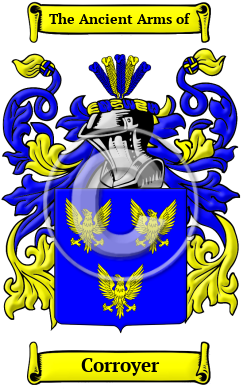
| ![Show Contents]() Corroyer History, Family Crest & Coats of Arms Corroyer History, Family Crest & Coats of Arms
- Origins Available:
France
Etymology of CorroyerWhat does the name Corroyer mean? The surname Corroyer is an ancient French name from the province of Champagne. It is thought to be derived from a pre-Latin word "caravu," which meant "rocky place." Early Origins of the Corroyer familyThe surname Corroyer was first found in Champagne. Gilles Corroret was from a family of haberdashers (boutique owners) and became a tour guide, leading foreigners around Paris during the sixteenth century. Étienne Corriveau, born in 1643, son of François and Marguerite (née Besnard), settled in New France in the 17th century. He married Catherine Bureau, born in 1651, daughter of Jacques and Marguerite (née Verrier), at Sainte-Famille on 28th October 1669. They settled together in Quebec until Étienne's death around 1695. 1 Early History of the Corroyer familyThis web page shows only a small excerpt of our Corroyer research. The years 1703, 1726, 1844, 1858, 1865 and 1869 are included under the topic Early Corroyer History in all our PDF Extended History products and printed products wherever possible. Corroyer Spelling VariationsOne can encounter great variation in the spelling of French surnames; in part, as spelling, and the spelling names was not yet standardized during the early development of the written French language. Later, there was much branching and movement of families, and spellings would change according to region. Variations of the name Corroyer include Corriveau, Corrivault, Corrivaux, Corroy, Corroyer, Corrier, Corriez, Corrège, Courrèges, Corrigier, Corrèges, Correnson, Corret, Corrette, Corette and many more. Early Notables of the Corroyer familyThomas-Olivier Corret, who was a Jesuit in 1703 and was employed as a preacher. A Corrette was a composer in Rouen and in 1726 became an organist at Ste-Marie-Madeleine then the following year was the organist for the great priest of France. He published many pieces for the viola or flute, and the violin, masses and motets, and methods for flute and viola, harpsichord, voice, and violin. Ferdinand Corrèges was a sketcher and engraver in 1844. He studied tombstones from the Basque area and drew many...
Another 86 words (6 lines of text) are included under the topic Early Corroyer Notables in all our PDF Extended History products and printed products wherever possible. Migration of the Corroyer familyIn the 1700s, land incentives were finally given out by France to 2,000 migrants. Early marriage was encouraged in New France, and youths of 18 took fourteen-year-old girls for their wives. The fur trade was developed and attracted migrants, both noble and commoner from France. 15,000 explorers left Montreal in the late 17th and 18th centuries, leaving French names scattered across the continent. The search for the Northwest passage continued. Migration from France to New France or Quebec, as it was now more popularly called, continued until 1759. By 1675, there were 7000 French in Quebec. By the same year the Acadian presence in Nova Scotia, New Brunswick and Prince Edward Island had reached 500. In the treaty of Utrecht, Acadia were ceded by France to Britain in 1713. In 1755, 10,000 French Acadians refused to take an oath of allegiance to England and were deported. They found refuge in Louisiana. Meanwhile, in Quebec, the French race flourished, founding in Lower Canada, one of the two great solitudes which became Canada. Many of this distinguished family name Corroyer were prominent in social, cultural, religious and political affairs in France and New France. Amongst the settlers in North America with this distinguished name Corroyer were 200 individuals who arrived from France onto Canadian shores between 1600 and 1900. Among these was Marguerite Corriveau, who was married in Quebec in 1650.
- Olivier, Reginald L. Your Ancient Canadian Family Ties. Logan: The Everton Publishers, Inc., P.O. Box 368, 1972. Print
 |