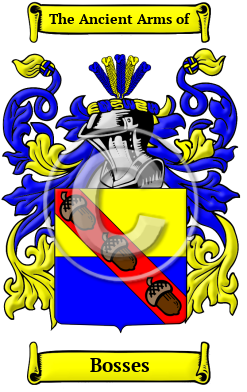
The roots of the Bosses family are found in the ancient German state of Bavaria. Bosses is one of the most common styles of German surname, that of patronymics and metronymics - names derived from the given names of the father or mother of their original bearers. Bosses is derived from the medieval name Boss, a frequent shortening of the personal name Burkhard. In medieval times, given names were frequently abbreviated as terms of affection and endearment. This Germanic personal name was also associated with the German word boese, which meant naughty and tough. Thus, the name referred to a person who was very tough or one who was inclined to fight.
Loading...
Early Origins of the Bosses family
The surname Bosses was first found in Westphalia, where the name Bosse was closely identified in early mediaeval times with the feudal society of early Europe. The family would later emerge as a noble family with great influence, having many distinguished branches, and become noted for its involvement in social, economic and political affairs.
Early History of the Bosses family
This web page shows only a small excerpt of our Bosses research. Another 71 words (5 lines of text) covering the year 1659 is included under the topic Early Bosses History in all our PDF Extended History products and printed products wherever possible.
Bosses Spelling Variations
One can encounter great variation in the spelling of surnames: in early times, spelling in general, and thus the spelling of names was not yet standardized; and later, spellings would change with branching and movement of families. Variations of the name Bosses include Bosse, Bosses, Bauss, Bausse, Bausses, Boss, von Bosse, Boesse and many more.
Early Notables of the Bosses family
More information is included under the topic Early Bosses Notables in all our PDF Extended History products and printed products wherever possible.
Loading...
Loading...
Loading...
Loading...
Migration of the Bosses family
Many Germans emigrated across the Atlantic to seek better lives in North America. This great migration began in the middle of the 17th century and continued into the 20th century. Resettlement was particularly attractive to those from Westphalia as a means of escape from poverty and religious persecution. For many Westphalian farmers, the chance to own one's own land was also a major incentive. The process of the widespread colonization of the United States began in 1650, when many immigrants from Germany settled in pockets in Pennsylvania, Texas, New York, Illinois, and California. In Canada, German settlements centered around Ontario and the Prairie provinces. Among them: William Bosse who arrived in Maryland in 1663; Job Bosse arrived in Virginia in 1702; Johann Christoph arrived in Philadelphia in 1773; John Christopher Bosse settled in Delaware in 1773.