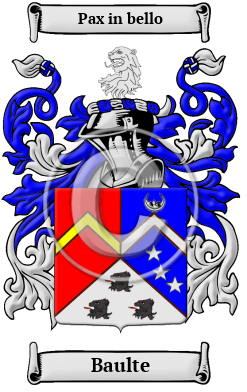
| ![Show Contents]() Baulte History, Family Crest & Coats of Arms Baulte History, Family Crest & Coats of Arms
- Origins Available:
Germany
Etymology of BaulteWhat does the name Baulte mean? The German state of Prussia, which reached the zenith of its power in the late 19th century, is the glorious birthplace of the distinguished surname Baulte. In the medieval era, after the fall of the Roman Empire, the German lands were inhabited by a variety of Barbarian tribes. The borders of the Barbarian kingdoms changed frequently, but the region that became known as Prussia was roughly divided between the areas of Brandenburg-Prussia, West Prussia, and East Prussia. The colorful history of East Prussia, which was located on the southern shore of the Baltic Sea and was bordered by Poland and Lithuania, provides a glimpse at the oldest origins of the Baulte family. Early Origins of the Baulte familyThe surname Baulte was first found in Prussia, where the name Bauld emerged in mediaeval times as one of the notable families of the region. From the 13th century the surname was identified with the great social and economic evolution which made this territory a landmark contributor to the development of the nation. Early History of the Baulte familyThis web page shows only a small excerpt of our Baulte research. Another 108 words (8 lines of text) are included under the topic Early Baulte History in all our PDF Extended History products and printed products wherever possible. Baulte Spelling VariationsOne can encounter great variation in the spelling of surnames: in early times, spelling in general, and thus the spelling of names was not yet standardized; and later, spellings would change with branching and movement of families. Variations of the name Baulte include Bauld, Bault, Baulte, Baulde, Baul, Baud, Baut, Bauldt and many more. Early Notables of the Baulte familyMore information is included under the topic Early Baulte Notables in all our PDF Extended History products and printed products wherever possible. Migration of the Baulte familyThe state of Prussia was a great influence on the shape of modern Germany. After the Second World War, Prussia's land was divided among the Soviet Union, Poland, East Germany and West Germany and the state was abolished. Some Prussians remained in those countries after the war, while many others migrated to North America in search of a new start. Philadelphia was their primary point of entry to the United States, after which many of them moved on to Ohio, Texas, Illinois, California, New York, and Maryland. A large number of Prussians also migrated to Ontario and the prairie provinces as United Empire Loyalists. Analysis of immigration records has shown some of the first Baultes to arrive in North America, and among them were: J. Christopher Baut settled in Philadelphia in 1773; Catha and Mathias Baldt who were both listed as having arrived in Philadelphia in 1787; Anne Marie, Catherine, Dietrich, Guillaume, Jean Henry, Jean Josse, Regine Elisabeth and Suzette Baldt all of whom were recorded as having arrived in Pennsylvania in 1797.
The motto was originally a war cry or slogan. Mottoes first began to be shown with arms in the 14th and 15th centuries, but were not in general use until the 17th century. Thus the oldest coats of arms generally do not include a motto. Mottoes seldom form part of the grant of arms: Under most heraldic authorities, a motto is an optional component of the coat of arms, and can be added to or changed at will; many families have chosen not to display a motto.
Motto: Pax in bello
Motto Translation: Peace in war.
 |