
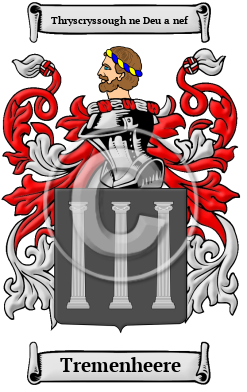
Show ContentsTremenheere History, Family Crest & Coats of Arms

Early Origins of the Tremenheere family

The surname Tremenheere was first found in Cornwall where they held a family seat as Lords of the Manor of Tremenheere in the parish of Ludgvan. Cornwall was a land set apart, a land of mystique and quaint customs, more strongly related to Brittany and Wales than to England. It was not until the 10th century that they submitted to the Saxon rule of England. Since then, their influence has moved east into Devon, Somerset and Dorset.

Early History of the Tremenheere family

This web page shows only a small excerpt of our Tremenheere research. Another 126 words (9 lines of text) covering the years 1200 and 1832 are included under the topic Early Tremenheere History in all our PDF Extended History products and printed products wherever possible.

Tremenheere Spelling Variations

Spelling variations of this family name include: Tremenheere, Tremenhere, Tramenheere, Tramenhere and many more.

Early Notables of the Tremenheere family

More information is included under the topic Early Tremenheere Notables in all our PDF Extended History products and printed products wherever possible.

Migration of the Tremenheere family

Some of the first settlers of this family name or some of its variants were: settlers who were recorded from the mid 17th century in the great migration from Europe to the New World. Many fisherman from the coastal villages of Cornwall migrated to the eastern seaboard from Newfoundland, to Maine, to Florida, and to the Leeward Islands..


Contemporary Notables of the name Tremenheere (post 1700) +

  • Hugh Seymour Tremenheere (1804-1893), English publicist and author, born at Wootton House, Gloucestershire, son of Walter Tremenheere
  • Walter Tremenheere (1761-1855), British Colonel, a member of a very ancient Cornish family, born at Penzance


The Tremenheere Motto +

The motto was originally a war cry or slogan. Mottoes first began to be shown with arms in the 14th and 15th centuries, but were not in general use until the 17th century. Thus the oldest coats of arms generally do not include a motto. Mottoes seldom form part of the grant of arms: Under most heraldic authorities, a motto is an optional component of the coat of arms, and can be added to or changed at will; many families have chosen not to display a motto.

Motto: Thryscryssough ne Deu a nef


Houseofnames.com on Facebook
