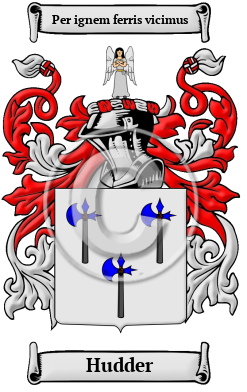
| ![Show Contents]() Hudder History, Family Crest & Coats of Arms Hudder History, Family Crest & Coats of Arms
Etymology of HudderWhat does the name Hudder mean? The name Hudder is Anglo-Saxon in origin. It was a name given to a maker of hoods. It was originally derived from the Old English hod, which meant "hood." Thus, the original bearer of the name was a maker of hoods. 1 There are a two alternate origins. The name may also be of a local derivation. There was a small hamlet in Yorkshire called Hodd. 2 And another sources notes the name may have been for a "dweller by the River Hodder, [in Lancashire] spelt Hoder, Hodre, in the 14th century." 3 Early Origins of the Hudder familyThe surname Hudder was first found in Essex where John le Hodder was listed in the Curia Regis Rolls for 1220. We did find an interesting entry pointing to the aforementioned occupational origin, John Hoder who is also called Hodmaker and Hodman in Colchester, Essex in 1361. 4 Exploring the Yorkshire origin, one source notes "it is evident that it must be looked for in Yorkshire," 2 and to underscore this claim the Yorkshire Poll Tax Rolls of 1379 included: Anabilla de Hodre; and Isabella de Hedre, as holding lands there at that time. Early History of the Hudder familyThis web page shows only a small excerpt of our Hudder research. Another 104 words (7 lines of text) covering the years 1220, 1279, 1361, 1661, 1664, 1666, 1672, 1681, 1685, 1693, 1697, 1702 and 1739 are included under the topic Early Hudder History in all our PDF Extended History products and printed products wherever possible. Hudder Spelling VariationsUntil the dictionary, an invention of only the last few hundred years, the English language lacked any comprehensive system of spelling rules. Consequently, spelling variations in names are frequently found in early Anglo-Saxon and later Anglo-Norman documents. One person's name was often spelled several different ways over a lifetime. The recorded variations of Hudder include Hodder, Hoddar, Hooder, Hoder, Hoader, Hoodar and others. Early Notables of the Hudder familyJames Hodder (fl. 1661), English arithmetician, a writing-master, with a school in Tokenhouse Yard in Lothbury, in 1661. "After the fire of 1666, he removed to Bromley-by-Bow, where he kept a boarding-school, but subsequently returned to Lothbury. He was first known as the author of ‘Hodder's Arithmetick,’ a popular manual upon which Cocker based his better known work. The two books are for the most part identical. Cocker's...
Another 67 words (5 lines of text) are included under the topic Early Hudder Notables in all our PDF Extended History products and printed products wherever possible. Migration of the Hudder family to IrelandSome of the Hudder family moved to Ireland, but this topic is not covered in this excerpt.
Another 33 words (2 lines of text) about their life in Ireland is included in all our PDF Extended History products and printed products wherever possible.
| Hudder migration to Australia | + |
Emigration to Australia included the Second Fleet of convicts, tradespeople and early settlers. Early immigrants include: Second Fleet - Mr. Priscilla Hudder, British settler convicted in London, England in 1790, sentenced to 7 years for stealing, transported aboard the ship "Mary Ann" leaving in 1790 arriving in New South Wales, Australia in 1791 5
The motto was originally a war cry or slogan. Mottoes first began to be shown with arms in the 14th and 15th centuries, but were not in general use until the 17th century. Thus the oldest coats of arms generally do not include a motto. Mottoes seldom form part of the grant of arms: Under most heraldic authorities, a motto is an optional component of the coat of arms, and can be added to or changed at will; many families have chosen not to display a motto.
Motto: Per ignem ferris vicimus
Motto Translation: Even through fire have we conquered with our sword.
- Smith, Eldson Coles, New Dictionary of American Family Names New York: Harper & Row, 1956. Print
- Bardsley, C.W, A Dictionary of English and Welsh Surnames: With Special American Instances. Wiltshire: Heraldry Today, 1901. Print. (ISBN 0-900455-44-6)
- Harrison, Henry, Surnames of the United Kingdom: A Concise Etymological Dictionary Baltimore: Geneological Publishing Company, 2013. Print
- Reaney, P.H and R.M. Wilson, A Dictionary of English Surnames. London: Routledge, 1991. Print. (ISBN 0-415-05737-X)
- Convict Records of Australia. Retrieved 4th February 2021 from https://convictrecords.com.au/ships
 |