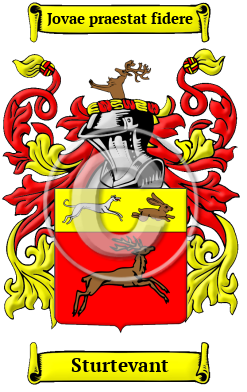
| ![Show Contents]() Sturtevant History, Family Crest & Coats of Arms Sturtevant History, Family Crest & Coats of Arms
- Origins Available:
Netherlands
England
Early Origins of the Sturtevant familyThe surname Sturtevant was first found in Holland, where the name became noted for its many branches in the region, particularly in Friesland. Each house acquired a status and influence which was envied by the princes of the region. The name was first recorded in Friesland, a province historically almost independent, but joined the Union of Utrecht to escape the tyranny of Spain. In the 17th and 18th centuries the house of Nassau-Siegen were stadtholders, but in 1748 William of Nasau-Siegen became Prince William IV of Orange and all the provinces. His grandson became William I, King of the Netherlands 1815. In their later history the name became a power unto themselves and were elevated to the ranks of nobility as they grew into this most influential family. Early History of the Sturtevant familyThis web page shows only a small excerpt of our Sturtevant research. Another 106 words (8 lines of text) covering the years 1610, 1672 and 1888 are included under the topic Early Sturtevant History in all our PDF Extended History products and printed products wherever possible. Sturtevant Spelling VariationsSpelling variations of this family name include: Stuyvesant, Steuvesant, Steubesand, Stòvesand, Stöwsand, Tuveson, Ruveson, Sturtevant and many more. Early Notables of the Sturtevant familyMore information is included under the topic Early Sturtevant Notables in all our PDF Extended History products and printed products wherever possible. Sturtevant RankingIn the United States, the name Sturtevant is the 9,184th most popular surname with an estimated 2,487 people with that name. 1
| Sturtevant migration to the United States | + |
Sturtevant Settlers in United States in the 17th Century- Samuel Sturtevant, who settled in Plymouth, Massachusetts in 1642
- Mary Sturtevant, who settled in Plymouth, Massachusetts in 1642
- Samuel Sturtevant, who arrived in Plymouth, Massachusetts in 1643 2
Sturtevant Settlers in United States in the 19th Century- R. Sturtevant went to San Francisco in 1850
- E. Sturtevant, who settled in San Francisco in 1851
- B. T. Sturtevant, who settled in San Francisco in 1852
- O. B. Sturtevant, who arrived in San Francisco in 1852
- M. Sturtevant, who settled in San Francisco in 1860
- ... (More are available in all our PDF Extended History products and printed products wherever possible.)
| Contemporary Notables of the name Sturtevant (post 1700) | + |
- Paul Allen Sturtevant (1898-1987), American inventor of the beam type torque wrench (1938)
- John Cirby Sturtevant (1835-1912), American politician, Member of the U.S. House of Representatives from Pennsylvania (1897-1899)
- Grace Sturtevant (1865-1947), American iris breeder who has been called "America's first lady of iris", founding member of the American Iris Society, daughter of Edward Lewis Sturtevant
- Edward Lewis Sturtevant (1842-1898), American agronomist and botanist
- Butler Stevens Sturtevant (1899-1971), American landscape architect
- Benjamin Franklin Sturtevant (1833-1890), American businessman, founder of B. F. Sturtevant Company was a Boston-based manufacturer of fans in 1860
- Aaron Paul Sturtevant (b. 1979), birth name of Aaron Paul, an American actor, best known for portraying Jesse Pinkman in the AMC series Breaking Bad
- Elaine Frances Sturtevant (b. 1930), née Horan, an American artist from Lakewood, Ohio
- Edgar H. Sturtevant (1875-1952), American linguist from Jacksonville, Illinois
- ... (Another 2 notables are available in all our PDF Extended History products and printed products wherever possible.)
| Historic Events for the Sturtevant family | + |
USS Indianapolis - Elwyn Lee Sturtevant (1924-1966), American crew member on board the ship "USS Indianapolis" when she was on a top secret trip for the first nuclear weapon, she was sunk by Japanese Navy on 30th July 1945, he survived the sinking 3
The motto was originally a war cry or slogan. Mottoes first began to be shown with arms in the 14th and 15th centuries, but were not in general use until the 17th century. Thus the oldest coats of arms generally do not include a motto. Mottoes seldom form part of the grant of arms: Under most heraldic authorities, a motto is an optional component of the coat of arms, and can be added to or changed at will; many families have chosen not to display a motto.
Motto: Jovae praestat fidere
- "What are the 5,000 Most Common Last Names in the U.S.?". NameCensus.com, https://namecensus.com/last-names/
- Filby, P. William, Meyer, Mary K., Passenger and immigration lists index : a guide to published arrival records of about 500,000 passengers who came to the United States and Canada in the seventeenth, eighteenth, and nineteenth centuries. 1982-1985 Cumulated Supplements in Four Volumes Detroit, Mich. : Gale Research Co., 1985, Print (ISBN 0-8103-1795-8)
- Final Crew List, retrieved 2021, October 30th Retrieved from https://www.ussindianapolis.com/final-crew
 |