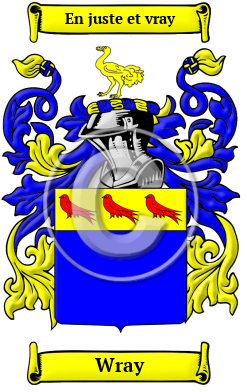
| ![Show Contents]() Wray History, Family Crest & Coats of Arms Wray History, Family Crest & Coats of Arms
Etymology of WrayWhat does the name Wray mean? The ancestors of the bearers of the Wray family name are thought have lived in ancient Anglo-Saxon England. They were first found as a local name for a secluded nook or corner of land, derived from the Old Norse word "vra" 1. The second possible origin was as a nickname for a person with twisted or crooked features. Early Origins of the Wray familyThe surname Wray was first found in Lancashire where Wray is a small village, part of the civil parish of Wray-with-Botton and in 2001 had a population of 521. This village dates back to at least 1227 when the village was named Wra. There is also a Wray in High Cumbria complete with Wray Castle which dates back to c. 1535 when it was spelled Wraye and a Wrea Green in Lancashire which dates back the farthest in 1201 with the spelling of Wra. 1 This latter reference is larger of the two Lancashire references as in 2001, 1600 people lived there. The Domesday Book lists the name Wray (spelled Werei) 2 as land held by Godwine in Devon and comprised land for 6 ploughs, 8 acres of meadows and 5 acres of pasture. And it is in Devon that Robert le Wrey who lived in the second year of King Stephen (1136-1137) and whose son was seated at Wrey, in parish of Moreton-Hamstead claimed their origins. 3 The manor of Trebicen or Trebigh, St. Ive, Cornwall was passed to the "Wreys, who are said to have had their seat here in the reign of Charles I. Sir William Wrey being described as of this place when created a Baronet in the year 1628. In this family both the manor and the estate have ever since remained. It is now the property of Sir Bourchier Wrey, whose family ever since the match with the heiress of Bourchier, have resided in Devonshire. The old mansion is at present a farm house." 4 Early History of the Wray familyThis web page shows only a small excerpt of our Wray research. Another 133 words (10 lines of text) covering the years 1524, 1555, 1586, 1592, 1601, 1611, 1617, 1619, 1625, 1626, 1645, 1646, 1653, 1654, 1655, 1660, 1664, 1669, 1696 and 1890 are included under the topic Early Wray History in all our PDF Extended History products and printed products wherever possible. Wray Spelling VariationsUntil quite recently, the English language has lacked a definite system of spelling rules. Consequently, Anglo-Saxon surnames are characterized by a multitude of spelling variations. Changes in Anglo-Saxon names were influenced by the evolution of the English language, as it incorporated elements of French, Latin, and other languages. Although Medieval scribes and church officials recorded names as they sounded, so it is common to find one person referred to by several different spellings of his surname, even the most literate people varied the spelling of their own names. Variations of the name Wray include Wray, Wraye, Wrey, Wreye and others. Early Notables of the Wray family- Sir Christopher Wray (1524-1592), an English judge and Chief Justice of the King’s Bench
- Sir William Wray, 1st Baronet, of Glentworth, Lincolnshire (c 1555-1617), English politician, appointed High Sheriff of Lincolnshire in 1592
- Sir John Wray, 2nd Baronet (1586-1655), English politician, supporter of the Parliamentary cause in the English Civil War
- Sir Christopher Wray (1601-1646), English politician, Member of Parliament for Grimsby
- Sir William Wray, 1st Baronet, of Ashby (1625-1669), an English politician who sat in the House of Commons between 1645 and 1660
- Sir John Wray, 3rd Baronet (1619-1664), an English politician who sat in the House of Commons in 1654
Wray RankingIn the United States, the name Wray is the 1,710th most popular surname with an estimated 17,409 people with that name. 5 Migration of the Wray family to IrelandSome of the Wray family moved to Ireland, but this topic is not covered in this excerpt.
Another 74 words (5 lines of text) about their life in Ireland is included in all our PDF Extended History products and printed products wherever possible.
| Wray migration to the United States | + |
Searching for a better life, many English families migrated to British colonies. Unfortunately, the majority of them traveled under extremely harsh conditions: overcrowding on the ships caused the majority of the immigrants to arrive diseased, famished, and destitute from the long journey across the ocean. For those families that arrived safely, modest prosperity was attainable, and many went on to make invaluable contributions to the development of the cultures of the new colonies. Research into the origins of individual families in North America revealed records of the immigration of a number of people bearing the name Wray or a variant listed above:
Wray Settlers in United States in the 17th Century- Daniel Wray, who landed in Massachusetts in 1634 6
- Ralph Wray, aged 64, who arrived in Virginia in 1635 aboard the ship "Plain Joan" 6
- Thomas Wray, who landed in Virginia in 1636 6
- Roger Wray, who arrived in Maryland in 1664 6
Wray Settlers in United States in the 18th Century- George Wray, who landed in New York in 1785 6
- John Wray, who landed in Mississippi in 1799 6
Wray Settlers in United States in the 19th Century- Robert Wray, who landed in Allegany (Allegheny) County, Pennsylvania in 1802 6
- William Wray, who arrived in New York, NY in 1815 6
- James Wray, who arrived in New York, NY in 1815 6
- Benjamin Wray, who arrived in New York, NY in 1836 6
- Elizabeth Wray, who arrived in New York, NY in 1836 6
- ... (More are available in all our PDF Extended History products and printed products wherever possible.)
| Wray migration to Canada | + |
Wray Settlers in Canada in the 18th Century- Mr. John Wray U.E. who settled in Saint John, New Brunswick c. 1784 7
| Wray migration to Australia | + |
Wray Settlers in Australia in the 19th Century- Mr. Henry Wray, (b. 1805), aged 29, English convict who was convicted in West Riding, Yorkshire, England for 7 years for house breaking, transported aboard the "Bengal Merchant" on 27th September 1834, arriving in New South Wales, Australia 8
- Mr. James Wray, British Convict who was convicted in Lancaster, England for life, transported aboard the "Asia" on 5th November 1835, arriving in Tasmania (Van Diemen's Land)1836 9
- Mr. James Wray, British Convict who was convicted in Kent, England for 15 years, transported aboard the "Asia" on 25th April 1840, arriving in Tasmania (Van Diemen's Land) 10
- R.M. Wray, who arrived in Adelaide, Australia aboard the ship "Posthumous" in 1849 11
- James Wray, aged 19, who arrived in South Australia in 1855 aboard the ship "Victoria Regia"
| Wray migration to New Zealand | + |
Emigration to New Zealand followed in the footsteps of the European explorers, such as Captain Cook (1769-70): first came sealers, whalers, missionaries, and traders. By 1838, the British New Zealand Company had begun buying land from the Maori tribes, and selling it to settlers, and, after the Treaty of Waitangi in 1840, many British families set out on the arduous six month journey from Britain to Aotearoa to start a new life. Early immigrants include: Wray Settlers in New Zealand in the 19th Century- Henry Wray, who landed in Nelson, New Zealand in 1842
- James Wray, who arrived in Wellington, New Zealand aboard the ship "Wyvern" in 1856
- Miss Ann Jane Wray, British settler travelling from London aboard the ship "England" arriving in Dunedin, Otago, South Island, New Zealand on 22nd September 1865 12
- Mr. Walter Wray, (b. 1850), aged 19, British farm labourer travelling from Gravesend aboard the ship "Hydaspes" arriving in Lyttelton, Christchurch, South Island, New Zealand on 30th September 1869 12
- William I. Wray, aged 24, a labourer, who arrived in Auckland, New Zealand aboard the ship "Oxford" in 1874
- ... (More are available in all our PDF Extended History products and printed products wherever possible.)
| Contemporary Notables of the name Wray (post 1700) | + |
- Fay Wray (1907-2004), born Vina Fay Wray, Canadian-born, American actress, best remembered for her role in the 1933 movie "King Kong", the first "scream queen"
- Margaret Jane Wray (1962-2025), American dramatic soprano known for her interpretations of the works of Richard Wagner
- Christopher Asher "Chris" Wray (b. 1967), American lawyer, 8th Director of the Federal Bureau of Investigation (FBI) (2017-)
- Bill Wray, American musician, composer and producer
- Fred Lincoln "Link" Wray Jr (1929-2005), American rock and roll guitarist, songwriter and vocalist, nominee for the Rock and Roll Hall of Fame in 2013
- John Wray (1887-1940), American character actor
- Bill Wray (b. 1956), American cartoonist and landscape painter
- Daniel Wray (1701-1783), English antiquary, born in the parish of St. Botolph, Aldersgate, the youngest child of Sir Daniel Wray (d. 1719), a London citizen and soap-boiler residing in Little Britain 13
- Sir William James Wray (1771-1808), 15th Baronet of Glentworth, Lincolnshire, English peer
- ... (Another 6 notables are available in all our PDF Extended History products and printed products wherever possible.)
The motto was originally a war cry or slogan. Mottoes first began to be shown with arms in the 14th and 15th centuries, but were not in general use until the 17th century. Thus the oldest coats of arms generally do not include a motto. Mottoes seldom form part of the grant of arms: Under most heraldic authorities, a motto is an optional component of the coat of arms, and can be added to or changed at will; many families have chosen not to display a motto.
Motto: En juste et vray
Motto Translation: In justice and truth.
| Suggested Readings for the name Wray | + |
- Kit, Kin & Kaboodle of Wilkins Wray by Bob Milner.
- Mills, A.D., Dictionary of English Place-Names. Oxford: Oxford University Press, 1991. Print. (ISBN 0-19-869156-4)
- Williams, Dr Ann. And G.H. Martin, Eds., Domesday Book A Complete Translation. London: Penguin, 1992. Print. (ISBN 0-141-00523-8)
- Shirley, Evelyn Philip, The Noble and Gentle Men of England; The Arms and Descents. Westminster: John Bower Nichols and Sons, 1866, Print.
- Hutchins, Fortescue, The History of Cornwall, from the Earliest Records and Traditions to the Present Time. London: William Penaluna, 1824. Print
- "What are the 5,000 Most Common Last Names in the U.S.?". NameCensus.com, https://namecensus.com/last-names/
- Filby, P. William, Meyer, Mary K., Passenger and immigration lists index : a guide to published arrival records of about 500,000 passengers who came to the United States and Canada in the seventeenth, eighteenth, and nineteenth centuries. 1982-1985 Cumulated Supplements in Four Volumes Detroit, Mich. : Gale Research Co., 1985, Print (ISBN 0-8103-1795-8)
- Rubincam, Milton. The Old United Empire Loyalists List. Genealogical Publishing Co., Inc, 1976. (Originally published as; United Empire Loyalists. The Centennial of the Settlement of Upper Canada. Rose Publishing Company, 1885.) ISBN 0-8063-0331-X
- Convict Records Voyages to Australia (Retrieved 7th October 2020). Retrieved from https://convictrecords.com.au/ships/bengal-merchant
- Convict Records Voyages to Australia (Retrieved 28th January 2020). Retrieved from https://convictrecords.com.au/ships/asia/1835
- Convict Records Voyages to Australia (Retrieved 17th January 2020). Retrieved from https://convictrecords.com.au/ships/asia/1840
- State Records of South Australia. (Retrieved 2010, November 5) The POSTHUMOUS 1849. Retrieved from http://www.slsa.sa.gov.au/BSA/1849Posthumous.htm
- New Zealand Yesteryears Passenger Lists 1800 to 1900 (Retrieved 17th October 2018). Retrieved from http://www.yesteryears.co.nz/shipping/passlist.html
- Wikisource contributors. "Dictionary of National Biography, 1885-1900." Wikisource . Wikisource , 4 Jun. 2018. Web. 13 Feb. 2019
 |