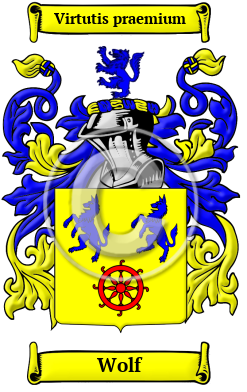
| ![Show Contents]() Wolf History, Family Crest & Coats of Arms Wolf History, Family Crest & Coats of Arms
Etymology of WolfWhat does the name Wolf mean? The Wolf surname is derived from the baptismal name for the son of Wolfgang, a popular personal name in Germany during medieval times. This personal name was originally derived from the Old German "wolf" which meant "wolf" and "ganc" meaning "battle." Early Origins of the Wolf familyThe surname Wolf was first found in the Rhineland, where the name emerged in mediaeval times as one of the notable families of the region. From the 13th century on the surname spread to nearly all parts of Germany, and was identified with the great social and economic evolution that contributed to the development of the nation. Chronicles mention Nivelung Wolf of Cologne as early as 1135, and Elbel Wolf of Bruenn in Moravia in 1365, showing the gradual eastward movement of the branches. Early History of the Wolf familyThis web page shows only a small excerpt of our Wolf research. Another 209 words (15 lines of text) covering the years 1491, 1498, 1499, 1527, 1573, 1679, 1683, 1739, 1754, 1759, 1786, 1790, 1824 and 1856 are included under the topic Early Wolf History in all our PDF Extended History products and printed products wherever possible. Wolf Spelling VariationsOne can encounter great variation in the spelling of surnames: in early times, spelling in general, and thus the spelling of names was not yet standardized; and later, spellings would change with branching and movement of families. Variations of the name Wolf include Wolf, Wolff, Wolfen, Wolfe, Wulf and others. Early Notables of the Wolf family- Reginald or Reyner Wolfe (d. 1573), printer and publisher, a native of Strasburg. However, "in both France and Germany many early printers bore the same surname: George Wolfe of Baden, printed at Pari...
- Christian Wolff (1679-1754), was one of the most widely read and influential Philosophers of the 18th century; Johann Christoph Wolf (1683-1739), was a German Christian Hebraist, polyhistor, and colle...
Wolf World RankingIn the United States, the name Wolf is the 524th most popular surname with an estimated 54,714 people with that name. 1 However, in France, the name Wolf is ranked the 1,931st most popular surname with an estimated 3,210 people with that name. 2 And in Netherlands, the name Wolf is the 342nd popular surname with an estimated 4,520 people with that name. 3
| Wolf migration to the United States | + |
Hundreds of thousands of Europeans, including many Rhinelanders, made the voyage to North America between the 17th and 20th centuries. It was an escape from religious persecution and poverty and also an opportunity for people to start over and own their own land. Most landed at Ellis Island, off New York before moving on to the states of Pennsylvania, Ohio, Texas, Illinois, and California. Some also landed in Canada and settled in Ontario, while others headed west to the prairie provinces. A study of passenger and immigration lists has shown a number of people bearing the name of Wolf, or one of its variants, reaching North America shores very early:
Wolf Settlers in United States in the 17th Century- Claes Wolf, who arrived in New Netherland(s) in 1658 4
- Thomas Wolf, who settled in Philadelphia, Pennsylvania in 1683
Wolf Settlers in United States in the 18th Century- John George Wolf, who settled in New England in 1709 with his wife, two sons, and two daughters
- Hans Bernard Wolf, who arrived in Pennsylvania in 1727 aboard the ship "William and Sarah" 4
- Hans Jerrick Wolf, German who arrived in Philadelphia, Pennsylvania in 1727 aboard the ship "William and Sarah" 5
- Abraham Wolf, who landed in Pennsylvania in 1728 4
- Jonas Wolf, who settled in Philadelphia in 1732
- ... (More are available in all our PDF Extended History products and printed products wherever possible.)
Wolf Settlers in United States in the 19th Century- Elizabeth Wolf, aged 30, who arrived in Pennsylvania in 1805 4
- Paul Wolf, who settled in Philadelphia, Pennsylvania in 1805
- Frederick Wolf, who arrived in Allegany (Allegheny) County, Pennsylvania in 1833 4
- Friedrich Philipp Christian Wolf, aged 27, who arrived in America in 1839 4
- Christoph Wolf, aged 40, who landed in St Louis, Missouri in 1841 4
- ... (More are available in all our PDF Extended History products and printed products wherever possible.)
Wolf Settlers in United States in the 20th Century- Harnenn Wolf, who landed in Galveston, Tex in 1905 4
| Wolf migration to Canada | + |
Wolf Settlers in Canada in the 18th Century- Magdalena Wolf, who arrived in Halifax, Nova Scotia in 1742
- Augustin Wolf, who landed in Nova Scotia in 1749-1752
Wolf Settlers in Canada in the 19th Century- Andrew Wolf, who landed in Canada in 1841
| Wolf migration to Australia | + |
Wolf Settlers in Australia in the 18th Century- Mr. George Wolf, English convict who was convicted in Middlesex, England for 7 years, transported aboard the "Barwell" in September 1797, arriving in New South Wales, Australia 6
Wolf Settlers in Australia in the 19th Century- Mr. Jacob Wolf, English convict who was convicted in Leeds, Yorkshire, England for 14 years, transported aboard the "Emperor Alexander"on 6th April 1833, arriving in Tasmania (Van Diemen's Land) 7
- Mr. George Wolf, (Wolfe), (b. 1826), aged 18, English tailor who was convicted in Coventry, England for 15 years for stealing, transported aboard the "Barossa" on 9th May 1844, arriving in Tasmania (Van Diemen's Land), he died in 1914 8
| Contemporary Notables of the name Wolf (post 1700) | + |
- Joseph James Wolf (1964-2024), American professional basketball player and coach
- Alice K. Wolf (1933-2023), née Koerner, Austrian-born American politician, Member of the Massachusetts House of Representatives from 1996 to 2013
- Charles Anthony "Charley" Wolf (1926-2022), American NBA basketball coach who coached the Cincinnati Royals from 1960 through 1963 and the Detroit Pistons from 1963 through 1964
- Dale Edward Wolf (1924-2021), American businessman and politician from Wilmington, in New Castle County, Delaware, 70th Governor of Delaware (1992-1993), 22nd Lieutenant Governor of Delaware (1989-1992)
- Philip C. Wolf (d. 2021), American entrepreneur and executive known for his work in the travel, tourism and hospitality industry
- Kathleen Louise Wolf (1925-2020), née Munsterman, an American politician, member of the Indiana House of Representatives from 1984 to 1986
- Warren H. Wolf (1927-2019), American high school football head coach and politician, Member of the New Jersey General Assembly (1982-1984)
- Charles Wolf Jr. (1924-2016), American senior economic advisor at the RAND Corporation (1955-2016)
- Max Wolf, American Olympic sliver medalist for gymnastics at the 1904 Summer Gamesw
- ... (Another 24 notables are available in all our PDF Extended History products and printed products wherever possible.)
| Historic Events for the Wolf family | + |
Bismarck- Herbert Wolf (1920-1941), German Verwaltungsgefreiter who served aboard the German Battleship Bismarck during World War II when it was sunk heading to France; he died in the sinking 9
- Gerhard Wolf (1920-1941), German Matrosengefreiter who served aboard the German Battleship Bismarck during World War II when it was sunk heading to France; he died in the sinking 10
- Edmund Wolf (1919-1941), German Mechanikersobergefreiter who served aboard the German Battleship Bismarck during World War II when it was sunk heading to France; he died in the sinking 10
- Mr. Charles Leslie Wolf, American resident in Santa Clarita killed when the St. Francis Dam failed and flooded the area in 1928
- Mr. George Alexanderson Wolf Jr., American Ensign from Pennsylvania, USA working aboard the ship "USS Arizona" when she sunk during the Japanese attack on Pearl Harbor on 7th December 1941, he died in the sinking 10
The motto was originally a war cry or slogan. Mottoes first began to be shown with arms in the 14th and 15th centuries, but were not in general use until the 17th century. Thus the oldest coats of arms generally do not include a motto. Mottoes seldom form part of the grant of arms: Under most heraldic authorities, a motto is an optional component of the coat of arms, and can be added to or changed at will; many families have chosen not to display a motto.
Motto: Virtutis praemium
Motto Translation: Virtues reward.
| Suggested Readings for the name Wolf | + |
- Jacob, Wolf, Burnet County Pioneer by R.S. Crawford.
- Jacob Wolf History by Merritt W. Wolfe.
- Descendants of Leonard Wolf, Sr., and Catherine Cripe, 1755-1984 by Ardelta Delores Wolfe Baker.
- "What are the 5,000 Most Common Last Names in the U.S.?". NameCensus.com, https://namecensus.com/last-names/
- http://www.journaldesfemmes.com/nom-de-famille/nom/
- "Most Common Last Names in Netherlands." Forebears, https://forebears.io/netherlands/surnames
- Filby, P. William, Meyer, Mary K., Passenger and immigration lists index : a guide to published arrival records of about 500,000 passengers who came to the United States and Canada in the seventeenth, eighteenth, and nineteenth centuries. 1982-1985 Cumulated Supplements in Four Volumes Detroit, Mich. : Gale Research Co., 1985, Print (ISBN 0-8103-1795-8)
- Egle, William Henry. Names of foreigners who took the oath of allegiance to the province and state of Pennsylvania... Edwin K. Meyers state printer, 1892
- Convict Records Voyages to Australia (Retrieved 29th September 2020). Retrieved from https://convictrecords.com.au/ships/barwell
- Convict Records Voyages to Australia (Retrieved 11th April 2022). https://convictrecords.com.au/ships/emperor-alexander
- Convict Records Voyages to Australia (Retrieved 24th September 2020). Retrieved from https://convictrecords.com.au/ships/barossa
- Bismarck & Tirpitz Class - Crew List Bismarck. (Retrieved 2018, February 06). Retrieved from https://www.bismarck-class.dk/bismarck/crew/bismarck_crew.html#crew_details
- Pearl Harbour: USS Arizona Casualties List Pearl Harbour December 7, 1941. (Retrieved 2018, July 31st). Retrieved from http://pearl-harbor.com/arizona/casualtylist.html
 |