| ![Show Contents]() Vecchiarelli History, Family Crest & Coats of Arms Vecchiarelli History, Family Crest & Coats of Arms
Etymology of VecchiarelliWhat does the name Vecchiarelli mean? The distinguished surname Vecchiarelli originated in an area of Italy, known as the Papal States. Although people were originally known only by a single name, it became necessary for people to adapt a second name to identify themselves as populations grew and travel became more frequent. The process of adopting fixed hereditary surnames was not complete until the modern era, but the use of hereditary family names in Italy began in the 10th and 11th centuries. Italian hereditary surnames were developed according to fairly general principles and they are characterized by a profusion of derivatives coined from given names. Although the most traditional type of family name found in the region of the Papal States is the patronymic surname, which is derived from the father's given name, the nickname type of surname is also frequently found. Nickname surnames were derived from an eke-name, or added name. They usually reflected the physical characteristics or attributes of the first person that used the name. The surname Vecchiarelli came from a person who was of aged appearance. The surname Vecchiarelli is derived from the Italian word vecchi, which further derives from the late Latin word veclus, which mean old, aged, or elderly. Early Origins of the Vecchiarelli familyThe surname Vecchiarelli was first found in Florence and Rome. However, due to internal political discord within the family, many of the family moved to other places, including Pisa, Siena and Arezzo, at the end of the 13th century. In PIsa, Giovanni de Vecchi became a member of the Ghibelline party, and resided among the Pisan priors in 1315. His son Bartolo went to live in San Gemignano, where in 1371 he was one of the deputies for the public expenses of that municipality; and his nephew Cristofano was captain of the Guelphs in 1405. Another branch was found in Siena where De Vecchi originally owned, and still own, the Verdelli castle. They have a tomb in S. Martino and own three altars in that church, including the main one, and others in S. Vigilio, in the Cathedral, in S. Donato, and the main altars of the churches of S. Spirito and dei Servi. The family was enrolled in the Order of the Reformers and came late to Siena to participate in the government. The first to reside was in fact Domenico, d'Agnolo, in 1380. After him Angelo, di Domenico, Appears again as a member of the Consistory in 1430; Lodovico, di Angelo, in 1446 and Domenico, di Lodovico, in 1477. And another branch was found in Modena, where in ancient times the family was also called del Vecchio and came from the Bolognese, Don de Diramo Lotreche to Finale, also and Modena, to Ferrara, to Cento and in other places, as stated by Frassoni, the historical Finalese, who still remembers that Francesco del Vecchio at the beginning of the 14th century had built the tower of Canne or Canoli, about a mile from Finale. Early History of the Vecchiarelli familyThis web page shows only a small excerpt of our Vecchiarelli research. Another 138 words (10 lines of text) covering the years 1480, 1528, 1603, 1656, 1678, 1746, 1788, 1792, 1824, 1825 and 1829 are included under the topic Early Vecchiarelli History in all our PDF Extended History products and printed products wherever possible. Vecchiarelli Spelling VariationsEnormous variation in spelling and form characterizes those Italian names that originated in the medieval era. This is caused by two main factors: regional tradition, and inaccuracies in the recording process. Before the last few hundred years, scribes spelled names according to their sounds. Spelling variations were the unsurprising result. The variations of Vecchiarelli include Vecchi, Della Vecchia, La Vecchia, Del Vecchio, De Vecchi, Lo Vecchio, Vecchia, Vecchiatini, Vecchione, Vecchiotti, VecChina, Vecchiarini, Vecchiarelli, Vechietti, Vechiet, Vechione, Vecchiato, Vecchiuzzo and many more. Early Notables of the Vecchiarelli family- Bartolomeo Vecchiarelli, who assumed the surname Vecchiarelli during the 17th century. His son Pietro served under the mayor of Rome. Others are: Odoardo Vecchiarelli, who became a Cardinal in 1656
- Costanzo Vecchiarelli became colonel in the service of the army of the Republic of Venice
| Vecchiarelli migration to the United States | + |
An inquiry into the early roots of North American families reveals a number of immigrants bearing the name Vecchiarelli or a variant listed above:
Vecchiarelli Settlers in United States in the 20th Century- Biugenia Vecchiarelli, aged 9, who immigrated to the United States from Gualdo Tadino, Italy, in 1911
- Clara Vecchiarelli, aged 8, who landed in America from Gualdo Tadino, Italy, in 1911
- Angela Vecchiarelli, aged 9, who landed in America from Enardiaregia, Italy, in 1912
- Antonio Vecchiarelli, aged 4, who immigrated to the United States from Agnone, Italy, in 1915
- Antonio Vecchiarelli, aged 3, who settled in America from Tusino, Italy, in 1915
- ... (More are available in all our PDF Extended History products and printed products wherever possible.)
| Contemporary Notables of the name Vecchiarelli (post 1700) | + |
- Claudia Vecchiarelli (1978-2009), Italian-born, German naive painter
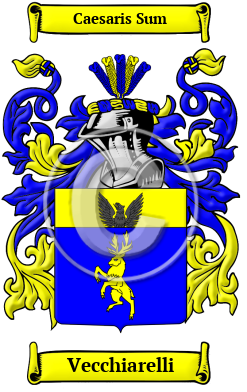
The motto was originally a war cry or slogan. Mottoes first began to be shown with arms in the 14th and 15th centuries, but were not in general use until the 17th century. Thus the oldest coats of arms generally do not include a motto. Mottoes seldom form part of the grant of arms: Under most heraldic authorities, a motto is an optional component of the coat of arms, and can be added to or changed at will; many families have chosen not to display a motto.
Motto: Caesaris Sum
Motto Translation: I am Caesar
 |