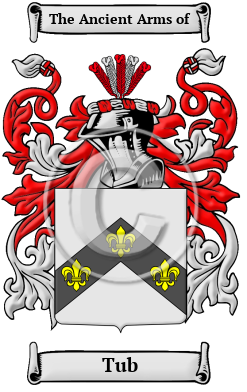
| ![Show Contents]() Tub History, Family Crest & Coats of Arms Tub History, Family Crest & Coats of Arms
- Origins Available:
England
Etymology of TubWhat does the name Tub mean? The name Tub is derived from the name of an ancestor, as in 'the son of Theobald.' 1 Another source claims the name could have been from Tubba, an Old Scandinavian name or from Tubo, an Old German name. "Tubba is recorded as the name of a Danish chief who was wounded at the sack of the monastery at Medeshamstede (Peterborough) c. 870." 2 Early Origins of the Tub familyThe surname Tub was first found in the Domesday Book of 1086 where the name Tubi was registered in Berkshire and Tube was registered in Warwickshire. 3 Years later we found Reginaldus filius Tobbe in the Pipe Rolls of Yorkshire in 1166 and later the same rolls listed Laurencius filius Tubb in the 1230. Early rolls in Norfolk listed Alan Tubbi in the the Curia Regis Rolls for 1206 and a few years later, John Tub was listed as a Baronet on the Isle of Man (1212-1213.) Over in Somerset, Roger Tubbe was listed in the Assize Rolls for 1243 and in Northumberland, William Tubbe was recorded in 1296. 4 "The name of Tubb is also represented in Berkshire. Tubbe was a Somerset name in the 13th century." 5 The Yorkshire Poll Tax Rolls of 1379 include an entry for Thomas Tubb, sonfer and Matilda Tubb. 1 Early History of the Tub familyThis web page shows only a small excerpt of our Tub research. Another 91 words (6 lines of text) covering the years 1620, 1881, 1915 and 1917 are included under the topic Early Tub History in all our PDF Extended History products and printed products wherever possible. Tub Spelling VariationsCornish surnames are characterized by a multitude of spelling variations. The frequent changes in surnames are due to the fact that the Old and Middle English languages lacked definite spelling rules. The official court languages, which were Latin and French, were also influential on the spelling of a surname. Since the spelling of surnames was rarely consistent in medieval times, and scribes and church officials recorded names as they sounded rather than adhering to any specific spelling rules, it was common to find the same individual referred to with different spellings of their surname in the ancient chronicles. Moreover, a large number of foreign names were brought into England, which accelerated and accentuated the alterations to the spelling of various surnames. Lastly, spelling variations often resulted from the linguistic differences between the people of Cornwall and the rest of England. The Cornish spoke a unique Brythonic Celtic language which was first recorded in written documents during the 10th century. However, they became increasingly Anglicized, and Cornish became extinct as a spoken language in 1777, although it has been revived by Cornish patriots in the modern era. The name has been spelled Tubb, Tub, Tubby, Tubman and others. Early Notables of the Tub family- Major Frederick Harold Tubb (1881-1917), Australian army officer, recipient of the Victoria Cross for actions in World War I at Lone Pine trenches, in the Gallipoli Peninsula, on 9th August, 1915
| Tub migration to the United States | + |
An examination into the immigration and passenger lists has discovered a number of people bearing the name Tub:
Tub Settlers in United States in the 17th Century- Thomas Tub, who arrived in Maryland in 1668
Tub Settlers in United States in the 18th Century- William Tub, who arrived in Philadelphia in 1739
- Bardsley, C.W, A Dictionary of English and Welsh Surnames: With Special American Instances. Wiltshire: Heraldry Today, 1901. Print. (ISBN 0-900455-44-6)
- Harrison, Henry, Surnames of the United Kingdom: A Concise Etymological Dictionary Baltimore: Geneological Publishing Company, 2013. Print
- Williams, Dr Ann. And G.H. Martin, Eds., Domesday Book A Complete Translation. London: Penguin, 1992. Print. (ISBN 0-141-00523-8)
- Reaney, P.H and R.M. Wilson, A Dictionary of English Surnames. London: Routledge, 1991. Print. (ISBN 0-415-05737-X)
- Guppy, Henry Brougham, Homes of Family Names in Great Britain. 1890. Print.
 |