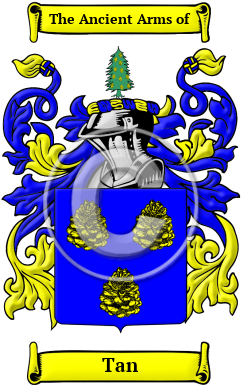
| ![Show Contents]() Tan History, Family Crest & Coats of Arms Tan History, Family Crest & Coats of Arms
- Origins Available:
Germany
Etymology of TanWhat does the name Tan mean? The Tan family name first began to be used in the German state of Bavaria. After the 12th century, as hereditary surnames began to be adopted, names that were derived from locations became particularly common. The family name Tan is a local surname. Originally denoting the proprietorship of an estate or influence within a village, the German preposition von, which means from or of, used with local names, was taken as a mark of aristocracy. The surname Tan was given to someone who lived in or near a forest. This name was originally derived from the German word tan, which means forest. Early Origins of the Tan familyThe surname Tan was first found in Franconia, where the name came from humble beginnings but gained a significant reputation for its contribution to the emerging mediaeval society. It later became more prominent as many branches of the same house acquired distant estates and branches, some in foreign countries, always elevating their social status by their great contributions to society. Early History of the Tan familyThis web page shows only a small excerpt of our Tan research. Another 245 words (18 lines of text) covering the years 1160, 1176, 1572, 1632 and 1704 are included under the topic Early Tan History in all our PDF Extended History products and printed products wherever possible. Tan Spelling VariationsMany cultural groups lived in the German states in medieval times. Each had its own dialect and traditions, and unique variations of popular names. Low German, which is similar to contemporary Dutch, was spoken in Westphalia. German names are characterized by additions such as regional suffixes and phrases that tell something about the origin or background of its original bearer. Further contributing to the variation in German names was the fact that there were no spelling rules in medieval times: scribes recorded names according to their sound. The recorded spelling variations of Tan include Tann, Tan, Tanner, Taner, Tanns, Tans, Tanne and many more. Early Notables of the Tan family- Conrad von Tann, the son of the founding father Friedrich (1160), who became the bishop of Speier and Adam Tanner (in Latin, Tannerus) (1572 -1632), Austrian Jesuit professor of mathematics and philos...
Tan World RankingIn the United States, the name Tan is the 2,588th most popular surname with an estimated 12,435 people with that name. 1 However, in Canada, the name Tan is ranked the 607th most popular surname with an estimated 8,365 people with that name. 2 And in France, the name Tan is the 1,890th popular surname with an estimated 3,263 people with that name. 3 Australia ranks Tan as 181st with 17,437 people. 4 New Zealand ranks Tan as 332nd with 1,896 people. 5 Netherlands ranks Tan as 811st with 2,404 people. 6
| Tan migration to the United States | + |
The great European flow of migration to North America, which began in the middle of the 17th century and continued into the 20th century, was particularly attractive to those from Bavaria who wished to escape either poverty or religious persecution. For many Bavarian tenant farmers, the chance to own their own land was a major incentive. So the widespread colonization of the United States began in 1650, when many immigrants from Germany settled in pockets in Pennsylvania, Texas, New York, Illinois, and California. In Canada, German settlement centered in Ontario and the prairie provinces. Among those of this surname listed in various historical records were:
Tan Settlers in United States in the 20th Century- Dominik Tan, aged 24, who settled in America from Austria, in 1903
- Chane Tan, aged 23, who immigrated to the United States from Minsk, in 1906
- Abraham Tan, aged 37, who settled in America from Horodcuka, Austria, in 1907
- Arito Tan, aged 17, who landed in America, in 1920
| Tan migration to New Zealand | + |
Emigration to New Zealand followed in the footsteps of the European explorers, such as Captain Cook (1769-70): first came sealers, whalers, missionaries, and traders. By 1838, the British New Zealand Company had begun buying land from the Maori tribes, and selling it to settlers, and, after the Treaty of Waitangi in 1840, many British families set out on the arduous six month journey from Britain to Aotearoa to start a new life. Early immigrants include: Tan Settlers in New Zealand in the 19th Century- James C. Tan a labourer, who arrived in Wellington, New Zealand aboard the ship "Halcione" in 1870 7
| Contemporary Notables of the name Tan (post 1700) | + |
- Amy Tan (b. 1952), award-winning American writer
- Mely Tan (1930-2024), born as Mely Tan Giok Lan, Indonesian sociologist
- Shaun Tan (b. 1974), Australian Academy Award-winning illustrator and author
- Alice Tan Ridley (1952-2025), American gospel, R&B singer and the mother of actress Gabourey Sidibe. advanced to the semi-finals of the NBC television series America's Got Talent, after previously winning $25,000 in the pilot episode of 30 Seconds to Fame, released her debut album Never Lost My Way in 2016
- Rodolfo Tan Cardoso (1937-2013), Filipino chess International Master
- Tan Crone (1930-2009), noted Dutch classical pianist
- Tan Dun (b. 1957), Chinese contemporary classical composer
- Tan Mei Lin, American Republican politician, Delegate to Republican National Convention from New York, 2004 8
 |