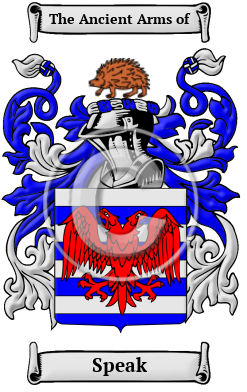
| ![Show Contents]() Speak History, Family Crest & Coats of Arms Speak History, Family Crest & Coats of Arms
- Origins Available:
England
Etymology of SpeakWhat does the name Speak mean? The name Speak was brought to England in the great wave of migration following the Norman Conquest of 1066. It comes from the Norman given name Espec. Early Origins of the Speak familyThe surname Speak was first found in Lancashire where a Norman noble Le Espec was an under tenant of Roger de Poitou, and was granted the lands of Speke outside Liverpool in Lancashire. Soon after the taking of the Domesday Book in 1086, a descendant, Richard Le Espec acquired the manors of Wenworthy and Brampton Speke in the county of Devon, 1 which he held from Robert Fitzroy of Oakhampton. His descendent, William Le Espec married and acquired the estates of Gervois. Walter Espec (d. 1153), was founder of Rievaulx Abbey, Yorkshire, and was probably the son of William Spech, who in 1085 held Warden, Bedfordshire, where some fifty years later Walter Espec founded and endowed an Abbey. "Espec's chief property was in Yorkshire, and he resided at Helmsley. Under Henry I he was Justice of the Forests and Itinerant Justice in the northern counties. Under Stephen he actively resisted the Scotch invasion. On 10 Jan. 1138 FitzDuncan failed in a night attack on Espec's castle of Wark. Then King David and his son Henry came up and formed a regular siege for three weeks, after which the main body passed on to Harry Northumberland. Three months later (c. 8 May) the garrison swooped down upon the Scotch king's commissariat, and had to submit to a second siege. The castle was stoutly defended by Walter's nephew, John de Bussey, but had to surrender about 11 Nov. " 2 Early History of the Speak familyThis web page shows only a small excerpt of our Speak research. Another 107 words (8 lines of text) covering the years 1592, 1653, 1661, 1675, 1681 and 1683 are included under the topic Early Speak History in all our PDF Extended History products and printed products wherever possible. Speak Spelling VariationsAnglo-Norman names are characterized by a multitude of spelling variations. When the Normans became the ruling people of England in the 11th century, they introduced a new language into a society where the main languages of Old and later Middle English had no definite spelling rules. These languages were more often spoken than written, so they blended freely with one another. Contributing to this mixing of tongues was the fact that medieval scribes spelled words according to sound, ensuring that a person's name would appear differently in nearly every document in which it was recorded. The name has been spelled Speak, Speck, Speake, Speke and others. Early Notables of the Speak familySir John Speke of Whitelackington; and Sir Hugh Speke, 1st Baronet of Hasilbury, Wiltshire (died 1661), an English politician who sat in the House of Commons in 1661; and...
Another 28 words (2 lines of text) are included under the topic Early Speak Notables in all our PDF Extended History products and printed products wherever possible.
| Speak migration to the United States | + |
For many English families, the political and religious disarray that plagued their homeland made the frontiers of the New World an attractive prospect. Thousands migrated, aboard cramped disease-ridden ships. They arrived sick, poor, and hungry, but were welcomed in many cases with far greater opportunity than at home in England. Many of these hardy settlers went on to make important contributions to the emerging nations in which they landed. Among early immigrants bearing the name Speak or a variant listed above were:
Speak Settlers in United States in the 17th Century- Thomas Speak, who landed in Maryland in 1639 4
Speak Settlers in United States in the 19th Century- Henry and James Speak, who arrived in Philadelphia in 1845
| Speak migration to Australia | + |
Emigration to Australia included the Second Fleet of convicts, tradespeople and early settlers. Early immigrants include: Second Fleet - Mr. Richard Speak, British settler convicted in Shrewsbury (Salop), England in 1789, sentenced to 7 years for stealing, transported aboard the ship "Admiral Barrington" leaving in 1790 arriving in New South Wales, Australia in 1791 3
- Shirley, Evelyn Philip, The Noble and Gentle Men of England; The Arms and Descents. Westminster: John Bower Nichols and Sons, 1866, Print.
- Smith, George (ed), Dictionary of National Biography. London: Smith, Elder & Co., 1885-1900. Print
- Convict Records of Australia. Retrieved 4th February 2021 from https://convictrecords.com.au/ships
- Filby, P. William, Meyer, Mary K., Passenger and immigration lists index : a guide to published arrival records of about 500,000 passengers who came to the United States and Canada in the seventeenth, eighteenth, and nineteenth centuries. 1982-1985 Cumulated Supplements in Four Volumes Detroit, Mich. : Gale Research Co., 1985, Print (ISBN 0-8103-1795-8)
 |