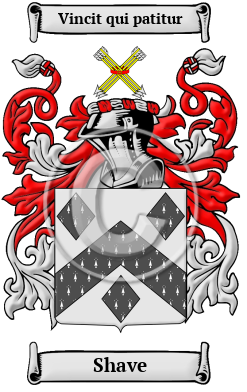
| ![Show Contents]() Shave History, Family Crest & Coats of Arms Shave History, Family Crest & Coats of Arms
Etymology of ShaveWhat does the name Shave mean? The Anglo-Saxon name Shave comes from the family having resided near a small wood or shaw. Shave is a topographic surname, which was given to a person who resided near a physical feature such as a hill, stream, church, or type of tree. The surname Shave is believed to be derived from the Old English word sceaga, which means dweller by the wood. Early Origins of the Shave familyThe surname Shave was first found in Berkshire, where they were established in the 12th century. Early History of the Shave familyThis web page shows only a small excerpt of our Shave research. Another 99 words (7 lines of text) covering the years 1191, 1281, 1307, 1388, 1407, 1615, 1617, 1635, 1659, 1660, 1661, 1679, 1680, 1690, 1696, 1780, 1815 and 1890 are included under the topic Early Shave History in all our PDF Extended History products and printed products wherever possible. Shave Spelling VariationsShave has been spelled many different ways. Before English spelling became standardized over the last few hundred years, spelling variations in names were a common occurrence. As the English language changed in the Middle Ages, absorbing pieces of Latin and French, as well as other languages, the spelling of people's names also changed considerably, even over a single lifetime. Spelling variants included: Shaw, Shawe, Shave, Sheaves, Shaves, Shay, Shayes and many more. Early Notables of the Shave familyJohn Shawe (died 1407), of Oxford, English politician, Member of the Parliament of England (MP) for Oxford in 1388; Sir John Shaw, 1st Baronet (c 1615-1680), an English merchant and politician, Member of Parliament for Lyme Regis (1661-1679); Sir John Shaw (c 1617-1690) , an English politician...
Another 46 words (3 lines of text) are included under the topic Early Shave Notables in all our PDF Extended History products and printed products wherever possible. Migration of the Shave family to IrelandSome of the Shave family moved to Ireland, but this topic is not covered in this excerpt.
Another 72 words (5 lines of text) about their life in Ireland is included in all our PDF Extended History products and printed products wherever possible.
| Shave migration to the United States | + |
In an attempt to escape the chaos experienced in England, many English families boarded overcrowded and diseased ships sailing for the shores of North America and other British colonies. Those families hardy enough, and lucky enough, to make the passage intact were rewarded with land and a social environment less prone to religious and political persecution. Many of these families became important contributors to the young colonies in which they settled. Early immigration and passenger lists have documented some of the first Shaves to arrive on North American shores:
Shave Settlers in United States in the 17th Century- Thomas Shave, who arrived in Hingham, Massachusetts in 1637
Shave Settlers in United States in the 18th Century- Valentine Shave, who settled in Philadelphia in 1739
| Shave migration to New Zealand | + |
Emigration to New Zealand followed in the footsteps of the European explorers, such as Captain Cook (1769-70): first came sealers, whalers, missionaries, and traders. By 1838, the British New Zealand Company had begun buying land from the Maori tribes, and selling it to settlers, and, after the Treaty of Waitangi in 1840, many British families set out on the arduous six month journey from Britain to Aotearoa to start a new life. Early immigrants include: Shave Settlers in New Zealand in the 19th Century- Alfred Shave, who arrived in Auckland, New Zealand aboard the ship "Pegasus" in 1865
| Contemporary Notables of the name Shave (post 1700) | + |
- Jonathan Taylor Shave (1967-1993), American Major League infielder who played from 1993 to 1999
- Lionel Kenneth Osborn Shave OBE (1916-2009), Australian soldier, businessman, benefactor and patron of the arts
- Justin George Shave (b. 1973), better known as Shave, an Australian music producer and composer
The motto was originally a war cry or slogan. Mottoes first began to be shown with arms in the 14th and 15th centuries, but were not in general use until the 17th century. Thus the oldest coats of arms generally do not include a motto. Mottoes seldom form part of the grant of arms: Under most heraldic authorities, a motto is an optional component of the coat of arms, and can be added to or changed at will; many families have chosen not to display a motto.
Motto: Vincit qui patitur
Motto Translation: He conquers who endures.
 |