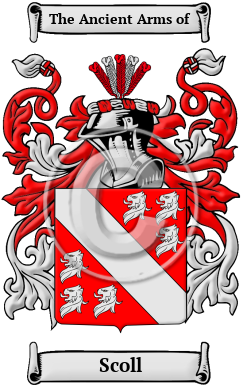
| ![Show Contents]() Scoll History, Family Crest & Coats of Arms Scoll History, Family Crest & Coats of Arms
Etymology of ScollWhat does the name Scoll mean? The surname Scoll has three possible origins, none of which are related to a skeletal "skull." Firstly, the name could have been derived "from the Old Norse skule, signifying a protector." 1 Secondly, the name could have been from "Skull (Schull), in the Barony of Carbery, co. Cork" 2 and finally, the name could have been "derived from the name of an ancestor as in 'the son of Scowle'". 3 Early Origins of the Scoll familyThe surname Scoll was first found in Suffolk where Robert Scule was recorded in the Abbey of Bury St. Edmonds, Suffolk, c. 1165. Later Robert filius Scule was listed in the Feet of Fines of Norfolk, in 1196. 4 In Lincolnshire, the Hundredorum Rolls of 1273 record William Scowle as holding lands there at that time. 3 Early History of the Scoll familyThis web page shows only a small excerpt of our Scoll research. Another 95 words (7 lines of text) covering the years 1438, 1448, 1579 and 1808 are included under the topic Early Scoll History in all our PDF Extended History products and printed products wherever possible. Scoll Spelling VariationsIt is only in the last few hundred years that the English language has been standardized. For that reason, Anglo-Norman surnames like Scoll are characterized by many spelling variations. Scribes and monks in the Middle Ages spelled names they sounded, so it is common to find several variations that refer to a single person. As the English language changed and incorporated elements of other European languages such as Norman French and Latin, even literate people regularly changed the spelling of their names. The variations of the name Scoll include Skull, Scull and others. Early Notables of the Scoll familyMore information is included under the topic Early Scoll Notables in all our PDF Extended History products and printed products wherever possible. Migration of the Scoll family to IrelandSome of the Scoll family moved to Ireland, but this topic is not covered in this excerpt.
Another 60 words (4 lines of text) about their life in Ireland is included in all our PDF Extended History products and printed products wherever possible.
| Scoll migration to the United States | + |
Faced with the chaos present in England at that time, many English families looked towards the open frontiers of the New World with its opportunities to escape oppression and starvation. People migrated to North America, as well as Australia and Ireland in droves, paying exorbitant rates for passages in cramped, unsafe ships. Many of the settlers did not make the long passage alive, but those who did see the shores of North America were welcomed with great opportunity. Many of the families that came from England went on to make essential contributions to the emerging nations of Canada and the United States. Some of the first immigrants to cross the Atlantic and come to North America carried the name Scoll, or a variant listed above:
Scoll Settlers in United States in the 19th Century- William Scoll, who landed in Mobile County, Ala in 1850 5
- Lower, Mark Anthony, Patronymica Britannica, A Dictionary of Family Names of the United Kingdom. London: John Russel Smith, 1860. Print.
- Charnock, Richard, Stephen, Ludus Patronymicus of The Etymology of Curious Surnames. London: Trubner & Co., 60 Paternoster Row, 1868. Print.
- Bardsley, C.W, A Dictionary of English and Welsh Surnames: With Special American Instances. Wiltshire: Heraldry Today, 1901. Print. (ISBN 0-900455-44-6)
- Reaney, P.H and R.M. Wilson, A Dictionary of English Surnames. London: Routledge, 1991. Print. (ISBN 0-415-05737-X)
- Filby, P. William, Meyer, Mary K., Passenger and immigration lists index : a guide to published arrival records of about 500,000 passengers who came to the United States and Canada in the seventeenth, eighteenth, and nineteenth centuries. 1982-1985 Cumulated Supplements in Four Volumes Detroit, Mich. : Gale Research Co., 1985, Print (ISBN 0-8103-1795-8)
 |