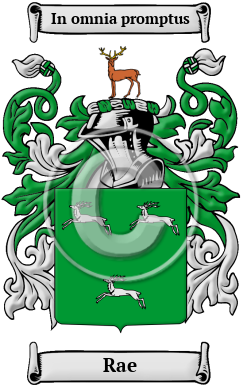
| ![Show Contents]() Rae History, Family Crest & Coats of Arms Rae History, Family Crest & Coats of Arms
Etymology of RaeWhat does the name Rae mean? The name Rae was first used by a Strathclyde-Briton family from the Scottish/English Borderlands. It was a name for a person known as a timid or shy person. Further research revealed that the name is derived from the Old English word ray, that referred to a roe or female deer. 1 Early Origins of the Rae familyThe surname Rae was first found in Cumberland at Gill, in the parish of Bromfield which belonged to the family from the time of William the Lion, king of Scotland (died 1214.) "Tradition says, that the original Ray was a faithful adherent of the Scottish monarch, by whom he was greatly esteemed, for his extraordinary swiftness of foot in pursuing the deer and who gave him the estate. The tenure was by a pepper-com rent, with the stipulation, that the name of William should be perpetuated in the family. This was strictly observed from generation to generation, until the latter half of the last [of the 18th] century, when the Mr. William Reay in possession gave to the ' hope of the house ' the name of John. " 1 Thomas filius Ray witnessed confirmation by Alexander, son of Walter, of his father's gift to the church of Paisley in 1239. 2 While there is no doubt of the family's origin in the north of England, the Hundredorum Rolls of 1273 list Reginald le Raye, in Oxfordshire; Nicholas le Ray in Suffolk; and Richard le Ray in Cambridgeshire. 3 Early History of the Rae familyThis web page shows only a small excerpt of our Rae research. Another 245 words (18 lines of text) covering the years 1350, 1376, 1465, 1487, 1530, 1558, 1612, 1627, 1670, 1671, 1705, 1748 and 1890 are included under the topic Early Rae History in all our PDF Extended History products and printed products wherever possible. Rae Spelling VariationsIt is only in the last few hundred years that rules have developed and the process of spelling according to sound has been abandoned. Scottish names from before that time tend to appear under many different spelling variations. Rae has been spelled Rae, Rea, Ree, Ray and others. Early Notables of the Rae family- William Rae (d. 1376) a 14th century Bishop of Glasgow
- James Rae (1671-1748), was a Scottish mechanic and historian, son of a clockmaker, born at Dumfries. He constructed for the Duke of QueensBerry at Drumlanrig Castle an astronomical and musical clock...
Rae World Rankingthe United States, the name Rae is the 5,086th most popular surname with an estimated 4,974 people with that name. 4 However, in Australia, the name Rae is ranked the 736th most popular surname with an estimated 5,285 people with that name. 5 And in New Zealand, the name Rae is the 317th popular surname with an estimated 1,925 people with that name. 6 The United Kingdom ranks Rae as 682nd with 9,721 people. 7 Migration of the Rae family to IrelandSome of the Rae family moved to Ireland, but this topic is not covered in this excerpt.
Another 70 words (5 lines of text) about their life in Ireland is included in all our PDF Extended History products and printed products wherever possible.
| Rae migration to the United States | + |
Unwelcome in their beloved homeland, many Scots sailed for the colonies of North America. There, they found land and freedom, and even the opportunity to make a new nation in the American War of Independence. These Scottish settlers played essential roles in the founding of the United States, and the shaping of contemporary North America. Among them:
Rae Settlers in United States in the 17th Century- John Rae who settled in Nevis in 1663
- Robert Rae, who arrived in New Jersey in 1685 8
Rae Settlers in United States in the 18th Century- James Rae, who arrived in Virginia in 1716 8
Rae Settlers in United States in the 19th Century- Frederick Rae, who arrived in America in 1810 8
- Mary Rae, who arrived in New York, NY in 1812 8
- Richard Rae, aged 27, who landed in Virginia in 1812 8
- George Rae, who landed in New York in 1818 8
- Christina Rae, who arrived in New York in 1818 8
- ... (More are available in all our PDF Extended History products and printed products wherever possible.)
| Rae migration to Canada | + |
Rae Settlers in Canada in the 19th Century- James Rae, who landed in Canada in 1821
| Rae migration to Australia | + |
Rae Settlers in Australia in the 19th Century- John Rae, Scottish convict from Aberdeen, who was transported aboard the "America" on April 4, 1829, settling in New South Wales, Australia 9
- Mr. Alexander Rae, Scottish convict who was convicted in Aberdeen, Scotland for 14 years, transported aboard the "Burrell" on 22nd July 1830, arriving in New South Wales 10
- Mr. John Rae, English convict who was convicted in Liverpool, Merseyside, England for 7 years, transported aboard the "Camden" on 21st September 1832, arriving in New South Wales, Australia 11
- Mr. James Rae, Scottish convict who was convicted in Dumfries, Scotland for 7 years, transported aboard the "Blenheim" on 11th March 1837, arriving in Tasmania (Van Diemen's Land) 12
- Mr. Robert Rae, Scottish convict who was convicted in Aberdeen, Scotland for 7 years, transported aboard the "Earl Grey" on 27th July 1838, arriving in New South Wales, Australia 13
- ... (More are available in all our PDF Extended History products and printed products wherever possible.)
| Rae migration to New Zealand | + |
Emigration to New Zealand followed in the footsteps of the European explorers, such as Captain Cook (1769-70): first came sealers, whalers, missionaries, and traders. By 1838, the British New Zealand Company had begun buying land from the Maori tribes, and selling it to settlers, and, after the Treaty of Waitangi in 1840, many British families set out on the arduous six month journey from Britain to Aotearoa to start a new life. Early immigrants include: - John Rae, aged 36, a farm servant, who arrived in Otago aboard the ship "Phoebe Dunbar" between 1841 and 1850
Rae Settlers in New Zealand in the 19th Century- Elizabeth Rae, aged 21, who arrived in Auckland, New Zealand aboard the ship "Jane Gifford" in 1842 14
- Thomas Rae, aged 35, a farm labourer, who arrived in Nelson, New Zealand aboard the ship "Prince of Wales" in 1842
- William Rae, aged 12, who arrived in Nelson, New Zealand aboard the ship "Prince of Wales" in 1842
- Elizabeth Rae, aged 10, who arrived in Nelson, New Zealand aboard the ship "Prince of Wales" in 1842
- Margaret Rae, aged 7, who arrived in Nelson, New Zealand aboard the ship "Prince of Wales" in 1842
- ... (More are available in all our PDF Extended History products and printed products wherever possible.)
| Contemporary Notables of the name Rae (post 1700) | + |
- Charlotte Rae (b. 1926), born Charlotte Rae Lubotsky, an American two-time Primetime Emmy Award nominated actor, known for her roles in The Facts of Life (1979), You Don't Mess with the Zohan (2008) and Hair (1979) and for her portrayal of Edna Garrett in the sitcoms Diff'rent Strokes
- Heather Rae (b. 1966), American film producer, director, and actress
- Tom Rae, American Republican politician, Delegate to Republican National Convention from Wyoming, 1956 15
- John W. Rae, American Republican politician, Candidate in primary for Michigan State House of Representatives from Washtenaw County 1st District, 1948 16
- Jason Rae, American Democratic Party politician, Member of Democratic National Committee from Wisconsin, 2008; Delegate to Democratic National Convention from Wisconsin, 2008 16
- J. Thomas Rae, American politician, U.S. Vice Consul in Pernambuco, 1943 16
- Archibald Rae, American Republican politician, Candidate for New York State Assembly from Bronx County 6th District, 1925 16
- Sir William Rae (1786-1873), Scottish naval surgeon, son of Matthew Rae of Park-end, Dumfries
- Sir William Rae (1769-1842), Scottish Lord Advocate, younger son of Sir David Rae, Lord Eskgrove
- ... (Another 20 notables are available in all our PDF Extended History products and printed products wherever possible.)
| Historic Events for the Rae family | + |
- Mr. Hector R Rae (b. 1913), English Plumber 3rd Class serving for the Royal Navy from Calbourne, Isle of Wight, England, who sailed into battle and died in the HMS Hood sinking 16
- Mr. William Rae, British Stoker 1st Class, who sailed into battle on the HMS Repulse (1941) and died in the sinking 17
- Robert Lockerbie Rae (1946-1971), Scottish football supporter, from Glasgow who was at the Ibrox disaster on 2nd January 1971 when a human crush among the crowd killed 66 and injured 200 people he died of his injuries 18
- James Whyte Rae (1952-1971), Scottish football supporter, from Dumbartonshire who was at the Ibrox disaster on 2nd January 1971 when a human crush among the crowd killed 66 and injured 200 people he died of his injuries 19
The motto was originally a war cry or slogan. Mottoes first began to be shown with arms in the 14th and 15th centuries, but were not in general use until the 17th century. Thus the oldest coats of arms generally do not include a motto. Mottoes seldom form part of the grant of arms: Under most heraldic authorities, a motto is an optional component of the coat of arms, and can be added to or changed at will; many families have chosen not to display a motto.
Motto: In omnia promptus
Motto Translation: Ready for everything.
- Lower, Mark Anthony, Patronymica Britannica, A Dictionary of Family Names of the United Kingdom. London: John Russel Smith, 1860. Print.
- Black, George F., The Surnames of Scotland Their Origin, Meaning and History. New York: New York Public Library, 1946. Print. (ISBN 0-87104-172-3)
- Bardsley, C.W, A Dictionary of English and Welsh Surnames: With Special American Instances. Wiltshire: Heraldry Today, 1901. Print. (ISBN 0-900455-44-6)
- "What are the 5,000 Most Common Last Names in the U.S.?". NameCensus.com, https://namecensus.com/last-names/
- "Most Common Last Names in Australia." Forebears, https://forebears.io/australia/surnames
- "Most Common Last Names in New Zealand." Forebears, https://forebears.io/new-zealand/surnames
- "UK surname ranking." UK Surname map, https://www.surnamemap.eu/unitedkingdom/surnames_ranking.php?p=10
- Filby, P. William, Meyer, Mary K., Passenger and immigration lists index : a guide to published arrival records of about 500,000 passengers who came to the United States and Canada in the seventeenth, eighteenth, and nineteenth centuries. 1982-1985 Cumulated Supplements in Four Volumes Detroit, Mich. : Gale Research Co., 1985, Print (ISBN 0-8103-1795-8)
- State Library of Queensland. (Retrieved 2014, November 26) America voyage to New South Wales, Australia in 1829 with 176 passengers. Retrieved from http://www.convictrecords.com.au/ships/america/1829
- Convict Records Voyages to Australia (Retrieved 5th November 2020). Retrieved from https://convictrecords.com.au/ships/burrell
- Convict Records Voyages to Australia (Retrieved 2nd December 2020). Retrieved from https://convictrecords.com.au/ships/camden
- Convict Records Voyages to Australia (Retrieved 15th October 2020). Retrieved from https://convictrecords.com.au/ships/blenheim
- Convict Records Voyages to Australia (Retrieved 17th August 2021). Retrieved from https://convictrecords.com.au/ships/earl-grey
- New Zealand Yesteryears Passenger Lists 1800 to 1900 (New Zealand Yesteryears Passenger Lists 1800 to 1900 (Retrieved 17th October 2018). Retrieved from http://www.yesteryears.co.nz/shipping/passlist.html
- The Political Graveyard: Alphabetical Name Index. (Retrieved 2015, October 26) . Retrieved from http://politicalgraveyard.com/alpha/index.html
- H.M.S. Hood Association-Battle Cruiser Hood: Crew Information - H.M.S. Hood Rolls of Honour, Men Lost in the Sinking of H.M.S. Hood, 24th May 1941. (Retrieved 2016, July 15) . Retrieved from http://www.hmshood.com/crew/memorial/roh_24may41.htm
- HMS Repulse Crew members. (Retrieved 2014, April 9) . Retrieved from http://www.forcez-survivors.org.uk/biographies/listrepulsecrew.html
- Bradford City Football Club In memory (retrieved 22nd March 2021). Retrieved from https://www.bradfordcityafc.com/club/in-memoriam/
 |