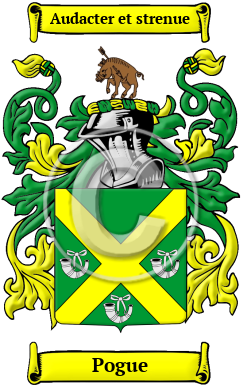
| ![Show Contents]() Pogue History, Family Crest & Coats of Arms Pogue History, Family Crest & Coats of Arms
The first people to use the name Pogue were a family of Strathclyde-Britons who lived in the Scottish/English Borderlands. The name comes from when someone lived at Pollok (Gaelic: Pollag), a large district on the south-western side of the city of Glasgow, home to Crookston Castle, where Mary, Queen of Scots, was once held. The name of the town has Gaelic origins, from the word 'poll', meaning "pool" or "pit". Early Origins of the Pogue familyThe surname Pogue was first found in Renfrewshire (Gaelic: Siorrachd Rinn Friù), a historic county of Scotland, today encompassing the Council Areas of Renfrew, East Renfrewshire, and Iverclyde, in the Strathclyde region of southwestern Scotland, where the first occurrence of the name is Peter, son of Fulbert or Fulburt who was granted the lands of Upper Pollock by the High Steward, and who took the surname from the lands, making him the first Pollock. Peter gave the church of Pulloc and its pertinents to the monastery of Paisley, sometime between 1177 and 1199. Within that same period of time, he also confirmed the charter of his brother Helias of Perthic to the same house. Peter also possessed lands in Moray and circa 1175, he witnessed the charter by William the Lion granting Burgin to the Abbey of Kinlos. 1 Circa 1230, Murial de Polloc, a daughter of Peter, gifted her land of Inuerorkel and all its pertinents for the benefit of the hospital erected beside the bridge of Spey for the reception of travelers. Continuing this pattern of generosity, Robert de Pollok granted to the monastery of Paisley, during the reign of Alexander II, alms of twelve pennies a year from the rents he earned from his lands. Other important Pollocks include John Pollok who was both steward of the Abbey of Arbroath and sheriff of Forfar. 1 In England, Pook was a popular variant and in this case, the family was probably from Puckney Gill in the parish of Charlwood, County Surrey, so called from the Old English word "puca" (goblin) and "eg" (island). 2 The surname is first found in Sussex in 1332 as atte Pukenegh, and occurs also in County Surrey at about the same date. From the fourteenth to the seventeenth century the name was largely confined to a small central area of central Sussex, around West Grinstead. The name was also occasionally used as a nickname 'the puk' from the complexion of hair or dress, a colour between russet and black. 3 William Puch was documented in the year 1166, and appears to be the first of the name on record. William le Puk of County Somerset, was documented during the reign of Edward III (1327-1377) and John Pouk was recorded in County Somerset at the same time. 4 Early History of the Pogue familyThis web page shows only a small excerpt of our Pogue research. Another 220 words (16 lines of text) covering the years 1234, 1272, 1590, 1603, 1660, 1827 and 1890 are included under the topic Early Pogue History in all our PDF Extended History products and printed products wherever possible. Pogue Spelling VariationsSurnames that evolved in Scotland in the Middle Ages often appear under many spelling variations. These are due to the practice of spelling according to sound in the era before dictionaries had standardized the English language. Pogue has appeared as Pollock, Pollocke, Polk, Polke, Pollok, Pollick, Polloch, Pook, Pooke, Poock, Pogue, Poag, Poage, Poague, Poak and many more. Early Notables of the Pogue familyMore information is included under the topic Early Pogue Notables in all our PDF Extended History products and printed products wherever possible. Pogue RankingIn the United States, the name Pogue is the 3,734th most popular surname with an estimated 7,461 people with that name. 5  Migration of the Pogue family to Ireland Migration of the Pogue family to Ireland
Some of the Pogue family moved to Ireland, but this topic is not covered in this excerpt.
Another 96 words (7 lines of text) about their life in Ireland is included in all our PDF Extended History products and printed products wherever possible.
| Pogue migration to the United States | + |
The North American colonies beckoned, with their ample land and opportunity as their freedom from the persecution suffered by so many Clan families back home. Many Scots even fought against England in the American War of Independence to gain this freedom. Recently, clan societies have allowed the ancestors of these brave Scottish settlers to rediscover their familial roots. Among them:
Pogue Settlers in United States in the 19th Century- William Pogue, aged 27, who landed in New York in 1812 6
- Alexander Pogue, who arrived in New York, NY in 1816 6
- Philip and James Pogue, who settled in Philadelphia, Pennsylvania in 1866 and 1876 respectively
- Saul F. Pogue, aged 20, who landed in America, in 1895
- J. M. Pogue, aged 29, who immigrated to America, in 1897
- ... (More are available in all our PDF Extended History products and printed products wherever possible.)
Pogue Settlers in United States in the 20th Century- Jane Pogue, aged 23, who landed in America from Cavan, in 1903
- Abram Pogue, aged 50, who immigrated to the United States from Costelrell, Ireland, in 1906
- Fanny Pogue, aged 19, who immigrated to the United States from Hohill, Ireland, in 1908
- Mary Anne Pogue, aged 20, who immigrated to the United States from Dublin, Ireland, in 1908
- Matilda Elizabeth Pogue, aged 23, who landed in America from Hohill, Ireland, in 1908
- ... (More are available in all our PDF Extended History products and printed products wherever possible.)
| Pogue migration to Australia | + |
Emigration to Australia followed the First Fleets of convicts, tradespeople and early settlers. Early immigrants include: Pogue Settlers in Australia in the 19th Century- Thomas Pogue, aged 25, a labourer, who arrived in South Australia in 1855 aboard the ship "Bucephalus"
| Pogue migration to New Zealand | + |
Emigration to New Zealand followed in the footsteps of the European explorers, such as Captain Cook (1769-70): first came sealers, whalers, missionaries, and traders. By 1838, the British New Zealand Company had begun buying land from the Maori tribes, and selling it to settlers, and, after the Treaty of Waitangi in 1840, many British families set out on the arduous six month journey from Britain to Aotearoa to start a new life. Early immigrants include: Pogue Settlers in New Zealand in the 19th Century- Miss Susan Pogue, Irish settler travelling from Glasgow aboard the ship "Storm Cloud" arriving in Dunedin, Otago, South Island, New Zealand on 27th April 1860 7
| Contemporary Notables of the name Pogue (post 1700) | + |
- Colonel (USAF) William Reid Pogue (1930-2014), former NASA astronaut with over 84 days in space aboard Skylab 4 8
- Donald Carl Pogue (1947-2016), American jurist, Senior Judge of the United States Court of International Trade (2014-2016), Chief Judge of the United States Court of International Trade (2010-2014)
- Harold Pogue (1893-1969), American football player and businessman
- Lloyd Welch Pogue (1899-2003), American pioneering aviation attorney and Chairman of the old Civil Aeronautics Board
- Alan Pogue (b. 1946), American photojournalist
- Forrest Carlisle Pogue Jr. (1912-1996), official United States Army historian during World War II 9
- David Pogue (b. 1963), American technology writer, technology columnist and commentator
- Harold Pogue, American Democratic Party politician, Delegate to Democratic National Convention from Illinois, 1960 10
- H. W. Pogue, American Democratic Party politician, Alternate Delegate to Democratic National Convention from Illinois, 1908 10
- Earl L. Pogue, American Democratic Party politician, Postmaster at Attica, Indiana, 1946 (acting, 1946) 10
- ... (Another 7 notables are available in all our PDF Extended History products and printed products wherever possible.)
The motto was originally a war cry or slogan. Mottoes first began to be shown with arms in the 14th and 15th centuries, but were not in general use until the 17th century. Thus the oldest coats of arms generally do not include a motto. Mottoes seldom form part of the grant of arms: Under most heraldic authorities, a motto is an optional component of the coat of arms, and can be added to or changed at will; many families have chosen not to display a motto.
Motto: Audacter et strenue
Motto Translation: Boldly and earnestly.
| Suggested Readings for the name Pogue | + |
- Pogue, Pollock, Polk Genealogy: as Mirrored in history, form Scotland to Northern Ireland/Ulster, Ohio, and Westward by Lloyd Welch Pogue.
- Black, George F., The Surnames of Scotland Their Origin, Meaning and History. New York: New York Public Library, 1946. Print. (ISBN 0-87104-172-3)
- Mills, A.D., Dictionary of English Place-Names. Oxford: Oxford University Press, 1991. Print. (ISBN 0-19-869156-4)
- Bardsley, C.W, A Dictionary of English and Welsh Surnames: With Special American Instances. Wiltshire: Heraldry Today, 1901. Print. (ISBN 0-900455-44-6)
- Dickinson, F.H., Kirby's Quest for Somerset of 16th of Edward the 3rd London: Harrison and Sons, Printers in Ordinary to Her Majesty, St, Martin's Lane, 1889. Print.
- "What are the 5,000 Most Common Last Names in the U.S.?". NameCensus.com, https://namecensus.com/last-names/
- Filby, P. William, Meyer, Mary K., Passenger and immigration lists index : a guide to published arrival records of about 500,000 passengers who came to the United States and Canada in the seventeenth, eighteenth, and nineteenth centuries. 1982-1985 Cumulated Supplements in Four Volumes Detroit, Mich. : Gale Research Co., 1985, Print (ISBN 0-8103-1795-8)
- New Zealand Yesteryears Passenger Lists 1800 to 1900 (Retrieved 26th March 2019). Retrieved from http://www.yesteryears.co.nz/shipping/passlist.html
- NASA Astronauts Homepage. (Retrieved 2010, September 27) William Pogue. Retrieved from http://www.jsc.nasa.gov/Bios/htmlbios/pogue-wr.html
- Forrest Pogue. (Retrieved 2011, January 14) Forrest Pogue. Retrieved from http://en.wikipedia.org/wiki/Forrest_Pogue
- The Political Graveyard: Alphabetical Name Index. (Retrieved 2015, October 29) . Retrieved from http://politicalgraveyard.com/alpha/index.html
|

 Pogue migration to the United States
  Pogue migration to Australia
  Pogue migration to New Zealand

 Scotland
 Ireland
 England