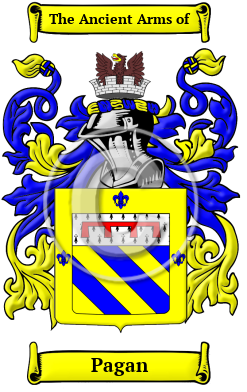
| ![Show Contents]() Pagan History, Family Crest & Coats of Arms Pagan History, Family Crest & Coats of Arms
Etymology of PaganWhat does the name Pagan mean? Pagan is one of the names derived from the families of the ancient Dalriadan clans of Scotland. It is derived from the personal name Payne. Pagan is a patronymic surname, which belongs to the category of hereditary surnames. Although this interpretation of the etymology of the surname Pagan is uncertain, it is generally accepted at the present time. Early Origins of the Pagan familyThe surname Pagan was first found in Yorkshire, where they held a family seat from very early times and were granted lands by Duke William of Normandy, their liege Lord, for their distinguished assistance at the Battle of Hastings in 1066 A.D. Early History of the Pagan familyThis web page shows only a small excerpt of our Pagan research. Another 97 words (7 lines of text) covering the years 1180, 1265 and 1821 are included under the topic Early Pagan History in all our PDF Extended History products and printed products wherever possible. Pagan Spelling VariationsSpelling in the medieval era was a highly imprecise process. Translation, particularly from Gaelic to English, was little better. For these reasons, early Scottish names are rife with spelling variations. In various documents Pagan has been spelled Pagan, Paganell, Paganel, Pagnell and others. Early Notables of the Pagan family Pagan RankingIn the United States, the name Pagan is the 1,206th most popular surname with an estimated 24,870 people with that name. 1
| Pagan migration to the United States | + |
The hardy Scots who made the crossing settled all along the east coast of North America and in the great west that was just then opening up. At the time of the American War of Independence, many United Empire Loyalists moved north from the American colonies to Canada. Scottish national heritage became better known in North America in the 20th century through highland games and other patriotic events. An examination of immigration records and passenger ship lists revealed that people bearing the name Pagan arrived in North America very early:
Pagan Settlers in United States in the 17th Century- James Pagan, who settled in Virginia in 1688
Pagan Settlers in United States in the 18th Century- John James Pagan, who arrived in Virginia in 1709 2
- Robert Pagan, who arrived in Maine in 1748
- William Pagan, who settled in New York in 1766
- Janet Pagan, who arrived in New York sometime between 1783 and 1843
Pagan Settlers in United States in the 19th Century- William Pagan, who arrived in Allegany (Allegheny) County, Pennsylvania in 1831 2
- S Pagan, who landed in San Francisco, California in 1850 2
- L Pagan, who landed in San Francisco, California in 1850 2
- Ramon Pagan, who arrived in Puerto Rico in 1860 2
| Pagan migration to Canada | + |
Pagan Settlers in Canada in the 18th Century- Mr. John Pagan U.E. who settled in St. Andrews, Charlotte County, New Brunswick c. 1784 member of the Penobscot Association 3
- Mr. Robert Pagan Jr., U.E. born in Glasgow, Scotland from Falmouth, Maine, USA who settled in St. Andrews, Charlotte County, New Brunswick c. 1784 member of the Penobscot Association 3
- Mr. Thomas Pagan U.E. born in Glasgow, Scotland from Falmouth, Maine, USA who settled in Parr Town, Saint John, New Brunswick c. 1784 member of the Penobscot Association, he was a Merchant who returned to Scotland where he died in 1804 3
Pagan Settlers in Canada in the 19th Century- Thomas Pagan, who arrived in Saint John, New Brunswick in 1800
- Jane Pagan, who settled in Nova Scotia in 1821
| Pagan migration to Australia | + |
Pagan Settlers in Australia in the 19th Century- Mr. John Pagan, (b. 1804), aged 37, Scottish labourer from Dumfries, Scotland, UK travelling aboard the ship "Ward Chapman" arriving in Port Phillip, New South Wales, Australia on 16th December 1841 4
- Mrs. Grace Pagan, (b. 1803), aged 38, Cornish house keeper travelling aboard the ship "Ward Chapman" arriving in Port Phillip, New South Wales, Australia on 16th December 1841 4
- Miss Mary Pagan, (b. 1830), aged 11, Cornish settler travelling aboard the ship "Ward Chapman" arriving in Port Phillip, New South Wales, Australia on 16th December 1841 4
- Miss Elizabeth Jane Pagan, (b. 1833), aged 8, Cornish settler travelling aboard the ship "Ward Chapman" arriving in Port Phillip, New South Wales, Australia on 16th December 1841 4
- Mr. John Pagan, (b. 1804), aged 37, Scottish labourer from Dumfries, Scotland departing from Bristol on 21st August 1841 aboard the ship "Ward Chipman" arriving in Port Phillip, Victoria, Australia on 6th December 1841 5
- ... (More are available in all our PDF Extended History products and printed products wherever possible.)
| Pagan migration to New Zealand | + |
Emigration to New Zealand followed in the footsteps of the European explorers, such as Captain Cook (1769-70): first came sealers, whalers, missionaries, and traders. By 1838, the British New Zealand Company had begun buying land from the Maori tribes, and selling it to settlers, and, after the Treaty of Waitangi in 1840, many British families set out on the arduous six month journey from Britain to Aotearoa to start a new life. Early immigrants include: Pagan Settlers in New Zealand in the 19th Century- Mr. Thomas Pagan, Scottish settler travelling from Glasgow aboard the ship "Jura" arriving in Dunedin, Otago, South Island, New Zealand on 23rd September 1858 6
- Mr. Archibald Pagan, Scottish settler travelling from Glasgow aboard the ship "Robert Henderson" arriving in Dunedin, Otago, South Island, New Zealand on 3rd September 1860 7
| Contemporary Notables of the name Pagan (post 1700) | + |
- Irmgard Pagan, American Democratic Party politician, Delegate to Democratic National Convention from Puerto Rico, 1996
- Carlos M. Pagan, American Democratic Party politician, Delegate to Democratic National Convention from New York, 1964
- Antonio Pagán (1958-2009), American politician, who held roles in the municipal government of New York City
- Ralfi Pagan (1947-1978), Bronx, New York based 'Latin soul ' and salsa singer
- José Antonio Pagán (b. 1935), former Major League Baseball player from Puerto Rico
- Isabel Pagan (1740-1821), Scottish poet of the Romantic Era
- William Pagan U.E. (1744-1819), Scottish-born United Empire Loyalist from Falmouth, Maine, USA who settled in St. Andrews, Charlotte County, New Brunswick c. 1783 to become Member of the Legislative Assembly of New Brunswick from 1786 to 1816, brother of Robert Pagan
- Robert Pagan U.E. (1750-1821), Scottish-born United Empire Loyalist from Falmouth, Maine, USA who settled in St. Andrews, Charlotte County, New Brunswick c. 1783 to become Member of the Legislative Assembly of New Brunswick from 1786 to 1819
- Adrian Pagan (b. 1947), Australian economist and Professor of Economics
- ... (Another 2 notables are available in all our PDF Extended History products and printed products wherever possible.)
- "What are the 5,000 Most Common Last Names in the U.S.?". NameCensus.com, https://namecensus.com/last-names/
- Filby, P. William, Meyer, Mary K., Passenger and immigration lists index : a guide to published arrival records of about 500,000 passengers who came to the United States and Canada in the seventeenth, eighteenth, and nineteenth centuries. 1982-1985 Cumulated Supplements in Four Volumes Detroit, Mich. : Gale Research Co., 1985, Print (ISBN 0-8103-1795-8)
- Rubincam, Milton. The Old United Empire Loyalists List. Genealogical Publishing Co., Inc, 1976. (Originally published as; United Empire Loyalists. The Centennial of the Settlement of Upper Canada. Rose Publishing Company, 1885.) ISBN 0-8063-0331-X
- Cornwall Online Parish Clerks. (Retrieved 2018, May 30). Ships' Passenger Lists of Arrivals in New South Wales on (1828 - 1842, 1848 - 1849) [PDF]. Retrieved from http://www.opc-cornwall.org/Resc/pdfs/emigration_nsw_1838_on.pdf
- Cornwall Online Parish Clerks. (Retreived 3rd May 2018). Retrieved from http://www.opc-cornwall.org/Resc/pdfs/emigration_australia_victoria.pdf
- New Zealand Yesteryears Passenger Lists 1800 to 1900 (Retrieved 17th October 2018). Retrieved from http://www.yesteryears.co.nz/shipping/passlist.html
- New Zealand Yesteryears Passenger Lists 1800 to 1900 (Retrieved 26th March 2019). Retrieved from http://www.yesteryears.co.nz/shipping/passlist.html
 |