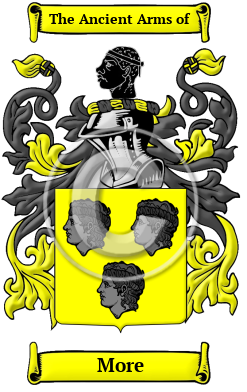
| ![Show Contents]() More History, Family Crest & Coats of Arms More History, Family Crest & Coats of Arms
Etymology of MoreWhat does the name More mean? More is a local name from the German speaking Austrian Empire. Local names and other types of hereditary surnames, first began to be used in this region after the 12th century. They were derived from the name of the place where the original bearer of the name lived. Sometimes local names bear the prefix "von", meaning "of" or "from". It was an indication of land-ownership, and was sometimes taken as a mark of aristocracy. The More family originally lived in the modern state of Austria. Early Origins of the More familyThe surname More was first found in Austria and the Rhineland, where the name became noted for its many branches within the region, each house acquiring a status and influence which was envied and enrolled by the princes of the region. In their later history the family became a power unto themselves and were elevated to the ranks of nobility as they grew into this most influential family. Early History of the More familyThis web page shows only a small excerpt of our More research. Another 221 words (16 lines of text) covering the years 1299, 1557, 1613, 1627, 1665, 1704, 1801, 1806, 1824, 1879 and 1901 are included under the topic Early More History in all our PDF Extended History products and printed products wherever possible. More Spelling VariationsMany cultural groups lived in the German states in medieval times. Each had its own dialect and traditions, and unique variations of popular names. Low German, which is similar to contemporary Dutch, was spoken in Westphalia. German names are characterized by additions such as regional suffixes and phrases that tell something about the origin or background of its original bearer. Further contributing to the variation in German names was the fact that there were no spelling rules in medieval times: scribes recorded names according to their sound. The recorded spelling variations of More include Mohr, More, Morher, Mohrer, Mor, Moor and others. Early Notables of the More familyJ.C.B. Mohr, who founded a well-known publishing house in 1801. Karl Friedrich Mohr (1806-1879) was the leading scientific pharmacist of his time in Germany. He invented various new analytical processes and the "Mohr's balance" for determining specific weights...
Another 37 words (3 lines of text) are included under the topic Early More Notables in all our PDF Extended History products and printed products wherever possible. More World RankingIn the United States, the name More is the 5,396th most popular surname with an estimated 4,974 people with that name. 1 However, in France, the name More is ranked the 6,952nd most popular surname with an estimated 1,000 - 1,500 people with that name. 2 And in South Africa, the name More is the 724th popular surname with an estimated 9,453 people with that name. 3
| More migration to the United States | + |
After the First World War, Austria became a republic. The Treaty of Versailles broke up the empire in 1919 and many of the Sudeten Germans were incorporated into the new nation of Czechoslovakia. In the 20th century, many Austrians migrated to other parts of Germany or Europe, as well as to North America. In the United States, the majority of settlers landed in Philadelphia, and moved on to Ohio, Texas, Illinois, California, New York, and Maryland. Many German settlers also migrated to Canada, particularly Ontario and the Prairies. Amongst the settlers in North America with this distinguished name More were
More Settlers in United States in the 17th Century- Mr. Leonard More, (Moore) who arrived in Virginia in 1619 aboard the ship "Bona Nova" 4
- Mr. John More, aged 36, who arrived in Virginia in 1619 aboard the ship "Bona Nova" 5
- Miss Mary More, (1616-1621), who arrived in Plymouth in 1620 aboard the ship "Mayflower" 5
- Mr. William More, (1616-1621), who arrived in Plymouth in 1620 aboard the ship "Mayflower" 5
- Jasper More, (b. 1613), who died aboard the "Mayflower" in 1620 at Cape Cod Harbor, Massachusetts and was believed to be buried ashore 4
- ... (More are available in all our PDF Extended History products and printed products wherever possible.)
More Settlers in United States in the 18th Century- Agnis More, who arrived in Virginia in 1714 4
- Joanna More, who landed in Virginia in 1714 4
- Mary More, who arrived in Virginia in 1714 4
- Ralph More, who landed in Virginia in 1714 4
- Susanna More, who landed in Virginia in 1714 4
- ... (More are available in all our PDF Extended History products and printed products wherever possible.)
More Settlers in United States in the 19th Century- Antonio More, who arrived in Puerto Rico in 1811 4
- Francisca More, who arrived in Puerto Rico in 1822 4
- Thomas More, aged 40, who landed in America in 1822 4
- John More, who arrived in New York, NY in 1829 4
- J W More, who arrived in San Francisco, California in 1850 4
| More migration to Canada | + |
More Settlers in Canada in the 18th Century- Mr. Sylvester More U.E., (Mose) who settled in Edwardsburgh-Cardinal, Leeds & Grenville, Ontario c. 1786 6
| More migration to Australia | + |
Emigration to Australia included the Third Fleet of convicts, tradespeople and early settlers. Early immigrants include: Following the Third Fleets, other convicts and early settlers arriving in Australia include: More Settlers in Australia in the 19th Century- James A. More, who arrived in Adelaide, Australia aboard the ship "Alice Brooks" in 1839 7
- James More, aged 33, Scottish convict from Perth, who was transported aboard the "Adelaide" on April 16, 1855, settling in Western Australia 8
| More migration to New Zealand | + |
Emigration to New Zealand followed in the footsteps of the European explorers, such as Captain Cook (1769-70): first came sealers, whalers, missionaries, and traders. By 1838, the British New Zealand Company had begun buying land from the Maori tribes, and selling it to settlers, and, after the Treaty of Waitangi in 1840, many British families set out on the arduous six month journey from Britain to Aotearoa to start a new life. Early immigrants include: More Settlers in New Zealand in the 19th Century- Miss Honora More, (b. 1850), aged 19, British dairymaid travelling from Gravesend aboard the ship "Hydaspes" arriving in Lyttelton, Christchurch, South Island, New Zealand on 30th September 1869 9
| More migration to West Indies | + |
The British first settled the British West Indies around 1604. They made many attempts but failed in some to establish settlements on the Islands including Saint Lucia and Grenada. By 1627 they had managed to establish settlements on St. Kitts (St. Christopher) and Barbados, but by 1641 the Spanish had moved in and destroyed some of these including those at Providence Island. The British continued to expand the settlements including setting the First Federation in the British West Indies by 1674; some of the islands include Barbados, Bermuda, Cayman Island, Turks and Caicos, Jamaica and Belize then known as British Honduras. By the 1960's many of the islands became independent after the West Indies Federation which existed from 1958 to 1962 failed due to internal political conflicts. After this a number of Eastern Caribbean islands formed a free association. 10More Settlers in West Indies in the 17th Century- Mr. John More, (b. 1606), aged 28, British settler travelling from London, UK arriving in St Christopher (St. Kitts) on 5th January 1634 4
- Mr. John More, (b. 1604), aged 30, British settler travelling from London, UK arriving in St Christopher (St. Kitts) on 5th January 1634 4
- Mr. Alexander More, aged 24, British settler travelling from Gravesend, UK aboard the ship "Hopewell" arriving in Barbados on 17th February 1634 4
- Miss Suzan More, (b. 1614), aged 21, British settler travelling from London, England aboard the ship "Anne and Elizabeth" arriving in Barbados in 1635 11
- Mr. Thomas More, (b. 1602), aged 33, British settler travelling from London, England aboard the ship "Alexander" arriving in Barbados in 1635 12
- ... (More are available in all our PDF Extended History products and printed products wherever possible.)
| Contemporary Notables of the name More (post 1700) | + |
- Michael More, American Republican politician, Member of Montana State House of Representatives 70th District; Elected 2010 13
- Lena Gay More, American Republican politician, Delegate to Republican National Convention from Texas, 1932, 1936, 1940, 1944; Member of Republican National Committee from Texas, 1940 14
- Jonas More, American politician, Member of New York State Assembly from Delaware County, 1839 14
- John T. More, American politician, Member of New York State Assembly from Delaware County, 1806-08, 1809-10, 1813-14; Member of New York State Senate Middle District, 1819-22 14
- John E. More, American Democratic Party politician, Candidate for Michigan State Senate 16th District, 1910 14
- Jake More, American Democratic Party politician, Delegate to Democratic National Convention from Iowa, 1940, 1944, 1948, 1952; Iowa Democratic State Chair, 1945-49, 1955-58 14
- Enoch H. More, American politician, Member of New Jersey State Senate from Cumberland County, 1845-46 14
- Ellsworth B. More (1890-1950), American Republican politician, Member of Michigan State Board of Agriculture, 1948-50 14
- Elijah A. More, American politician, Mayor of Little Rock, Arkansas, 1834 14
- ... (Another 11 notables are available in all our PDF Extended History products and printed products wherever possible.)
| Historic Events for the More family | + |
- Miss Florentina Duran y More, aged 30, Spanish Second Class passenger from Barcelona, Spain who sailed aboard the RMS Titanic and survived the sinking escaping on life boat 12 14
- Miss Asunción Duran y More, aged 27, Spanish Second Class passenger from Barcelona, Spain who sailed aboard the RMS Titanic and survived the sinking escaping on life boat 12 15
- Mr. Pinefas More, South African Labour Corps Soldier, who died aboard the ship "SS Mendi" when she was struck off the coast of the Isle of Wight, England on the 21st February 1917
- "What are the 5,000 Most Common Last Names in the U.S.?". NameCensus.com, https://namecensus.com/last-names/
- http://www.journaldesfemmes.com/nom-de-famille/nom/
- "Most Common Last Names in South Africa." Forebears, https://forebears.io/south-africa/surnames
- Filby, P. William, Meyer, Mary K., Passenger and immigration lists index : a guide to published arrival records of about 500,000 passengers who came to the United States and Canada in the seventeenth, eighteenth, and nineteenth centuries. 1982-1985 Cumulated Supplements in Four Volumes Detroit, Mich. : Gale Research Co., 1985, Print (ISBN 0-8103-1795-8)
- Pilgrim Ship's of 1600's Retrieved January 6th 2023, retrieved from https://www.packrat-pro.com/ships/shiplist.htm
- Rubincam, Milton. The Old United Empire Loyalists List. Genealogical Publishing Co., Inc, 1976. (Originally published as; United Empire Loyalists. The Centennial of the Settlement of Upper Canada. Rose Publishing Company, 1885.) ISBN 0-8063-0331-X
- State Records of South Australia. (Retrieved 2010, November 5) ALICE BROOKS 1839. Retrieved from http://www.slsa.sa.gov.au/BSA/1839AliceBrooks.gif
- State Library of Queensland. (Retrieved 2014, November 17) Adelaide voyage to Western Australia, Australia in 1855 with 261 passengers. Retrieved from http://www.convictrecords.com.au/ships/adelaide/1855
- New Zealand Yesteryears Passenger Lists 1800 to 1900 (Retrieved 17th October 2018). Retrieved from http://www.yesteryears.co.nz/shipping/passlist.html
- https://en.wikipedia.org/wiki/British_West_Indies
- Pilgrim Ship Lists Early 1600's. Retrieved 23rd September 2021 from https://www.packrat-pro.com/ships/shiplist.htm
- Pilgrim Ship Lists Early 1600's retrieved 28th September 2021 from https://www.packrat-pro.com/ships/shiplist.htm
- The Political Graveyard: Alphabetical Name Index. (Retrieved 2015, October 19) . Retrieved from http://politicalgraveyard.com/alpha/index.html
- Titanic Passenger List - Titanic Facts. (Retrieved 2016, July 13) . Retrieved from http://www.titanicfacts.net/titanic-passenger-list.html
 |