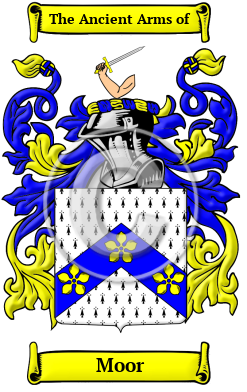
| ![Show Contents]() Moor History, Family Crest & Coats of Arms Moor History, Family Crest & Coats of Arms
Etymology of MoorWhat does the name Moor mean? The Moor surname in England arose independently from several sources. The name was topographic, for someone who lived near a moor, from Middle English more word "moor," meaning "an area of uncultivated land." It was taken on as a surname from an existing place name such as Moore in Cheshire or More in Shropshire. And, it also evolved from the personal name Moor, which came to Britain with the Normans. Early Origins of the Moor familyThe surname Moor was first found in Leicestershire, before the name had made its way to Ireland. Moor-Town in Yorkshire held an early significance to the family's lineage. "This place, which derives its name from its situation, anciently belonged to the Moore family, who flourished here at a very early period." 1 Barnbrough, or Barmbrough in the West Riding of Yorkshire was home to another branch of the family. "This place has long been in the possession of the family of More; John More, only son and heir of Sir Thomas, the celebrated chancellor of England, having obtained it by marriage with Ann Cresacre, whose family had settled here in the reign of Edward I. Barmbrough Hall, the former seat of the Cresacres and Mores, is in a retired situation near the church." 1 "In the family vault of the Ropers church [in St. Dunstan, Kent], still lies the head of Sir Thomas More, which was placed here by his beloved daughter, and was discovered during some repairs in 1835." 1 Kirkdale in Lancashire was home to another branch of the family in early times. "The first on record of the Moore family is Randle de la Moore, who as reeve of Liverpool appeared at the sessions of the justices in eyre at Lancaster in 1246. His name frequently occurs in documents of the time of Henry III and Edward I. His eldest son, John de la Moore, sen., also attested many charters of the time of the first Edwards; he was one of the three attorneys found by the borough of Liverpool in a plea of quo warranto at Lancaster in 1292." 2 Early History of the Moor familyThis web page shows only a small excerpt of our Moor research. Another 113 words (8 lines of text) covering the years 1185, 1186, 1201, 1205, 1216, 1227, 1272, 1296, 1595, 1599, 1617, 1618, 1621, 1627, 1630, 1646, 1649, 1650, 1657, 1671, 1672, 1679, 1688, 1691, 1695, 1697, 1707, 1711, 1714 and 1715 are included under the topic Early Moor History in all our PDF Extended History products and printed products wherever possible. Moor Spelling VariationsSpelling variations of this family name include: Moore, Moor and others. Early Notables of the Moor family- John Moore (c. 1595-1657), an English clergyman of Puritan views, an author of pamphlets against enclosures
- Colonel John Moore (1599-1650), Governor of Liverpool, and a Parliamentarian in the English Civil Ward, who was one of the signatories of the death warrant of King Charles I in 1649
- Thomas Moore (1618-1695) of Hawkchurch, Dorset, an English politician, High Sheriff of Dorset (1671-1672)
- Sir Jonas Moore, FRS (1617-1679), an English mathematician, surveyor, Ordnance Officer and patron of astronomy, a driving force in the creation of the Royal Observatory, Greenwich
- Gerard Moore (d. 1627), who was made the first Viscount Moore in the Peerage of Ireland in 1621
- The Honorable Samuel Moore (c. 1630-1688), early American civil leaders in the Province of New Jersey
- John Moore (1646-1714), an English cleric, scholar, and book collector from Devon, Bishop of Norwich (1691-1707) and Bishop of Ely (1707-1714)
- Francis Moore (1657-1715), an English physician and astrologer who wrote and published Old Moore's Almanack in 1697 and which is still published today
Moor Rankingthe United States, the name Moor is the 10,449th most popular surname with an estimated 2,487 people with that name. 3
| Moor migration to the United States | + |
Moor Settlers in United States in the 17th Century- Thomas Moor, who landed in New Hampshire in 1630 5
- Henry Moor, who landed in Maryland in 1649 5
- Jane Moor, who landed in Maryland in 1652-1653 5
- Roger Moor, who landed in Maryland in 1652-1653 5
- Ann Moor, who landed in Maryland in 1652-1653 5
- ... (More are available in all our PDF Extended History products and printed products wherever possible.)
Moor Settlers in United States in the 18th Century- Margaret Moor, who arrived in Virginia in 1701 5
- Rebecca Moor, who landed in Virginia in 1703 5
- Gilbert Moor, who arrived in Virginia in 1705 5
- Andreas Moor, who arrived in New York in 1709 5
- Henrich Moor, who arrived in New York, NY in 1710 5
- ... (More are available in all our PDF Extended History products and printed products wherever possible.)
Moor Settlers in United States in the 19th Century- Gabriel Moor, who landed in Philadelphia, Pennsylvania in 1812 5
- James Moor, aged 23, who arrived in Delaware in 1812 5
- Samuel D Moor, aged 27, who landed in New York, NY in 1821 5
- Lewis Moor, aged 22, who landed in America in 1822 5
- Johannes Moor, who arrived in Texas in 1840-1850 5
- ... (More are available in all our PDF Extended History products and printed products wherever possible.)
| Moor migration to Canada | + |
Moor Settlers in Canada in the 18th Century- Mr. Mosa Moor U.E. who settled in Eastern District [Cornwall], Ontario c. 1784 he served in Jessups Rangers 6
- Mr. Thomas Moor U.E. who settled in Kingston, Kings County, New Brunswick c. 1784 6
- Mr. William Moor U.E. who settled in Adolphus Town [Adolphustown], Ontario c. 1786 he was in the Works, Engineers Department 6
Moor Settlers in Canada in the 19th Century- Richard Moor, who arrived in Nova Scotia in 1825
- Mary Mullany Moor, who arrived in Nova Scotia in 1831
| Moor migration to Australia | + |
Emigration to Australia included the Second Fleet of convicts, tradespeople and early settlers. Early immigrants include: Second Fleet - Mr. Thomas Moor, (Allen), British settler convicted in Oxfordshire, England in 1790, sentenced to Life for theft, transported aboard the ship "Albermarle" leaving in 1790 arriving in New South Wales, Australia in 1791 4
Following the Second Fleet, other convicts and early settlers arriving in Australia include: Moor Settlers in Australia in the 19th Century- Mr. Edward Moor, British Convict who was convicted in Newark (Newark-on-Trent), Nottinghamshire, England for 7 years, transported aboard the "Batavia" in October 1817, arriving in New South Wales, Australia 7
- Mr. William Moor, British Convict who was convicted in Newark (Newark-on-Trent), Nottinghamshire, England for 7 years, transported aboard the "Batavia" in October 1817, arriving in New South Wales, Australia 7
- Mr. Joseph Moor, English convict who was convicted in York, Yorkshire, England for 7 years, transported aboard the "Asiatic" on 5th June 1819, arriving in New South Wales, Australia 8
- Mr. John Moor, English convict who was convicted in North Riding, Yorkshire, England for 7 years, transported aboard the "Dromedary" on 11th September 1819, arriving in Tasmania (Van Diemen's Land) 9
- Robert Moor, English convict from York, who was transported aboard the "Albion" on May 29, 1828, settling in New South Wales, Australia 10
- ... (More are available in all our PDF Extended History products and printed products wherever possible.)
| Moor migration to New Zealand | + |
Emigration to New Zealand followed in the footsteps of the European explorers, such as Captain Cook (1769-70): first came sealers, whalers, missionaries, and traders. By 1838, the British New Zealand Company had begun buying land from the Maori tribes, and selling it to settlers, and, after the Treaty of Waitangi in 1840, many British families set out on the arduous six month journey from Britain to Aotearoa to start a new life. Early immigrants include: Moor Settlers in New Zealand in the 19th Century- Mr. Simon Moor, (b. 1860), aged 19, Scottish farm labourer, from Orkney travelling from Clyde aboard the ship "Nelson" arriving in Invercargill, Southland, South Island, New Zealand on 28th August 1879 11
- Sarah Moor, aged 34, who arrived in Auckland, New Zealand aboard the ship "S. S. Rimutaka" in 1886
- Henry R. Moor, aged 11, who arrived in Auckland, New Zealand aboard the ship "S. S. Rimutaka" in 1886
- Thomas Moor, aged 10, who arrived in Auckland, New Zealand aboard the ship "S. S. Rimutaka" in 1886
- Emma M. Moor, aged 8, who arrived in Auckland, New Zealand aboard the ship "S. S. Rimutaka" in 1886
- ... (More are available in all our PDF Extended History products and printed products wherever possible.)
| Contemporary Notables of the name Moor (post 1700) | + |
- Wyman Bradbury Seavy Moor (1811-1869), American politician and lawyer, United States Senator from Maine in 1848
- Terry Moor (b. 1952), American former tennis player
- Drew Moor (b. 1984), American professional soccer player
- William Moor (b. 1765), English sailor and explorer associated with the Hudson’s Bay Company
- Ian John Moor (b. 1974), English singer
- Henry Moor (1809-1877), English lawyer and politician who emigrated to Australia in 1842 where he became Mayor of Melbourne (1842-1854)
- Benedict "Ben" Moor (b. 1969), English comedy writer and actor
- Andy Moor (b. 1980), English DJ, producer and remixer
- Andrew Moor (1960-2025), Canadian businessman and banker, CEO of EQ Bank or Equitable Bank
- ... (Another 4 notables are available in all our PDF Extended History products and printed products wherever possible.)
| Historic Events for the Moor family | + |
- Mrs. Beila Moor, aged 29, Russian Third Class passenger from Romania who sailed aboard the RMS Titanic and survived in the sinking in life boat 14 12
- Master Meier Moor, aged 7, Russian Third Class passenger from Romania who sailed aboard the RMS Titanic and survived in the sinking in life boat 14 13
- Eliz. Moor, who was traveling aboard the ship "SS Atlantic" when it struck rocks off Nova Scotia in 1873, died in the sinking
- Mr. Patrick Moor, British traveler who was aboard the ship "SS Atlantic" when it struck rocks off Nova Scotia in 1873, survived the sinking
- Lewis, Samuel, A Topographical Dictionary of England. Institute of Historical Research, 1848, Print.
- 'Townships: Scarisbrick', in A History of the County of Lancaster: Volume 3, ed. William Farrer and J Brownbill (London, 1907), pp. 265-276. British History Online http://www.british-history.ac.uk/vch/lancs/vol3/pp265-276 [accessed 21 January 2017].
- "What are the 5,000 Most Common Last Names in the U.S.?". NameCensus.com, https://namecensus.com/last-names/
- Convict Records of Australia. Retrieved 4th February 2021 from https://convictrecords.com.au/ships
- Filby, P. William, Meyer, Mary K., Passenger and immigration lists index : a guide to published arrival records of about 500,000 passengers who came to the United States and Canada in the seventeenth, eighteenth, and nineteenth centuries. 1982-1985 Cumulated Supplements in Four Volumes Detroit, Mich. : Gale Research Co., 1985, Print (ISBN 0-8103-1795-8)
- Rubincam, Milton. The Old United Empire Loyalists List. Genealogical Publishing Co., Inc, 1976. (Originally published as; United Empire Loyalists. The Centennial of the Settlement of Upper Canada. Rose Publishing Company, 1885.) ISBN 0-8063-0331-X
- Convict Records Voyages to Australia (Retrieved 30th September 2020). Retrieved from https://convictrecords.com.au/ships/batavia
- Convict Records Voyages to Australia (Retrieved 14th July 2020). Retrieved from https://convictrecords.com.au/ships/atlas
- Convict Records Voyages to Australia (Retrieved 16th July 2021). Retrieved from https://convictrecords.com.au/ships/dromedary
- State Library of Queensland. (Retrieved 2014, November 24) Albion voyage to New South Wales, Australia in 1828 with 192 passengers. Retrieved from http://www.convictrecords.com.au/ships/albion/1828
- New Zealand Yesteryears Passenger Lists 1800 to 1900 (Retrieved 17th October 2018). Retrieved from http://www.yesteryears.co.nz/shipping/passlist.html
- Titanic Passenger List - Titanic Facts. (Retrieved 2016, July 13) . Retrieved from http://www.titanicfacts.net/titanic-passenger-list.html
 |