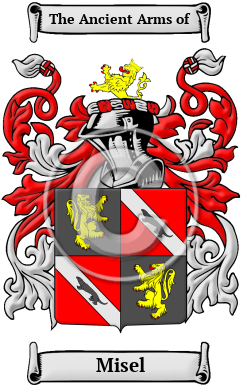
The German surname Misel, and its variants are of occupational origin, belonging to the category of surnames derived from the trade or profession pursued by the initial bearer. In this case, the name is derived from the Middle High German word "meizel" meaning "chisel", a derivative of the verb "meizen" meaning "to chop or cut". Thus the name indicates "one who used a chisel in his daily word, a wood or stone cutter". Alternatively, the name also denotes "one who made and sold chisels".
Loading...
Early Origins of the Misel family
The surname Misel was first found in Austria, where the family was anciently associated with the political and religious conflicts of the area. They declared allegiances to many nobles and princes of early history, lending their influence in struggles for power and status within the region.
The Meisel family (also spelt Meisels and Meizels) is a distinguished Bohemian rabbinic family originally from Prague, who descend from Yitskhak Eizik Meisels (b. 1425), a paternal 10th generation descendant of the Exilarch, Mar Ukba.
Early History of the Misel family
This web page shows only a small excerpt of our Misel research. Another 178 words (13 lines of text) covering the years 1775, 1807 and 1853 are included under the topic Early Misel History in all our PDF Extended History products and printed products wherever possible.
Misel Spelling Variations
Spelling variations of this family name include: Meisel, Misel, Meissel, Meissl, Meisl, Misl, Maisel, Meysel, Maysel, Maysl, Meysl, Meyssel and many more.
Early Notables of the Misel family
Ernst Adolph von Meissel, who served as Lord Chamberlain to the Queen of Sweden. Karl Meisl (1775-1853) was a Viennese playwrite with a talent for parody, who is reputed to have written... Another 32 words (2 lines of text) are included under the topic Early Misel Notables in all our PDF Extended History products and printed products wherever possible.
Loading...
Loading...
Loading...
Loading...
Misel migration to the United States
+
Misel Settlers in United States in the 19th Century