| ![Show Contents]() McEnroe History, Family Crest & Coats of Arms McEnroe History, Family Crest & Coats of Arms
- Origins Available:
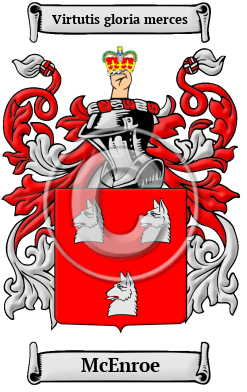
Ireland
Scotland
Etymology of McEnroeWhat does the name McEnroe mean? The Dalriadan clans of ancient Scotland spawned the ancestors of the McEnroe family. Their name comes from the personal name Robert. Known as the Clan Donnachaidh, (MacDhonnchaidh) 'son of Duncan' the family's origins are very distinguished, as the senior branch of the line were the hereditary abbots of Dunkeld, who traced their descent from Iona. In addition, Abbot Duncan of Dunkeld, the Robertson progenitor, was killed in battle in 964, as he led the warriors, bearing, a reliquary of St. Columba. His grandson, Abbot Crinan of Dunkeld, married the Kings daughter and then fathered King Duncan I of Scotland who was killed by MacBeth (of Shakespearean fame). Crinan is buried at the Isle of lona, burial place of Scotland's early Kings. 1 McEnroe Coat of Arms CreationThe wolf, long a terror in many parts of Scotland, appears in several crests and shields. Wolves were evidently a pest in Perthshire, and it is said that one Donald Macdonald got the lands of Struan or Strowan in Perthshire for killing wolves, and three wolf heads appear in his shield. The crest is a hand holding an imperial crown, and the motto is " Virtutis gloria merces " (Glory is the reward of valour). Robert, one of the heads of the family, apprehended one of the murderers of King James I., and for this the family of Struan has since borne a wild man chained under the escutcheon of their arms. In the Highlands the Robertsons are known as the Clan Donnachai, pronounced Donachie, and it is sometimes asserted that the clan is not derived from the Macdonalds, but from Duncan, eldest son of Malcolm III., and it was from some Robert in the reign of James II. that they got the name Robertson. 2 Early Origins of the McEnroe familyThe surname McEnroe was first found in Atholl. King Duncan's younger son, Maelmore, sired Madadh, Earl of Atholl, and his grandson, Earl Henry, was father to Conan who held vast territories in this area. Conan of Glenerochie was the first Chief of the Robertsons and gave his name to the Clan Connchaidh or Duncan. His successor, Duncan, the 5th Chief, led the Clan in the army of King Bruce at Bannockburn in 1314 against the English. For this service, and his subsequent staunch support of the Scottish Crown, his grandson Robert of Struan was granted the lands and barony in 1451. Early History of the McEnroe familyThis web page shows only a small excerpt of our McEnroe research. Another 403 words (29 lines of text) covering the years 1520, 1561, 1587, 1645, 1653, 1668, 1680, 1686, 1689, 1703, 1705, 1715, 1723, 1727, 1745, 1746, 1749, 1783, 1784 and 1890 are included under the topic Early McEnroe History in all our PDF Extended History products and printed products wherever possible. McEnroe Spelling VariationsThe medieval practice of spelling according to sound and repeated translation between Gaelic and English created many spelling variations of the same name. McEnroe has been recorded as Robertson, MacConachie, Maconachie, MacConaghy, MacConchie, MacConckey, MacConkey, MacDonnachie, MacDonachie, MacDunnachie, MacInroy, MacLagan, Mac Raibeirt (Gaelic) and many more. Early Notables of the McEnroe familyThomas Robertson (fl. 1520-1561), schoolmaster and dean of Durham, was born at or near Wakefield in Yorkshire early in the sixteenth century.
William Robertson (d. 1686?), Scottish lexicographer, was a graduate of Edinburgh, and is probably the William Robertson who was laureated by Duncan Forester in April 1645. From 1653 to 1680 he lived in the city of London and...
Another 60 words (4 lines of text) are included under the topic Early McEnroe Notables in all our PDF Extended History products and printed products wherever possible. Migration of the McEnroe family to IrelandSome of the McEnroe family moved to Ireland, but this topic is not covered in this excerpt.
Another 107 words (8 lines of text) about their life in Ireland is included in all our PDF Extended History products and printed products wherever possible.
| McEnroe migration to the United States | + |
Descendents of Dalriadan-Scottish families still populate many communities across North America. They are particularly common in Canada, since many went north as United Empire Loyalists at the time of the American War of Independence. Much later, in the late 19th and early 20th centuries, the highland games and Clan societies that now dot North America sprang up, allowing many Scots to recover their lost national heritage. Some of the first immigrants to cross the Atlantic and come to North America bore the name McEnroe, or a variant listed above:
McEnroe Settlers in United States in the 19th Century- Ann McEnroe, who settled in New York in 1860
- Madge McEnroe, who settled in New York, NY in 1863
- Andrew McEnroe, who settled in Philadelphia in 1876
McEnroe Settlers in United States in the 20th Century- Bridget McEnroe, who settled in New York in 1903
- Mary McEnroe, who settled in New York in 1927
- Maggie McEnroe, who arrived in Nebraska in 1941
| McEnroe migration to Canada | + |
McEnroe Settlers in Canada in the 19th Century- Jane McEnroe, who arrived in Quebec in 1847
- Mrs. Jane McEnroe, aged 40 who immigrated to Canada, arriving at the Grosse Isle Quarantine Station in Quebec aboard the ship "Clarendon" departing from the port of Liverpool, England but died on Grosse Isle in July 1847 3
| McEnroe migration to Australia | + |
McEnroe Settlers in Australia in the 19th Century- Patrick McEnroe, aged 22, who arrived in South Australia in 1859 aboard the ship "Lady Ann"
| Contemporary Notables of the name McEnroe (post 1700) | + |
- Colin McEnroe, American columnist and radio personality, host of The Colin McEnroe Show
- John Patrick McEnroe Jr. (b. 1959), former World No. 1 professional tennis player from the United States
- Patrick H. McEnroe, Union Army soldier during the American Civil War, recipient of the Medal of Honor for gallantry during the Third Battle of Winchester, Virginia on September 19, 1864
| Historic Events for the McEnroe family | + |
- Mr. Edward McEnroe (d. 1914), British Trimmer from United Kingdom who worked aboard the Empress of Ireland and died in the sinking 4
The motto was originally a war cry or slogan. Mottoes first began to be shown with arms in the 14th and 15th centuries, but were not in general use until the 17th century. Thus the oldest coats of arms generally do not include a motto. Mottoes seldom form part of the grant of arms: Under most heraldic authorities, a motto is an optional component of the coat of arms, and can be added to or changed at will; many families have chosen not to display a motto.
Motto: Virtutis gloria merces
Motto Translation: Glory is the reward of valour.
- Black, George F., The Surnames of Scotland Their Origin, Meaning and History. New York: New York Public Library, 1946. Print. (ISBN 0-87104-172-3)
- Polson, Alexander, The Romance of Scottish Crests and Mottoes. Inverness: Walter Alexander, Inglis Street 1929. Print
- Charbonneau, André, and Doris Drolet-Dubé. A Register of Deceased Persons at Sea and on Grosse Île in 1847. The Minister of Canadian Heritage, 1997. ISBN: 0-660-198/1-1997E (p. 44)
- Commemoration Empress of Ireland 2014. (Retrieved 2014, June 17) . Retrieved from http://www.empress2014.ca/seclangen/listepsc1.html
 |