| ![Show Contents]() Ley History, Family Crest & Coats of Arms Ley History, Family Crest & Coats of Arms
Etymology of LeyWhat does the name Ley mean? The name Ley was brought to England in the wave of migration that followed the Norman Conquest of 1066. The Ley family lived in any of the various places named Leigh in England. There are at least 16 counties that contain a place named Leigh. The place-name was originally derived from the Old English word leah, which means wood clearing. 1 The English Ley family is descended from the Norman Ley family. The family name Ley became popular in England after the Norman Conquest, when William the Conqueror gave his friends and relatives most of the land formerly owned by Anglo-Saxon aristocrats. The Normans frequently adopted the names of their recently acquired estates in England. Early Origins of the Ley familyThe surname Ley was first found in Cheshire, at High Leigh, where the name is from "an eminent family, who for centuries in that county nearly all the gentry families of that name claim descent." 2 Of note are the following ancient families: Legh of East Hall, in High Legh, county Chester, descended from Efward de Lega, who lived at or near the period of the Conquest and who appears to have a Saxon origin; Leigh of West Hall, in High Leigh, originally De Lynne who married a Legh heiress in the 13th century; and Leigh of Adlestrop (Baron Leigh) county Gloucester, descended from Agens, daughter and heiress of Richard de Legh. 3 "The Lees of Lee, and Darnhall, co. Chester, now represented by the Townshends of Hem and Trevallyn, and the Lees of Quarendon, Bucks, of whom was the gallant Sir Henry Lee, K.G. and the Lees of Ditchley, Earls of Lichfield, whose descendant Viscount Dillon now possesses the Ditchley estate, spring from the De Lee of Battle Abbey." 4 Leigh is a fairly common place name that dates back to pre-Conquest times as Leigh, Herefordshire and Worcestershire were both listed as Beornothesleah in 972. 1 There are over nineteen villages that are either named Leigh or include Leigh in their name throughout Britain. The parish of Hughley in Shropshire derives "its name from Hugh de Lea, proprietor of the manor in the twelfth century, and ancestor of the Leas of Langley and Lea Hall." 5 "The township [of Poulton with Fearnhead, Lancashire] has been the property of the Legh family, of Lyme, since their union with the Haydocks. Bruch, or Birch, the old manor-house, existing in the 12th of Charles I., was given by Sir Peter Legh to his fourth son Peter, whose grand-daughter married the grandson of Dr. Thomas Legh, the third son of Sir Peter." 5 Down in Devon, "a Totnes man, Sir Edmund Lye, ranks among the boldest seamen of Elizabethan days, and as one of the heroes who bore his part in the defeat of the Invincible Armada. Totnes contributed largely towards the fitting out of the Crescent and the Hart, two vessels sent from Dartmouth to join the Anti-Armada fleet. " 6 Early History of the Ley familyThis web page shows only a small excerpt of our Ley research. Another 252 words (18 lines of text) covering the years 1548, 1563, 1583, 1589, 1600, 1614, 1634, 1639, 1640, 1642, 1651, 1653, 1656, 1659, 1660, 1662, 1663, 1667, 1678, 1681, 1687, 1692, 1694, 1701, 1702, 1705, 1711, 1713, 1716, 1717, 1721, 1722, 1743, 1760, 1767, 1797 and 1890 are included under the topic Early Ley History in all our PDF Extended History products and printed products wherever possible. Ley Spelling VariationsSpelling variations in names were a common occurrence in the eras before English spelling was standardized a few hundred years ago. In the Middle Ages, even the literate regularly changed the spellings of their names as the English language incorporated elements of French, Latin, and other European languages. Many variations of the name Ley have been found, including Leigh, Lee, Lea, Legh, Leghe, Ligh, Lighe, Leyie, Ley and many more. Early Notables of the Ley family- John Ley (1583-1662), an English clergyman and member of the Westminster Assembly
- Sir Edward Henry Lee, 5th Baronet, of Ditchley and of Quarendon, created 1st Earl of Lichfield (1663-1716), an English peer
Ley RankingIn the United States, the name Ley is the 7,081st most popular surname with an estimated 4,974 people with that name. 7 However, in France, the name Ley is ranked the 6,238th most popular surname with an estimated 1,000 - 1,500 people with that name. 8 Migration of the Ley family to IrelandSome of the Ley family moved to Ireland, but this topic is not covered in this excerpt.
Another 77 words (6 lines of text) about their life in Ireland is included in all our PDF Extended History products and printed products wherever possible.
| Ley migration to the United States | + |
For many English families, the social climate in England was oppressive and lacked opportunity for change. For such families, the shores of Ireland, Australia, and the New World beckoned. They left their homeland at great expense in ships that were overcrowded and full of disease. Many arrived after the long voyage sick, starving, and without a penny. But even those were greeted with greater opportunity than they could have experienced back home. Numerous English settlers who arrived in the United States and Canada at this time went on to make important contributions to the developing cultures of those countries. Many of those families went on to make significant contributions to the rapidly developing colonies in which they settled. Early North American records indicate many people bearing the name Ley were among those contributors:
Ley Settlers in United States in the 17th Century- John Ley, who arrived in Virginia in 1635 10
- Rachell Ley, who arrived in America in 1654-1679 10
- Edward Ley, who landed in Maryland in 1664 10
- William Ley, who landed in New Jersey in 1677 10
- Hump Ley, who landed in Virginia in 1698 10
- ... (More are available in all our PDF Extended History products and printed products wherever possible.)
Ley Settlers in United States in the 18th Century- Hans Jurigh Ley, aged 28, who arrived in Pennsylvania in 1733 10
- Anna Maria Ley, aged 24, who arrived in Pennsylvania in 1733 10
- Johannes Ley, who landed in Pennsylvania in 1740 10
- Hans Yerrick Ley, aged 21, who landed in Pennsylvania in 1753 10
- Felix Ley, who arrived in Pennsylvania in 1764 10
- ... (More are available in all our PDF Extended History products and printed products wherever possible.)
Ley Settlers in United States in the 19th Century- Matthias Ley, aged 47, who landed in Brazil in 1846 10
- Karl Ley, who arrived in America in 1846 10
- Rogina VanDer Ley, who arrived in Iowa in 1849 10
- Hannis VanDer Ley, who arrived in Iowa in 1849 10
- Johannes VanDer Ley, who arrived in Iowa in 1849 10
- ... (More are available in all our PDF Extended History products and printed products wherever possible.)
Ley Settlers in Canada in the 18th Century- Joseph Ley, who landed in Nova Scotia in 1749-1752
- Michael Ley, who arrived in Nova Scotia in 1749-1752
Ley Settlers in Canada in the 19th Century- Mr. Godfred Ley who was emigrating through Grosse Isle Quarantine Station, Quebec aboard the ship "General Hewitt" departing 22nd July 1847 from Bremen, Germany; the ship arrived on 12th September 1847 but he died on board 11
| Ley migration to Australia | + |
Emigration to Australia included the Second Fleet of convicts, tradespeople and early settlers. Early immigrants include: Second Fleet - Mr. John Ley, British settler convicted in Devon, England in 1789, sentenced to 7 years for stealinjg, transported aboard the ship "Atlantic" leaving in 1790 arriving in New South Wales, Australia in 1791 9
Following the Second Fleet, other convicts and early settlers arriving in Australia include: Ley Settlers in Australia in the 19th Century- Mr. John Ley, (b. 1803), aged 15 born in Cornwall, UK convicted in Cornwall on 14th July 1818, sentenced for 7 years for stealing iron gads, transported aboard the ship "Coromandel" in 1819 to Van Diemen's Land, Tasmania, Australia 12
- Mr. John Ley(b. 1803), aged 15, Cornish settler convicted in Cornwall, UK on 14th July 1818, sentenced for 7 years for stealing a number of iron gads from Thomas Menheer and William Hancock, transported aboard the ship "Coromandel" on 27th October 1819 to Van Diemen's Land, Tasmania, Australia 13
- Mr. John Ley, Cornish convict who was convicted in Cornwall, England for 7 years, transported aboard the "Coromandel" on 27th October 1819, arriving in Tasmania (Van Diemen's Land) 14
- Mr. William Ley, (b. 1798), aged 30, English convict who was convicted in York, Yorkshire, England for 7 years, transported aboard the "Eliza" on 25th June 1828, arriving in New South Wales, Australia, he died in 1873 15
- Robert Kent Ley, who arrived in Adelaide, Australia aboard the ship "Moffatt" in 1839 16
- ... (More are available in all our PDF Extended History products and printed products wherever possible.)
| Contemporary Notables of the name Ley (post 1700) | + |
- Douglas A. Ley (d. 2021), American educator and politician who served in the New Hampshire House of Representatives from Cheshire District 9 from 2013 to 2021
- Bob Ley (b. 1955), American sportscaster for ESPN
- Willy Ley (1906-1969), German-American science writer and space advocate
- Sir Francis Ley (1846-1916), 1st Baronet, English businessman and politician who founded Ley's Malleable Castings Vulcan Ironworks in Derby and owned Ley's Baseball Ground from 1890 to 1924, High Sheriff of Nottinghamshire (1905)
- Henry George Ley MA DMus FRCO FRCM (1887-1962), English organist, composer and music teacher
- Mr. Alastair Belvins Ley M.B.E., British Lieutenant Commander for the Royal Navy, recipient of Member of the Order of the British Empire on 8th June 2018 17
- Kem Ley (1970-2016), Cambodian political commentator and activist
- David Ley, Welsh professor at the University of British Columbia
- Sussan Penelope Ley (b. 1961), Australian politician
- ... (Another 1 notables are available in all our PDF Extended History products and printed products wherever possible.)
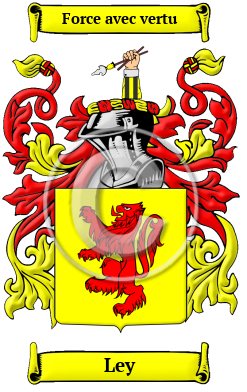
The motto was originally a war cry or slogan. Mottoes first began to be shown with arms in the 14th and 15th centuries, but were not in general use until the 17th century. Thus the oldest coats of arms generally do not include a motto. Mottoes seldom form part of the grant of arms: Under most heraldic authorities, a motto is an optional component of the coat of arms, and can be added to or changed at will; many families have chosen not to display a motto.
Motto: Force avec vertu
Motto Translation: Strength with virtue.
- Mills, A.D., Dictionary of English Place-Names. Oxford: Oxford University Press, 1991. Print. (ISBN 0-19-869156-4)
- Lower, Mark Anthony, Patronymica Britannica, A Dictionary of Family Names of the United Kingdom. London: John Russel Smith, 1860. Print.
- Shirley, Evelyn Philip, The Noble and Gentle Men of England; The Arms and Descents. Westminster: John Bower Nichols and Sons, 1866, Print.
- Burke, John Bernard, The Roll of Battle Abbey. London: Edward Churton, 26, Holles Street, 1848, Print.
- Lewis, Samuel, A Topographical Dictionary of England. Institute of Historical Research, 1848, Print.
- Worth, R.N., A History of Devonshire London: Elliot Stock, 62, Paternoster Row, E.G., 1895. Digital
- "What are the 5,000 Most Common Last Names in the U.S.?". NameCensus.com, https://namecensus.com/last-names/
- http://www.journaldesfemmes.com/nom-de-famille/nom/
- Convict Records of Australia. Retrieved 4th February 2021 from https://convictrecords.com.au/ships
- Filby, P. William, Meyer, Mary K., Passenger and immigration lists index : a guide to published arrival records of about 500,000 passengers who came to the United States and Canada in the seventeenth, eighteenth, and nineteenth centuries. 1982-1985 Cumulated Supplements in Four Volumes Detroit, Mich. : Gale Research Co., 1985, Print (ISBN 0-8103-1795-8)
- Charbonneau, André, and Doris Drolet-Dubé. A Register of Deceased Persons at Sea and on Grosse Île in 1847. The Minister of Canadian Heritage, 1997. ISBN: 0-660-198/1-1997E (p. 84)
- Cornwall Online Parish Clerks. (Retrieved 30th May 2018). Retrieved from http://www.opc-cornwall.org/Resc/pdfs/tasmanian_convicts_cornish.pdf
- Cornwall Online Parish Clerks. (Retrieved 30th May 2018). Retrieved from http://www.opc-cornwall.org/Resc/pdfs/emigration_australia_convicts.pdf
- Convict Records Voyages to Australia (Retrieved 12th March 2021). Retrieved from https://convictrecords.com.au/ships/coromandel
- Convict Records Voyages to Australia (Retrieved 17th February 2022). Retrieved from https://convictrecords.com.au/ships/eliza
- State Records of South Australia. (Retrieved 2010, November 5) MOFFATT 1839. Retrieved from http://www.slsa.sa.gov.au/BSA/1839Moffatt.htm
- "Birthday and New Year Honours Lists (1940 to 2019)." Issue 62507, 28 December 2018 | London Gazette, The Gazette, Dec. 2018, www.thegazette.co.uk/honours-lists
 |