| ![Show Contents]() Leicester History, Family Crest & Coats of Arms Leicester History, Family Crest & Coats of Arms
Etymology of LeicesterWhat does the name Leicester mean? The lineage of the name Leicester begins with the Anglo-Saxon tribes in Britain. It is a result of when they lived in Leicester, in Leicestershire. Leicester is the capital of the county and its name is derived from the Old English element ceaster, which meant "Roman town." 1 Early Origins of the Leicester familyThe surname Leicester was first found in Cheshire at Leycester, more commonly known as Leicester, a city now in the unitary authority area in the East Midlands. The first record of the place name was found in the early 10th century as "Ligera ceater" but by the Domesday Book of 1086 the place name had evolved to Ledecestre. 2 Literally the place name means "Roman town of the people called Ligore," having derived from the Tribal name + the Old English word "ceater." 1 As far as the surname is concerned, the family are "descended from Sir Nicholas Leycester, who acquired the manor of Nether-Tabley in marriage, and died in 1295." 3 But another source notes that Hugo de Legrecestra was listed in the Pipe Rolls of Leicestershire in 1130, followed by Nicholas de Leycester who was listed in the Assize Rolls for Cheshire in 1287. 4 And another source notes that the Hundredorum Rolls of 1273 list what is probably the first instance of the name as Robert de Lestre. 5 Yorkshire was home to an early branch of the family: Richard de Laycestre in 1305; Henry Lycester in the Yorkshire Poll Tax Rolls in 1381; William Leycetter in 1480; and Henry Lasisture in 1503. 4 Early History of the Leicester familyThis web page shows only a small excerpt of our Leicester research. Another 133 words (10 lines of text) covering the years 1586, 1588, 1604, 1605, 1614, 1620, 1642, 1643, 1647, 1674, 1678, 1684, 1705, 1706, 1715, 1727, 1732, 1742, 1762, 1770 and 1827 are included under the topic Early Leicester History in all our PDF Extended History products and printed products wherever possible. Leicester Spelling VariationsOnly recently has spelling become standardized in the English language. As the English language evolved in the Middle Ages, the spelling of names changed also. The name Leicester has undergone many spelling variations, including Leycester, Leicester, Leister, Lester and others. Early Notables of the Leicester family- Sir Peter Leycester (Leicester), 1st Baronet (1614-1678), an English antiquarian and historian, supporter of the Royalist side in the Civil War. He was born at Nether Tabley, near Knutsford, Cheshire...
- He was succeeded in the baronetage by his eldest son, Sir Robert Leicester (1643-1684.) Sir Francis Leicester, 3rd Baronet (1674-1742) of Tabley, Cheshire was a British landowner and politician who sa...
- John Leicester, 1st Baron de Tabley (4 April 1762-June 1827) was an English landowner, politician, amateur artist, and patron of the arts. Born at Tabley House in Cheshire, 4 April 1762, he was the el...
Migration of the Leicester family to IrelandSome of the Leicester family moved to Ireland, but this topic is not covered in this excerpt.
Another 31 words (2 lines of text) about their life in Ireland is included in all our PDF Extended History products and printed products wherever possible.
| Leicester migration to the United States | + |
To escape the unstable social climate in England of this time, many families boarded ships for the New World with the hope of finding land, opportunity, and greater religious and political freedom. Although the voyages were expensive, crowded, and difficult, those families that arrived often found greater opportunities and freedoms than they could have experienced at home. Many of those families went on to make significant contributions to the rapidly developing colonies in which they settled. Early North American records indicate many people bearing the name Leicester were among those contributors:
Leicester Settlers in United States in the 17th Century- Peter Leicester, who landed in Pennsylvania in 1682 7
Leicester Settlers in United States in the 18th Century- John Leicester, who settled in Virginia in 1732
| Leicester migration to Australia | + |
Emigration to Australia included the First Fleet of convicts, tradespeople and early settlers. Early immigrants include: First Fleet - Miss Elizabeth Leicester, (b. 1754), aged 34, British settler convicted in Middlesex, England in 1788, sentenced to 7 years for theft, transported aboard the ship "Lady Juliana" leaving in 1789 arriving in New South Wales, Australia in 1790 6
Following the First Fleet, other convicts and early settlers arriving in Australia include: Leicester Settlers in Australia in the 19th Century- Mr. Edward Leicester, English convict who was convicted in Lancaster, Lancashire, England for 14 years, transported aboard the "Claudine" on 20th May 1821, arriving in Tasmania (Van Diemen's Land) 8
- Mary Leicester, who arrived in Adelaide, Australia aboard the ship "Duke Of Bronte" in 1849 9
| Contemporary Notables of the name Leicester (post 1700) | + |
- Billee Leicester (1887-1956), American actress, known for Lummox (1930)
- David E. Leicester (b. 1950), American artist, best known for Jason Goes to Hell: The Final Friday (1993), Velocity Trap (1999) and Liquid Dreams (1991)
- William F. Leicester (1915-1969), American writer and actor from Chicago, Illinois, known for The Last Man on Earth (1964), Tales of Wells Fargo (1957) and The High Chaparral (1967)
- Ann Leicester (1912-1996), American film actress, best known for her role in The Towering Inferno (1974)
- Robert T. Leicester, American politician, Representative from New York 17th District, 1950
- Margot Leicester (b. 1949), English actress, best known for her role in 1408 (2007)
- James Leicester (1905-1989), American editor, known for Mildred Pierce (1945) and Enchanted Island (1958)
- Darren Leicester Cheeseman (b. 1976), Australian politician, Labor Party member of the Victorian Legislative Assembly since November 2018, representing the seat of South Barwon
- Edward Leicester Atkinson DSO AM RN (1881-1929), Royal naval surgeon and Antarctic explorer, eponym of Atkinson Cliffs, Antarctica
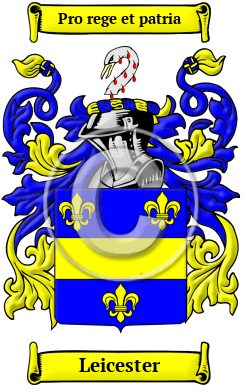
The motto was originally a war cry or slogan. Mottoes first began to be shown with arms in the 14th and 15th centuries, but were not in general use until the 17th century. Thus the oldest coats of arms generally do not include a motto. Mottoes seldom form part of the grant of arms: Under most heraldic authorities, a motto is an optional component of the coat of arms, and can be added to or changed at will; many families have chosen not to display a motto.
Motto: Pro rege et patria
Motto Translation: For King and country.
- Mills, A.D., Dictionary of English Place-Names. Oxford: Oxford University Press, 1991. Print. (ISBN 0-19-869156-4)
- Williams, Dr Ann. And G.H. Martin, Eds., Domesday Book A Complete Translation. London: Penguin, 1992. Print. (ISBN 0-141-00523-8)
- Shirley, Evelyn Philip, The Noble and Gentle Men of England; The Arms and Descents. Westminster: John Bower Nichols and Sons, 1866, Print.
- Reaney, P.H and R.M. Wilson, A Dictionary of English Surnames. London: Routledge, 1991. Print. (ISBN 0-415-05737-X)
- Harrison, Henry, Surnames of the United Kingdom: A Concise Etymological Dictionary Baltimore: Geneological Publishing Company, 2013. Print
- Convict Records of Australia. Retrieved 4th February 2021 from https://convictrecords.com.au/ships
- Filby, P. William, Meyer, Mary K., Passenger and immigration lists index : a guide to published arrival records of about 500,000 passengers who came to the United States and Canada in the seventeenth, eighteenth, and nineteenth centuries. 1982-1985 Cumulated Supplements in Four Volumes Detroit, Mich. : Gale Research Co., 1985, Print (ISBN 0-8103-1795-8)
- Convict Records Voyages to Australia (Retrieved 17th February 2021). Retrieved from https://convictrecords.com.au/ships/claudine
- State Records of South Australia. (Retrieved 2010, November 5) The DUKE OF BRONTE 1849. Retrieved from http://www.slsa.sa.gov.au/BSA/1849DukeOfBronte.htm
 |