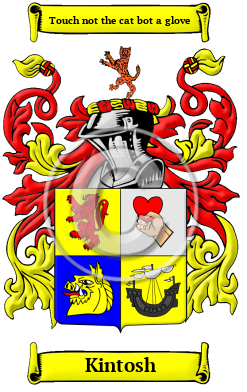
| ![Show Contents]() Kintosh History, Family Crest & Coats of Arms Kintosh History, Family Crest & Coats of Arms
- Origins Available:
Scotland
Ireland
Etymology of KintoshWhat does the name Kintosh mean? The Kintosh surname comes from the Anglicized form of the Gaelic name, Mac an Toisich. Kintosh is a patronymic surname, which belongs to the category of hereditary surnames. Many patronymic surnames were formed by adopting the given name of an ancestor of the bearer, while others came from popular religious names, and from the names of secular heroes. The surname Kintosh comes from the Gaelic name Mac an Toisich, which means "son of the chief, leader, or thane." Members of this distinguished Pictish family were originally found in Moray. Kintosh Coat of Arms CreationThere exists a declaration from the Lord Lyon in the year 1672 in favour of the Laird of Macintosh, which says that he is the only undoubted Chief of the name of Macintosh and of the Clan Chattan, which comprehended Macpherson, Macgillivray, Farquharson, Macqueen, Macphail, Macbean, and others. This ended the claims of the chief of the Macphersons to be chief of the Clan Chattan. In common with the Macphersons and the Sutherlands, they have a cat as their crest. Like the Macphersons, their motto is " Touch not the cat bot (without) a glove," and they have in their arms a right hand holding a dagger as a badge of their faithfulness to King Robert the Bruce in killing his enemy, the Cumming. They claim to be descended from Macduff, a Thane of Fife, and for this reason they have the red lion of Scotland in their shield. The boar's head in their shield shows that Lachlan Macintosh married Jean Gordon of Lochinvar, and there is a lymphad in memory of ancestors being driven to the coast of Caithness (Cattu), or as Nisbet has it, for marry-ing the heiress of the Clan Chattan. 1 Early Origins of the Kintosh familyThe surname Kintosh was first found in Moray (part of the modern region of Grampian). The Kintosh family is said to descend from Seach MacDuff, who was awarded the lands of Petty and Breachley in Inverness-shire and was appointed Constable of Inverness Castle for his support of King Malcolm IV in the suppression of a rebellion in Morayshire in 1160. A son of Seach then assumed the name "Mac-an-Toisch," and thus began the Clan MacIntosh. Early History of the Kintosh familyThis web page shows only a small excerpt of our Kintosh research. Another 424 words (30 lines of text) covering the years 1263, 1314, 1336, 1396, 1411, 1594, 1704, 1715, 1745, 1746, 1833, 1890 and 1957 are included under the topic Early Kintosh History in all our PDF Extended History products and printed products wherever possible. Kintosh Spelling VariationsAlthough Medieval Scotland lacked a basic set of spelling rules, which meant that scribes recorded names according to their sounds it was not uncommon for the names of a father and son to be recorded differently. As a result, there are many spelling variations of Scottish single names. Kintosh has been written Kyntosh, Intosh, Intoch, Toshe, Tosh, McKyntosh, McKintosh, McKintoisch, McKintoch, McIntosh, McComtosh, McKintowse, McIntosh, MacKyntosh, MacIntoch, MacIntosh, McIntoch, Mackintowse, MacKintosh and many more. Early Notables of the Kintosh family- William, 7th Chief of Mackintosh, who first acquired Moy, in 1336
Migration of the Kintosh family to IrelandSome of the Kintosh family moved to Ireland, but this topic is not covered in this excerpt.
Another 47 words (3 lines of text) about their life in Ireland is included in all our PDF Extended History products and printed products wherever possible. Migration of the Kintosh familyThousands of Scots left their home country to travel to Ireland or Australia, or to cross the Atlantic for the North American colonies. The difficult crossing was an enormous hurdle, but those who survived found freedom and opportunity in ample measure. Some Scots even fought for their freedom in the American War of Independence. This century, their ancestors have become aware of the illustrious history of the Scots in North America and at home through Clan societies and other organizations. Passenger and immigration lists show many early and influential immigrants bearing the name Kintosh: Enoch Macintosh, who came to Virginia in 1668; Henry Mackintosh, who arrived in Boston in 1702; Adam Macintosh, who settled in Georgia in 1736; John Mackintosh, who came to Georgia in 1736.
| Kintosh Motto and War Cry | + |
The motto was originally a war cry or slogan. Mottoes first began to be shown with arms in the 14th and 15th centuries, but were not in general use until the 17th century. Thus the oldest coats of arms generally do not include a motto. Mottoes seldom form part of the grant of arms: Under most heraldic authorities, a motto is an optional component of the coat of arms, and can be added to or changed at will; many families have chosen not to display a motto.
Motto: Touch not the cat bot a glove
Motto Translation: Don't touch the cat without a glove.
War Cry: "Loch Moy."
- Polson, Alexander, The Romance of Scottish Crests and Mottoes. Inverness: Walter Alexander, Inglis Street 1929. Print
 |