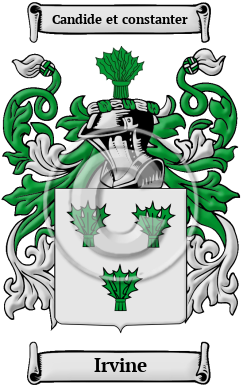
| ![Show Contents]() Irvine History, Family Crest & Coats of Arms Irvine History, Family Crest & Coats of Arms
In ancient Scotland, Irvine was a Strathclyde-Briton name for someone who lived in the parish of Irving in the county of Dumfriesshire or from Irvine in Strathclyde. There are a variety of possible origins of the name and we will explore some of them here. One source claims the name was a "descendant of Erewine (sea friend); or one who came from Irvine (green river), in Ayrshire. " 1 Another source postulates the name was from "Mac Heremon, 'Here-mon's Son.' Heremon was the seventh in descent from Milesius, and became monarch of all Ireland. 2 And another believes that Irwin was "the Irish form of Irvine. The singular Christian name Crinus, which prevails in the family of I. of Tanragoe, co. Sligo, is traditionally derived from Krynin Abethnas, the second husband of the mother of Duncan, King of Scotland." 3 Early Origins of the Irvine familyThe surname Irvine was first found in Ayrshire, at Irvine, a parish, in the district of Cunninghame, about 26 miles (W. S. W.) from Glasgow. "[Irvine] derives its name from the river on which it is situated, and appears to have attained a high degree of importance at a very early period. The inhabitants obtained from Alexander II. a charter conferring upon the town all the privileges of a royal burgh; and a charter confirming all previous grants was subsequently given to them by Robert Bruce, in recompense of their services during his wars with England in the reign of Edward I." 4 Alternatively, the name was "from Irving, the name of an old parish in Dumfriesshire, There are many Irvings (or Irvines as most of the Dumfriesshire families spell the name) here." 5 According to voice of tradition, the family descend from Duncan "the first of Eryvine," killed at the battle of Duncrub in 965. Other records show the earliest listed was William de Irwin, an armor bearer to King Robert the Bruce. He received a grant of lands encompassing the Forest of Drum, on the banks of the River Irvine. And it was here that he had Drum Castle built which would become the family seat of the Clan for centuries. The river originally was named Lar Avon, or West River. Robert de Hirvine, ancestor of that previous William was mentioned in a Charter dated 1226 and he was at that time tenant of the Douglas Clan. From 1331-33 the family received further grants of land and by 1400 had become a very predominant family. The Chief of the Irvines lead his Clansmen in the Battle of Harlaw in 1511. Sir Alexander Irvine was slain there, and it was said of him: 'Gude Sir Alexander Irvine, The much renowned Laird of Drum.' 5 "Washington Irving (1783-1859), the American author, was son of William Irving, a native of Shapinsay, Orkney." 5 Early History of the Irvine familyThis web page shows only a small excerpt of our Irvine research. Another 263 words (19 lines of text) covering the years 1057, 1323, 1324, 1331, 1332, 1376, 1411, 1455, 1587, 1602, 1638, 1658, 1685, 1689, 1752, 1759, 1762, 1763, 1769, 1890 and 1976 are included under the topic Early Irvine History in all our PDF Extended History products and printed products wherever possible. Irvine Spelling VariationsIn Medieval times, spelling and translation were not nearly so highly developed as today. They were generally carried out according to the sound and intuition of the bearer. For that reason spelling variations are extremely common among early Scottish names. Irvine has been spelled Irwin, Erwin, Irvine, Irving, Urwin, Erwine, Ervin, Erwing, Ervynn, Ervine, Erwynn, Irwing, Irwryn and many more. Early Notables of the Irvine familyNotable amongst the family at this time was - Adam Irvine, Burgess of Irvine in 1455, doubtless derived his surname from Aberdeenshire
- Sir Alexander Irvine of Drum (d. 1658), the Royalist, "was descended from William de Irvine, who was armour-bearer to Robert Bruce, and was rewarded for his devoted services by a grant of the forest o...
Irvine World RankingIn the United States, the name Irvine is the 3,511st most popular surname with an estimated 7,461 people with that name. 6 However, in Canada, the name Irvine is ranked the 874th most popular surname with an estimated 6,103 people with that name. 7 And in Australia, the name Irvine is the 444th popular surname with an estimated 8,469 people with that name. 8 New Zealand ranks Irvine as 372nd with 1,718 people. 9 The United Kingdom ranks Irvine as 543rd with 11,935 people. 10  Migration of the Irvine family to Ireland Migration of the Irvine family to Ireland
Some of the Irvine family moved to Ireland, but this topic is not covered in this excerpt.
Another 144 words (10 lines of text) about their life in Ireland is included in all our PDF Extended History products and printed products wherever possible.
| Irvine migration to the United States | + |
Unrest, poverty, and persecution caused thousands to look for opportunity and freedom in the North American colonies. The crossing was long, overcrowded, and unsanitary, though, and came only at great expense. Many Strathclyde families settled on the east coast of North America in communities that would form the backbone of what would become the great nations of the United States and Canada. The American War of Independence caused those who remained loyal to England to move north to Canada as United Empire Loyalists. In the 20th century, Strathclyde and other Scottish families across North America began to recover their collective heritage through highland games and Clan societies. Among them:
Irvine Settlers in United States in the 17th Century- James Irvine, who landed in New Jersey in 1685 11
Irvine Settlers in United States in the 19th Century- Francis Irvine, aged 32, who landed in New York in 1800 11
- Alex Irvine, aged 21, who landed in New York, NY in 1804 11
- Charles Irvine, who landed in America in 1805 11
- Gerard Irvine, who landed in America in 1805 11
- Margaret Irvine, aged 23, who arrived in Philadelphia, Pennsylvania in 1805 11
- ... (More are available in all our PDF Extended History products and printed products wherever possible.)
| Irvine migration to Canada | + |
Some of the first settlers of this family name were: Irvine Settlers in Canada in the 19th Century- Samuel Irvine, aged 19, a labourer, who arrived in Saint John, New Brunswick aboard the ship "Madawaska" in 1833
- Michael Irvine, aged 5, who arrived in Saint John, New Brunswick in 1834 aboard the barque "Ceres" from Sligo, Ireland
- Miss. Elizabeth Reid Irvine who immigrated to Canada, arriving at the Grosse Isle Quarantine Station in Quebec but died on Grosse Isle on 9th August 1847 12
- Mr. John Irvine, aged 53 who immigrated to Canada, arriving at the Grosse Isle Quarantine Station in Quebec aboard the ship "John & Robert" departing from the port of Liverpool, England but died on Grosse Isle In August 1847 12
- Mr. John Irvine, aged 43 who immigrated to Canada, arriving at the Grosse Isle Quarantine Station in Quebec aboard the ship "John & Robert" departing from the port of Liverpool, England but died on Grosse Isle on 16th August 1847 12
- ... (More are available in all our PDF Extended History products and printed products wherever possible.)
| Irvine migration to Australia | + |
Emigration to Australia followed the First Fleets of convicts, tradespeople and early settlers. Early immigrants include: Irvine Settlers in Australia in the 19th Century- Miss. Sarah Irvine (Douglas), British Convict who was convicted in Glasgow, Scotland for 7 years, transported aboard the "Asia" on 9th March 1847, arriving in Tasmania (Van Diemen's Land) 13
- James Alexander Irvine, who arrived in Adelaide, Australia aboard the ship "Baboo" in 1848 14
- Elizabeth Irvine, who arrived in Adelaide, Australia aboard the ship "Constance" in 1848 15
- Mr. Joseph Irvine, British convict who was convicted in Liverpool, Merseyside, England for 7 years, transported aboard the "Cornwall" on 28th February 1851, arriving in Tasmania (Van Diemen's Land) 16
- Thomas Irvine, aged 29, a labourer, who arrived in South Australia in 1851 aboard the ship "Marion" 17
- ... (More are available in all our PDF Extended History products and printed products wherever possible.)
| Irvine migration to New Zealand | + |
Emigration to New Zealand followed in the footsteps of the European explorers, such as Captain Cook (1769-70): first came sealers, whalers, missionaries, and traders. By 1838, the British New Zealand Company had begun buying land from the Maori tribes, and selling it to settlers, and, after the Treaty of Waitangi in 1840, many British families set out on the arduous six month journey from Britain to Aotearoa to start a new life. Early immigrants include: Irvine Settlers in New Zealand in the 19th Century- Mr Irvine, who landed in Wellington, New Zealand in 1841 aboard the ship Arab
- Thomas Irvine, aged 32, a shoemaker, who arrived in Wellington, New Zealand aboard the ship "Arab" in 1841
- Eliza Irvine, aged 34, who arrived in Wellington, New Zealand aboard the ship "Arab" in 1841
- Edward Irvine, aged 32, who arrived in Auckland, New Zealand aboard the ship "Duchess of Argyle" in 1842
- Mr. Irvine, British settler travelling from London aboard the ship "Gypsy" arriving in Auckland, New Zealand on 9th October 1846 18
- ... (More are available in all our PDF Extended History products and printed products wherever possible.)
| Contemporary Notables of the name Irvine (post 1700) | + |
- George R. Irvine (1948-2017), American professional basketball player and coach
- James Irvine (1793-1835), American educator and Presbyterian minister, 2nd President of Ohio University from 1822 to 1824
- Alexander Christian "Alex" Irvine (b. 1969), American fantasy and science fiction writer
- Major-General Willard Wadsworth Irvine (1892-1969), American Deputy Assistant Chief of Staff, War Department General Staff (1944-1945) 19
- Edith Irvine (1884-1949), American photographer who documented the 1906 San Francisco earthquake
- Harry Irvine, American politician, Mayor of Cumberland, Maryland, 1939-42 20
- Mrs. H. G. Irvine, American Republican politician, Alternate Delegate to Republican National Convention from Minnesota, 1936 20
- Gordon F. Irvine, American Democratic Party politician, Delegate to Democratic National Convention from California, 1944 20
- Frank Irvine (1858-1931), American Democratic Party politician, District Judge in Nebraska 4th District, 1891-93; Justice of Nebraska State Supreme Court, 1893-99 20
- Frances L. Irvine, American Republican politician, Presidential Elector for Florida, 1992 20
- ... (Another 47 notables are available in all our PDF Extended History products and printed products wherever possible.)
| Historic Events for the Irvine family | + |
- Mr. Robert J Irvine, British Petty Officer Stoker, who sailed into battle on the HMS Repulse (1941) and survived the sinking 21
The motto was originally a war cry or slogan. Mottoes first began to be shown with arms in the 14th and 15th centuries, but were not in general use until the 17th century. Thus the oldest coats of arms generally do not include a motto. Mottoes seldom form part of the grant of arms: Under most heraldic authorities, a motto is an optional component of the coat of arms, and can be added to or changed at will; many families have chosen not to display a motto.
Motto: Candide et constanter
Motto Translation: Fairly and firmly.
- Smith, Eldson Coles, New Dictionary of American Family Names New York: Harper & Row, 1956. Print
- Moore, A.W., Manx Names. London: Elliot Stock, 62 Paternoster Row, 1906. Print
- Lower, Mark Anthony, Patronymica Britannica, A Dictionary of Family Names of the United Kingdom. London: John Russel Smith, 1860. Print.
- Lewis, Samuel, A Topographical Dictionary of Scotland. Institute of Historical Research, 1848, Print.
- Black, George F., The Surnames of Scotland Their Origin, Meaning and History. New York: New York Public Library, 1946. Print. (ISBN 0-87104-172-3)
- "What are the 5,000 Most Common Last Names in the U.S.?". NameCensus.com, https://namecensus.com/last-names/
- "Surnames Meanings, Origins & Distribution Maps - Forebears." Forebears, https://forebears.io/surnames
- "Most Common Last Names in Australia." Forebears, https://forebears.io/australia/surnames
- "Most Common Last Names in New Zealand." Forebears, https://forebears.io/new-zealand/surnames
- "UK surname ranking." UK Surname map, https://www.surnamemap.eu/unitedkingdom/surnames_ranking.php?p=10
- Filby, P. William, Meyer, Mary K., Passenger and immigration lists index : a guide to published arrival records of about 500,000 passengers who came to the United States and Canada in the seventeenth, eighteenth, and nineteenth centuries. 1982-1985 Cumulated Supplements in Four Volumes Detroit, Mich. : Gale Research Co., 1985, Print (ISBN 0-8103-1795-8)
- Charbonneau, André, and Doris Drolet-Dubé. A Register of Deceased Persons at Sea and on Grosse Île in 1847. The Minister of Canadian Heritage, 1997. ISBN: 0-660-198/1-1997E (p. 35)
- Convict Records Voyages to Australia (Retrieved 14th February 2020). Retrieved from https://convictrecords.com.au/ships/asia/1847
- State Records of South Australia. (Retrieved 2010, November 5) BABOO 1848. Retrieved from http://www.slsa.sa.gov.au/BSA/1848Baboo.htm
- State Records of South Australia. (Retrieved 2010, November 5) CONSTANCE - 1848. Retrieved from http://www.slsa.sa.gov.au/BSA/1848Constance.htm
- Convict Records Voyages to Australia (Retrieved 11th March 2021). Retrieved from https://convictrecords.com.au/ships/cornwall
- State Records of South Australia. (Retrieved 2010, November 5) MARION 1851 - HER HISTORY. Retrieved http://www.slsa.sa.gov.au/BSA/1851Marion.htm
- New Zealand Yesteryears Passenger Lists 1800 to 1900 (Retrieved 17th October 2018). Retrieved from http://www.yesteryears.co.nz/shipping/passlist.html
- Generals of World War II. (Retrieved 2012, March 30) Willard Irvine. Retrieved from http://generals.dk/general/Irvine/Willard_Wadsworth/USA.html
- The Political Graveyard: Alphabetical Name Index. (Retrieved 2015, October 28) . Retrieved from http://politicalgraveyard.com/alpha/index.html
- HMS Repulse Crew members. (Retrieved 2014, April 9) . Retrieved from http://www.forcez-survivors.org.uk/biographies/listrepulsecrew.html
- Lusitania Passenger List - The Lusitania Resource. (Retrieved 2014, March 6) . Retrieved from http://www.rmslusitania.info/lusitania-passenger-list/
|

 Irvine migration to the United States
  Irvine migration to Canada
  Irvine migration to Australia
  Irvine migration to New Zealand

 Ireland
 Scotland
 England