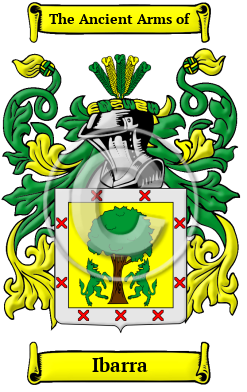
| ![Show Contents]() Ibarra History, Family Crest & Coats of Arms Ibarra History, Family Crest & Coats of Arms
- Origins Available:
 Spain Spain The surname Ibarra is a Basque name, no doubt derived from any of the several place names in the region. The name comes from the word "ibar," which means "meadow." Early Origins of the Ibarra familyThe surname Ibarra was first found in Sopelana (Biscaye) on the coast of Northern Spain, in the Basque region. Early History of the Ibarra familyThis web page shows only a small excerpt of our Ibarra research. Another 75 words (5 lines of text) covering the years 1557, 1589, 1603, 1609, 1628, 1638, 1690, 1772, 1785 and 1918 are included under the topic Early Ibarra History in all our PDF Extended History products and printed products wherever possible. Ibarra Spelling VariationsSpelling variations of this family name include: Ibarra, Ibaretta, Ibarrieta, Ibarrae, Ybarra and others. Early Notables of the Ibarra familyProminent among bearers of the family name at this time was - Pedro de Ibarra, a Spanish soldier, Governor of Florida (1603 to 1609)
- Don Carlos de Ibarra Barreri, an Admiral in the Navy, who was made the Marquis of Taracena on August 17, 1638, Don Juan Antonio de Ibarra y Ubilla of Santiago, who was made Viscount of Santo Domingo d...
Ibarra RankingIn the United States, the name Ibarra is the 1,051st most popular surname with an estimated 27,357 people with that name. 1
 Ibarra migration to the United States Ibarra migration to the United States | + |
Some of the first settlers of this family name were: Ibarra Settlers in United States in the 19th Century- Ramona Ibarra, who arrived in Puerto Rico in 1816 2
- Gab Ibarra, aged 40, who landed in New Orleans, La in 1831 2
- Ignacio Ibarra, aged 51, who arrived in New Orleans, La in 1831 2
- Mariano Ibarra, who landed in Puerto Rico in 1860 2
- Ramon Ibarra, who landed in Puerto Rico in 1875 2
- ... (More are available in all our PDF Extended History products and printed products wherever possible.)
Ibarra Settlers in United States in the 20th Century- Filiberto Ibarra, aged 19, who landed in America from Sevilla, Spain, in 1908
- Francisco Rubio Ibarra, aged 22, who immigrated to America from Merida, Mexico, in 1908
- Castor Ibarra, aged 33, who landed in America from Madrid, Spain, in 1910
- Carmen Ibarra, aged 17, who settled in America, in 1911
- Estebon Ibarra, aged 27, who immigrated to the United States from Biscaya, Spain, in 1914
- ... (More are available in all our PDF Extended History products and printed products wherever possible.)
| Contemporary Notables of the name Ibarra (post 1700) | + |
- Susie Ibarra (b. 1970), American contemporary composer and percussionist
- Mickey Ibarra, American Democratic Party politician, Delegate to Democratic National Convention from Maryland, 1996 3
- Bowie Ibarra, American Libertarian politician, Candidate for Texas state comptroller, 2002 3
- Juan Carlos Rodríguez Ibarra (b. 1948), Spanish politician
- Andrés Mora Ibarra (1955-2015), Mexican Major League Baseball outfielder who played from 1976 to 1980
- Gabriel Rafael Mendoza Ibarra (b. 1968), retired Chilean footballer
- Hugo Benjamín Ibarra (b. 1974), retired Argentine professional football player
- José María Velasco Ibarra (1893-1979), President of Ecuador (1944 to 1947)
- Aníbal Ibarra (b. 1958), Argentine politician
- Abelardo Colome Ibarra (b. 1939), vice president of the State Council of Cuba
- "What are the 5,000 Most Common Last Names in the U.S.?". NameCensus.com, https://namecensus.com/last-names/
- Filby, P. William, Meyer, Mary K., Passenger and immigration lists index : a guide to published arrival records of about 500,000 passengers who came to the United States and Canada in the seventeenth, eighteenth, and nineteenth centuries. 1982-1985 Cumulated Supplements in Four Volumes Detroit, Mich. : Gale Research Co., 1985, Print (ISBN 0-8103-1795-8)
- The Political Graveyard: Alphabetical Name Index. (Retrieved 2015, October 7) . Retrieved from http://politicalgraveyard.com/alpha/index.html
|

 Ibarra migration to the United States