|
![Show Contents]() Huse History, Family Crest & Coats of Arms Huse History, Family Crest & Coats of Arms
The ancestors of the bearers of the Huse surname were Welsh Brythonic-Celts. However, their name came to Britain with the Norman invasion; Huse is derived from the Old French personal name Hughe, also spelled Hue. This name was made popular by the exploits of several saints including: St. Hugh of Lincoln (1140-1200), who was born in Burgundy (French: Bourgogne) and established the first Carthusian monastery in England; as well as St. Hugh of Cluny (1024-1109). Hugh (d. 1094), called of Grantmesnil, or Grentemaisnil, was Baron and Sheriff of Leicestershire, son of Robert of Grantmesnil, in the arrondissement of Lisieux. 1 Hugh (d. 1098), called of Montgomery, Earl of Shrewsbury and Arundel, second son of Roger of Montgomery, held during his father's lifetime the manor of Worfield in Shropshire. 1 Early Origins of the Huse familyThe surname Huse was first found in Carmarthenshire (Welsh: Sir Gaerfyrddin), located in Southwest Wales, one of thirteen historic counties and presently one of the principal area in Wales. Early rolls provide us a glimpse of the spelling variations used at that time. By example, Hugo was listed in the Domesday Book of 1086; Willelmus filius Hugonis was found in Wiltshire in 1084 and Reginaldus le fiz Hugonis was in the Pipe Rolls of Leicestershire from 1195. 2 Early History of the Huse familyThis web page shows only a small excerpt of our Huse research. Another 106 words (8 lines of text) covering the years 1038, 1518, 1545, 1553, 1600, 1603, 1604, 1612, 1613, 1620, 1632, 1645, 1654, 1659, 1662, 1664, 1667, 1670, 1674, 1677, 1685, 1693, 1695, 1704, 1719, 1720, 1731, 1740, 1751, 1776 and 1890 are included under the topic Early Huse History in all our PDF Extended History products and printed products wherever possible. Huse Spelling VariationsThere are relatively few surnames native to Wales, but they have an inordinately large number of spelling variations. Early variations of Welsh surnames can be explained by the fact that very few people in the early Middle Ages were literate. Priests and the few other literate people were responsible for recording names in official documents. And because most people could not specific how to properly record their names it was up to the individual recorder of that time to determine how a spoken name should be recorded. Variations due to the imprecise or improper recording of a name continued later in history when names originally composed in the Brythonic Celtic, language of Wales, known by natives as Cymraeg, were transliterated into English. Welsh names that were documented in English often changed dramatically since the native language of Wales, which was highly inflected, did not copy well. Occasionally, however, spelling variations were carried out according to an individual's specific design: a branch loyalty within the family, a religious adherence, or even patriotic affiliations could be indicated by minor variations. The spelling variations of the name Huse have included Hughes, Hugh, Hews, Hughs, Hues, Huse and others. Early Notables of the Huse familyProminent amongst the family during the late Middle Ages was Owen ap Hugh (1518-1613), of Bodeon, near Llangadwaladr, Anglesey, a Welsh politician, Member of the Parliament for Newborough in 1545; Robert Hues (1553-1632), an English mathematician and geographer; George Hughes (1603-1667), an English Puritan clergyman and writer; Thomas Hughes (1604-1664), a Welsh politician who sat in the House of Commons in 1654...
Another 62 words (4 lines of text) are included under the topic Early Huse Notables in all our PDF Extended History products and printed products wherever possible. Huse RankingIn the United States, the name Huse is the 11,209th most popular surname with an estimated 2,487 people with that name. 3  Migration of the Huse family to Ireland Migration of the Huse family to Ireland
Some of the Huse family moved to Ireland, but this topic is not covered in this excerpt.
Another 84 words (6 lines of text) about their life in Ireland is included in all our PDF Extended History products and printed products wherever possible.
| Huse migration to the United States | + |
North America in the 1800s and 1900s saw the arrival of many Welsh people hoping to share in the wealth of land, work, and freedom that they felt North America held. Those who made the journey often attained those expectations, but only through an enormous amount of hard work, perseverance, and often a bout of good luck. These immigrants helped contribute to the growth of industry, commerce, and culture of both Canada and the United States. Discovered in the immigration and passenger lists were a number of people bearing the name Huse:
Huse Settlers in United States in the 17th Century- Abel Huse, who arrived in Newbury, Massachusetts in 1639 4
- John Huse, who arrived in Virginia in 1648
- Abigail Huse, who landed in Virginia in 1650 4
- Kath Huse, who landed in Virginia in 1652 4
- Tho Huse, who arrived in Virginia in 1664 4
Huse Settlers in United States in the 19th Century- Andreas Huse, who arrived in Texas in 1852 4
- Henry Huse, who landed in St Clair County, Illinois in 1866 4
| Contemporary Notables of the name Huse (post 1700) | + |
- Caleb Huse (1831-1905), American Major in the Confederate States Army, known as an arms procurement agent and purchasing specialist during the American Civil War
- Brad Huse (b. 1966), American college basketball coach and the former head men's basketball coach at Montana State University
- Harry McLaren Pinckney Huse (1858-1942), American Navy vice admiral, recipient of the Medal of Honor for his actions during the U.S. intervention at Veracruz, Mexico, eponym of the USS Huse (DE-145), an Edsall-class destroyer escort
- Thomas Huse, American Republican politician, Mayor of Newburyport, Massachusetts, 1899-1900; Member of Massachusetts State House of Representatives Twenty-Second Essex District, 1905; U.S. Collector of Customs, 1909 5
- Hiram A. Huse (b. 1843), American Republican politician, Member of Vermont State House of Representatives from Montpelier, 1878; Washington County State's Attorney, 1882-83 5
- Harry Huse, American Democratic Party politician, Washington Democratic State Chair, 1945 5
- E. W. Huse, American Republican politician, Delegate to Republican National Convention from Nebraska, 1940 5
- Clair L. Huse, American Republican politician, Merchant; Member of Connecticut State House of Representatives from Middlefield, 1939-40 5
- Charles E. Huse, American politician, Member of California State Assembly 3rd District, 1853-54 5
- Patrick Huse (b. 1948), Norwegian painter and multimedia artist
- ... (Another 2 notables are available in all our PDF Extended History products and printed products wherever possible.)
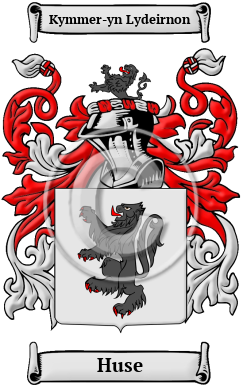
The motto was originally a war cry or slogan. Mottoes first began to be shown with arms in the 14th and 15th centuries, but were not in general use until the 17th century. Thus the oldest coats of arms generally do not include a motto. Mottoes seldom form part of the grant of arms: Under most heraldic authorities, a motto is an optional component of the coat of arms, and can be added to or changed at will; many families have chosen not to display a motto.
Motto: Kymmer-yn Lydeirnon
Motto Translation: Name of the lordship of the family.
- Smith, George (ed), Dictionary of National Biography. London: Smith, Elder & Co., 1885-1900. Print
- Reaney, P.H and R.M. Wilson, A Dictionary of English Surnames. London: Routledge, 1991. Print. (ISBN 0-415-05737-X)
- "What are the 5,000 Most Common Last Names in the U.S.?". NameCensus.com, https://namecensus.com/last-names/
- Filby, P. William, Meyer, Mary K., Passenger and immigration lists index : a guide to published arrival records of about 500,000 passengers who came to the United States and Canada in the seventeenth, eighteenth, and nineteenth centuries. 1982-1985 Cumulated Supplements in Four Volumes Detroit, Mich. : Gale Research Co., 1985, Print (ISBN 0-8103-1795-8)
- The Political Graveyard: Alphabetical Name Index. (Retrieved 2015, October 9) . Retrieved from http://politicalgraveyard.com/alpha/index.html
|

 Huse migration to the United States

 Scotland
 Wales
Wales Ireland