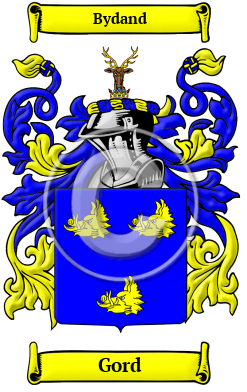
| ![Show Contents]() Gord History, Family Crest & Coats of Arms Gord History, Family Crest & Coats of Arms
Etymology of GordWhat does the name Gord mean? The ancestors of the first family to use the name Gord lived among the Boernician tribe of ancient Scotland. They lived on the lands of Gordon, in the former county of Berwickshire, since ancient times. There is little doubt that bearers of Gord came to Britiain with the Normans, and it is generally thought that they descend from the place named "Gourdon" in Saone-et-Loire, Normandy, but the oldest roots of the bearers of Gord in Scotland may lie with the Boernician tribe of ancient Scotland. It is entirely possible that the Gord surname was created from a pre-existing place name Gordon. It has been suggested that this place-name was originally derived from the Welsh (ancient Brithonic) words, gor and din, which mean "spacious" and "fort," and such, Gord would be a type hereditary surname, known as a habitation name: one that is derived from a pre-exiting name for a town, village, parish, or farmstead. Gord Coat of Arms CreationThe name Gordon with the boars' heads in the Duke of Richmond and Gordon's coat-of-arms originated, according to an old story, in a way which shows that the first of that name was hardy, brave, witty, and romantic-a trait of the clan to this day. It is said that when the wild boars had increased to such an extent in the south of Scotland that they became a public menace, a reward was offered for every boar's head brought to Holyrood, and hunting the wild boar became the favourite sport of the young gallants of the time. Among other hunters was the young Lochinvar, who had a double incentive, as he was in love with the beautiful Margaret Scott, the daughter of Sir James Scott, whose estate was pestered by one of the most ferocious of these brutes. There was, however, another claimant for fair Margaret's hand, the wealthy James Ogilvie. Margaret favoured the poorer Loch- invar, and the father in a quandary at last promised her to the one who should kill this wild boar. Both set out, but Lochinvar came first on the prey, chased it for many a mile, and, when it turned at bay, he, after a stubborn fight, laid it low, and then, exhausted by the chase and a wound, lay down to rest, but before doing so he cut out the animal's tongue. As he lay asleep Ogilvie passed, saw the boar dead, quietly cut off the head, hurried back to Sir James, claimed his bride, and then made off to Holyrood to ask for the King's promised reward. When Lochinvar awoke he saw the trick played on him, and at once started in pursuit of his rival. When he arrived at Court he found that Ogilvie was there before him. Lochinvar was, however, after some little trouble, admitted to the Royal presence, stated his case, and asked for justice. Ogilvie was re-called and denounced Lochinvar as a cheat. The King was puzzled, and asked if there were any witnesses. Lochinvar replied that the boar would speak for him, and asked that its head be pro-duced. When this was done Lochinvar showed that the tongue was awanting, and produced it from his pouch. The King was satisfied; the reward was refunded by Ogilvie, who was then imprisoned as a cheat. The King then asked the happy Lochinvar how he managed to kill such a wild animal, and Lochinvar replied, "May it please your Grace, I just gored him down with my spear." "You are a brave man," said the King; "and as a mark of my appreciation of your courage you shall henceforth be known as the Knight of " Goredown." In course of time this got shortened into " Gordon." It is said that the son of this man and his wife, Margaret Scott, was " the young Lochinvar who came out of the west." 1 Early Origins of the Gord familyThe surname Gord was first found in Berwickshire an ancient county of Scotland, presently part of the Scottish Borders Council Area, located in the eastern part of the Borders Region of Scotland, where legend has it that they were granted lands by King Malcolm Ceanmore, successor to MacBeth, in 1057, thus placing bearers of the name in lowland Scotland, before the invasion of the Normans. "The earliest known home of the Scots family was in Berwickshire, and here we find a place name Gordon, from which the surname may have been derived. There was also a distinguished family named Gurdon in Hampshire, England, with whom it has been suggested they were connected. It has been further suggested that the Gordons were cadets of the Swintons as the coats of arms borne by the two families are the same. " 2 "According to some genealogists this name is derived from Gordonia, a town in Macedonia; according to others from a manor in Normandy-origins literally too "far-fetched," since the parish of Gordon, in Berwickshire, where we find the family located at an early date, is its true source. " 3 "There is a nice little romance to the tune of making the founder of the family a certain Bertrand de Gourdon, who shot Richard the Lion-Hearted at Chaluz. According to history, this Gourdon was a common archer, who having been brought before the dying monarch was forgiven by him, and ordered to be liberated with a handsome present; but the Flemish general, who had no notion of such generosity, very coolly ordered him to be flayed alive. How, after such an operation, he could get into Scotland we are not told." 3 The first Gordon on record was Richer de Gordum, lord of the Barony of Gordon in the Merse, who granted a piece of land and the church of St. Michael between the years 1150-1180, to the monks of Kelso. 2 Adam Gordon acquired by Royal grant the lands of Coldstream on the River Tweed and his successors held these lands for many centuries. Early History of the Gord familyThis web page shows only a small excerpt of our Gord research. Another 203 words (14 lines of text) covering the years 1280, 1402, 1439, 1449, 1470, 1498, 1501, 1514, 1546, 1562, 1594, 1609, 1610, 1611, 1614, 1619, 1632, 1635, 1637, 1644, 1651, 1652, 1665, 1679, 1697, 1720, 1761 and 1890 are included under the topic Early Gord History in all our PDF Extended History products and printed products wherever possible. Gord Spelling VariationsBoernician names that evolved in the largely preliterate Middle Ages are often marked by considerable spelling variations. Gord has been spelled Gordon, Gordun, Gôrdon (Gaelic) and others. Early Notables of the Gord family- Sir Adam de Gordon, Lord of Gordon (died 1402), 14th-century Scottish baron
- Alexander Seton, 1st Earl of Huntly (died 1470) when he succeeded his father as Lord Gordon he began using his mother's family name of Gordon, was knighted in 1439 and was Lord of Badenoch, Gordon, St...
- George Gordon, 4th Earl of Huntly (1514-1562), Scottish nobleman, Lord High Chancellor in 1546 who led a revolt against Mary Queen of Scots and was killed at the battle of Corrichie
- Sir John Gordon, 1st Baronet (1610-1644), a Scottish Royalist supporter of Charles I during the Wars of the Three Kingdoms
- John Gordon (1609-1679), the 14th Earl of Sutherland, Keeper of the Privy Seal of Scotland
- George Gordon, 1st Earl of Aberdeen (1637-1720), Lord Chancellor of Scotland
- Sir John Gordon, 2nd Baronet (c. 1632-1665.) Alexander Gordon (1635-1697), fought as a Royalist but was captured by Oliver Cromwell's army at the Battle of Worcester at the end of the English Civil Wa...
Migration of the Gord family to IrelandSome of the Gord family moved to Ireland, but this topic is not covered in this excerpt.
Another 77 words (6 lines of text) about their life in Ireland is included in all our PDF Extended History products and printed products wherever possible.
| Gord migration to the United States | + |
Some of the Boernician-Scottish Clan families who came to North America were Loyalists who went north to Canada after the American War of Independence. Families on both sides of the border went on to found two of the world's great nations. This century, families with Scottish roots have rediscovered their heritage through highland games and Clan societies. An inquiry into the early roots of North American families reveals a number of immigrants bearing the name Gord or a variant listed above:
Gord Settlers in United States in the 19th Century- Ole Gord, who landed in Illinois in 1857 4
| Gord migration to Canada | + |
Gord Settlers in Canada in the 19th Century- L. Gord, aged 25 who immigrated to Canada, arriving at the Grosse Isle Quarantine Station in Quebec aboard the ship "Sisters" departing from the port of Liverpool, England but died on Grosse Isle in June 1847 5
| Gord migration to New Zealand | + |
Emigration to New Zealand followed in the footsteps of the European explorers, such as Captain Cook (1769-70): first came sealers, whalers, missionaries, and traders. By 1838, the British New Zealand Company had begun buying land from the Maori tribes, and selling it to settlers, and, after the Treaty of Waitangi in 1840, many British families set out on the arduous six month journey from Britain to Aotearoa to start a new life. Early immigrants include: Gord Settlers in New Zealand in the 19th Century- Mr. Richard Gord, Cornish settler travelling from Launceston aboard the ship "Halcyon" arriving in New Zealand in 1853 6
- J. F. Gord, who arrived in Auckland, New Zealand aboard the ship "Sydenham" in 1870
| Contemporary Notables of the name Gord (post 1700) | + |
- Gord Kirke (b. 1945), Canadian sports and entertainment lawyer
- Gord Steeves, Canadian politician, city councilor from Winnipeg, Manitoba
- Gord Hampson (b. 1959), Canadian hockey player
- Gord Bamford (b. 1976), Australian country music singer
The motto was originally a war cry or slogan. Mottoes first began to be shown with arms in the 14th and 15th centuries, but were not in general use until the 17th century. Thus the oldest coats of arms generally do not include a motto. Mottoes seldom form part of the grant of arms: Under most heraldic authorities, a motto is an optional component of the coat of arms, and can be added to or changed at will; many families have chosen not to display a motto.
Motto: Bydand
Motto Translation: Remaining.
- Polson, Alexander, The Romance of Scottish Crests and Mottoes. Inverness: Walter Alexander, Inglis Street 1929. Print
- Black, George F., The Surnames of Scotland Their Origin, Meaning and History. New York: New York Public Library, 1946. Print. (ISBN 0-87104-172-3)
- Lower, Mark Anthony, Patronymica Britannica, A Dictionary of Family Names of the United Kingdom. London: John Russel Smith, 1860. Print.
- Filby, P. William, Meyer, Mary K., Passenger and immigration lists index : a guide to published arrival records of about 500,000 passengers who came to the United States and Canada in the seventeenth, eighteenth, and nineteenth centuries. 1982-1985 Cumulated Supplements in Four Volumes Detroit, Mich. : Gale Research Co., 1985, Print (ISBN 0-8103-1795-8)
- Charbonneau, André, and Doris Drolet-Dubé. A Register of Deceased Persons at Sea and on Grosse Île in 1847. The Minister of Canadian Heritage, 1997. ISBN: 0-660-198/1-1997E (p. 30)
- New Zealand Yesteryears Passenger Lists 1800 to 1900 (Retrieved 17th October 2018). Retrieved from http://www.yesteryears.co.nz/shipping/passlist.html
 |