| ![Show Contents]() Gone History, Family Crest & Coats of Arms Gone History, Family Crest & Coats of Arms
Etymology of GoneWhat does the name Gone mean? Gone was first used as a surname among the descendants of the ancient Scottish people known as the Picts. It was a name for a metalworker. The Gaelic form of the name is Mac Ghobhainn, which means son of the smith. 1 Early Origins of the Gone familyThe surname Gone was first found in Inverness-shire (Gaelic: Siorrachd Inbhir Nis) divided between the present day Scottish Council Areas of Highland and Western Isles, and consisting of a large northern mainland area and various island areas off the west coast, the shire was anciently both a Pictish and Norwegian stronghold, where the name is from the Gaelic 'Govha' meaning 'a blacksmith' and as such could have been a name that applied to people throughout Scotland. However, as in the case of clans like the Fletchers or Clarks, eventually the name became attributed to a specific area or region. As such, The Clan was also located in Nithsfield in the 12th century, and recorded as a Border Clan. To the west in Elgin and Galloway they were known as the MacGavins. Due to the Anglicization of the Gaelic name, spellings were often widely different. "MacGowan (McGowan) is the name of an old Stirling family. Gilcallum McGoun had a precept of remission for rapine and other crimes on the lands of the abbot of Cupar, 1503 (RSS., I, 953). Gilbert Makgowin, a follower of the earl of Cassilis, was respited for murder in 1526 (ibid., 3386). William McGown in Pitcalny, a follower of Ross of Pitcalny, 1592 (RPC., V, p. 31). Murchie McGowy or Muithie McGowne in Fanmoir, Mull, was put to horn in 1629 (RPC., 2 ser. II, p. 341; III, p. 45). Alister McGhowin, an engager on royalist side, in parish of Urray, 1649 (IDR., p. 368). Alexander M'Gowne was retoured heir in the lands of Langlandes of Lochanes in the territory of Dumfries, 1672." 2 "In the reign of David II there was a Clan M'Gowan, probably located somewhere on the river Nith, whose chiefship was adjudged to Donald Edzear (RMS., I, App II, 982). This Edzear was a descendant of Dunegal of Stranith (Nithsdale), whose seat was at Morton, Dumfriesshire, about the beginning of the twelfth century. The name here may indicate descent from Owen the Bald (the Eugenius Calvin of Simeon of Durham), king of the Strathclyde Britons, who was killed in 1018." 2 Early History of the Gone familyThis web page shows only a small excerpt of our Gone research. Another 158 words (11 lines of text) covering the years 1396, 1613, 1631, 1658, 1661, 1683, 1698, 1725 and 1890 are included under the topic Early Gone History in all our PDF Extended History products and printed products wherever possible. Gone Spelling VariationsBefore the first dictionaries appeared in the last few hundred years, scribes spelled according to sound. spelling variations are common among Scottish names. Gone has been spelled MacGowan, McGowan, MacGowin, McGowin, MacGowen, McGowen, Gow, Gowan, Gowen, Gowin, MacGavin, McGavin and many more. Early Notables of the Gone familyJohn Gow (c. 1698-1725), Scottish notorious pirate probably born in Wick, Caithness whose short career was immortalized by Charles Johnson in "A General History of the Pyrates."
Thomas Gowan (1631-1683), was a writer on logic, "born at Caldermuir, Scotland, in 1631. About 1658 he went to Ireland...
Another 46 words (3 lines of text) are included under the topic Early Gone Notables in all our PDF Extended History products and printed products wherever possible. Migration of the Gone family to IrelandSome of the Gone family moved to Ireland, but this topic is not covered in this excerpt.
Another 100 words (7 lines of text) about their life in Ireland is included in all our PDF Extended History products and printed products wherever possible.
| Gone migration to the United States | + |
In those unstable times, many had no choice but to leave their beloved homelands. Sickness and poverty hounded travelers to North America, but those who made it were welcomed with land and opportunity. These settlers gave the young nations of Canada and the United States a strong backbone as they stood up for their beliefs as United Empire Loyalists and in the American War of Independence. In this century, the ancestors of these brave Scots have begun to recover their illustrious heritage through Clan societies and other heritage organizations. Early passenger and immigration lists reveal many Scottish settlers bearing the name Gone:
Gone Settlers in United States in the 19th Century- J J Gone, who arrived in San Francisco, California in 1860 3
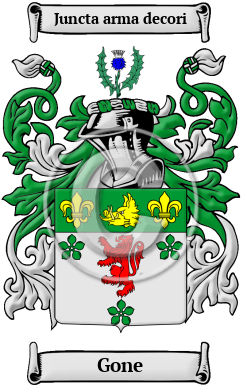
The motto was originally a war cry or slogan. Mottoes first began to be shown with arms in the 14th and 15th centuries, but were not in general use until the 17th century. Thus the oldest coats of arms generally do not include a motto. Mottoes seldom form part of the grant of arms: Under most heraldic authorities, a motto is an optional component of the coat of arms, and can be added to or changed at will; many families have chosen not to display a motto.
Motto: Juncta arma decori
Motto Translation: Arms united to merit.
- Smith, Eldson Coles, New Dictionary of American Family Names New York: Harper & Row, 1956. Print
- Black, George F., The Surnames of Scotland Their Origin, Meaning and History. New York: New York Public Library, 1946. Print. (ISBN 0-87104-172-3)
- Filby, P. William, Meyer, Mary K., Passenger and immigration lists index : a guide to published arrival records of about 500,000 passengers who came to the United States and Canada in the seventeenth, eighteenth, and nineteenth centuries. 1982-1985 Cumulated Supplements in Four Volumes Detroit, Mich. : Gale Research Co., 1985, Print (ISBN 0-8103-1795-8)
 |