| ![Show Contents]() Gar History, Family Crest & Coats of Arms Gar History, Family Crest & Coats of Arms
Etymology of GarWhat does the name Gar mean? Irish surnames are linked to the long Gaelic heritage of the Island nation. The original Gaelic form of the name Gar is "O Gadhra," which is derived from the word "gadhar," which means "dog." Early Origins of the Gar familyThe surname Gar was first found in County Sligo (Irish: Sligeach), in the province of Connacht in Northwestern Ireland, where they were Chiefs of Coolavin aad Sliabh Lugha. (O'Hart) The surname also spelled Gara, O'Gara, and Gerry is descended from Tiachleach, Lord of South Leyney who was killed in 964 A.D. The Geary family was closely associated with the O'Haras from an early time and the chiefs of the two septs alternated as rulers of Luighne. 1 "The O'Garas were lords of the territory of Luighne, now forming and giving name to the barony of Leyney or Lieny, in the county of Sligo, whence they were expelled by the MacSurtains and the Mac Costelloes, families of Anglo-Norman descent." (O'Hart) Once more into the archives we delved to find life in early times was fraught with battles and deaths. By example, some of the first entries of the family include: Tiachleach O'Gara, slain in 964; Rory O'Gara, tanist of Leyney, slain; Rory O'Gara, heir presumptive died in 1059; Donlevy O'Gara, lord of Leyney, killed by Brian O'Hara; O'Gadhra, lord of Layney, slain at battle of Ardee; and O'Gara, lord of Sliabh-Lugha, died. (O'Hart) Early History of the Gar familyThis web page shows only a small excerpt of our Gar research. Another 79 words (6 lines of text) covering the years 1710, 1727 and 1796 are included under the topic Early Gar History in all our PDF Extended History products and printed products wherever possible. Gar Spelling VariationsIrish names recorded during the Middle Ages are characterized by many spelling variations. This preponderance of variations for common names can be explained by the fact that the scribes and church officials that kept records during that period individually decided how to capture one's name. These recorders primarily based their decisions on how the name was pronounced or what it meant. Research into the name Gar revealed many variations, including Geary, Gara, O'Gara, O'Geary, Gearie, Gearey and many more. Early Notables of the Gar familyElbridge Gerry of Massachusetts Bay (now the Commonwealth of Massachusetts), signer of the American Declaration of Independence.
Sir Francis Geary (1710?-1796),was an "admiral, of a family long settled in Cardiganshire, entered the navy in 1727 on board the Revenge...
Another 37 words (3 lines of text) are included under the topic Early Gar Notables in all our PDF Extended History products and printed products wherever possible.
| Gar migration to the United States | + |
Suffering from poverty and racial discrimination, thousands of Irish families left the island in the 19th century for North America aboard cramped passenger ships. The early migrants became settlers of small tracts of land, and those that came later were often employed in the new cities or transitional work camps. The largest influx of Irish settlers occurred with Great Potato Famine during the late 1840s. Although the immigrants from this period were often maligned when they arrived in the United States, they provided the cheap labor that was necessary for the development of that country as an industrial power. Early immigration and passenger lists have revealed many immigrants bearing the name Gar:
Gar Settlers in United States in the 19th Century- Andw S. Gar, who arrived in Philadelphia in 1822
- Nicholas Gar, who landed in Missouri in 1840 2
- A Gar, who arrived in San Francisco, California in 1851 2
| Contemporary Notables of the name Gar (post 1700) | + |
- Gar Chisenhall, American Chief Appellate Counsel at Dep't of Bus. & Prof'l Regulation, Tallahassee, Florida
- Gar Samuelson (1958-1999), American drummer for the band Megadeth
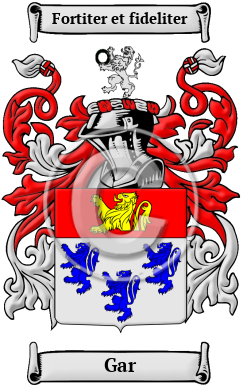
The motto was originally a war cry or slogan. Mottoes first began to be shown with arms in the 14th and 15th centuries, but were not in general use until the 17th century. Thus the oldest coats of arms generally do not include a motto. Mottoes seldom form part of the grant of arms: Under most heraldic authorities, a motto is an optional component of the coat of arms, and can be added to or changed at will; many families have chosen not to display a motto.
Motto: Fortiter et fideliter
Motto Translation: Boldly and faithfully.
- MacLysaght, Edward, Irish Families Their Names, Arms and Origins 4th Edition. Dublin: Irish Academic, 1982. Print. (ISBN 0-7165-2364-7)
- Filby, P. William, Meyer, Mary K., Passenger and immigration lists index : a guide to published arrival records of about 500,000 passengers who came to the United States and Canada in the seventeenth, eighteenth, and nineteenth centuries. 1982-1985 Cumulated Supplements in Four Volumes Detroit, Mich. : Gale Research Co., 1985, Print (ISBN 0-8103-1795-8)
 |