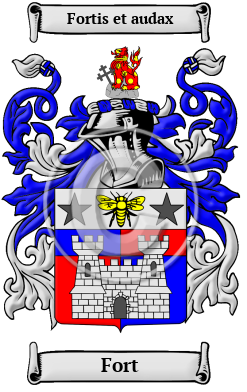
| ![Show Contents]() Fort History, Family Crest & Coats of Arms Fort History, Family Crest & Coats of Arms
Etymology of FortWhat does the name Fort mean? The name Fort has a history dating as far back as the Norman Conquest of England in 1066. It was a name for a strong, brave, or hardy person as the name was originally derived from the Old French fort, which meant strong. Another derivation suggests that the name is a local surname and it indicates that its bearer lived near a fortress or stronghold. The former is more common, but time has confused the two derivations and etymologists now disagree on which is appropriate in a given instance. Early Origins of the Fort familyThe surname Fort was first found in Lancashire where they were granted lands by William the Conqueror for their assistance at the Battle of Hastings in 1066 A.D. They were Lords of the manor of this estate. They are believed to be descended from the Norman noble, William de Fortibus, Earl of Albemarle, who married Isobel, Countess of Devon. This line eventually became Earls of Lancaster, and conjecturally the junior lines assumed the name Forte. Early History of the Fort familyThis web page shows only a small excerpt of our Fort research. Another 56 words (4 lines of text) are included under the topic Early Fort History in all our PDF Extended History products and printed products wherever possible. Fort Spelling VariationsBefore the last few hundred years the English language had no fixed system of spelling rules. For that reason, spelling variations occurred commonly in Anglo Norman surnames. Over the years, many variations of the name Fort were recorded, including Fort, Forte, Forts, Fortes, Foort, Foorte and many more. Early Notables of the Fort family Fort RankingIn the United States, the name Fort is the 3,127th most popular surname with an estimated 9,948 people with that name. 1 However, in France, the name Fort is ranked the 505th most popular surname with an estimated 8,878 people with that name. 2
| Fort migration to the United States | + |
The unstable environment in England at this time caused numerous families to board ships and leave in search of opportunity and freedom from persecution abroad in places like Ireland, Australia, and particularly the New World. The voyage was extremely difficult, however, and only taken at great expense. The cramped conditions and unsanitary nature of the vessels caused many to arrive diseased and starving, not to mention destitute from the enormous cost. Still opportunity in the emerging nations of Canada and the United States was far greater than at home and many went on to make important contributions to the cultures of their adopted countries. An examination of many early immigration records reveals that people bearing the name Fort arrived in North America very early:
Fort Settlers in United States in the 17th Century- Marmaduke Fort, who landed in Maryland in 1653 3
- John Fort, who arrived in Maryland in 1678 3
- John Fort who settled in Maryland in 1685
Fort Settlers in United States in the 18th Century- Jean Fort, aged 30, who landed in Louisiana in 1720 3
- Francis Fort, who settled in Virginia in 1736
- Claude Fort, who settled in Louisiana in 1756
- Andrew Fort, who arrived in New York in 1760
- Andreas Fort, who settled in New York in 1771
Fort Settlers in United States in the 19th Century- Lewis Emanuel Fort, who settled in Philadelphia, Pennsylvania in 1804
- C Fort, who landed in San Francisco, California in 1851 3
- J. A. Fort settled in San Francisco, California in 1852
- J. A. Fort, who settled in San Francisco in 1852
- Joseph A. Fort, who settled in San Francisco in 1856
- ... (More are available in all our PDF Extended History products and printed products wherever possible.)
| Fort migration to Canada | + |
Fort Settlers in Canada in the 18th Century- Francis Fort, who arrived in Nova Scotia in 1749
| Fort migration to Australia | + |
Fort Settlers in Australia in the 19th Century- James Fort, who arrived in Adelaide, Australia aboard the ship "John" in 1840 4
- Harriet Mary Fort, who arrived in Adelaide, Australia aboard the ship "John" in 1840 4
- John Fort, aged 37, a labourer, who arrived in South Australia in 1849 aboard the ship "Constance" 5
| Fort migration to New Zealand | + |
Emigration to New Zealand followed in the footsteps of the European explorers, such as Captain Cook (1769-70): first came sealers, whalers, missionaries, and traders. By 1838, the British New Zealand Company had begun buying land from the Maori tribes, and selling it to settlers, and, after the Treaty of Waitangi in 1840, many British families set out on the arduous six month journey from Britain to Aotearoa to start a new life. Early immigrants include: Fort Settlers in New Zealand in the 19th Century- Mr. William H Fort, British settler travelling from London aboard the ship "Matoaka" arriving in Auckland, New Zealand on 26th September 1859 6
- David Fort, who arrived in Auckland, New Zealand aboard the ship "Black Eagle" in 1861 7
- Elizabeth Fort, who arrived in Auckland, New Zealand aboard the ship "Black Eagle" in 1861 7
- Mary Anne Fort, who arrived in Auckland, New Zealand aboard the ship "Black Eagle" in 1861 7
- Jessie Fort, who arrived in Auckland, New Zealand aboard the ship "Black Eagle" in 1861 7
- ... (More are available in all our PDF Extended History products and printed products wherever possible.)
| Contemporary Notables of the name Fort (post 1700) | + |
- Vincent Dean Fort (1956-2024), American politician, Member of the Georgia State Senate for the 39th district from 1996 to 2017
- Brigadier-General Guy Osborne Fort (1879-1942), American Commanding General Lanao Force (1942) 8
- Charles Hoy Fort (1874-1932), American writer and researcher into anomalous phenomena
- Jean Fort, former headmistress of Rodean
- André Louis Fort (1935-2025), French Roman Catholic prelate, Bishop of Perpignan-Elne from 1996 to 2002
- Marie-Louise Fort (1950-2022), French politician, Member of the National Assembly of France, born in Villeneuve-la-Guyard
- Ricardo Fort (1968-2013), Argentine entrepreneur and television director
- Jean Pierre Fort, French engineer, General Controller of the army, and Director of firms in Paris
- Alain Roger Louis Fort, French lawyer and deputy in Paris
The motto was originally a war cry or slogan. Mottoes first began to be shown with arms in the 14th and 15th centuries, but were not in general use until the 17th century. Thus the oldest coats of arms generally do not include a motto. Mottoes seldom form part of the grant of arms: Under most heraldic authorities, a motto is an optional component of the coat of arms, and can be added to or changed at will; many families have chosen not to display a motto.
Motto: Fortis et audax
Motto Translation: Strong and brave
- "What are the 5,000 Most Common Last Names in the U.S.?". NameCensus.com, https://namecensus.com/last-names/
- http://www.journaldesfemmes.com/nom-de-famille/nom/
- Filby, P. William, Meyer, Mary K., Passenger and immigration lists index : a guide to published arrival records of about 500,000 passengers who came to the United States and Canada in the seventeenth, eighteenth, and nineteenth centuries. 1982-1985 Cumulated Supplements in Four Volumes Detroit, Mich. : Gale Research Co., 1985, Print (ISBN 0-8103-1795-8)
- State Records of South Australia. (Retrieved 2010, November 5) JOHN from London 1840. Retrieved from http://www.slsa.sa.gov.au/BSA/1840John.htm
- State Records of South Australia. (Retrieved 2010, November 5) CONSTANCE 1849. Retrieved from http://www.slsa.sa.gov.au/BSA/1849Constance.htm
- New Zealand Yesteryears Passenger Lists 1800 to 1900 (Retrieved 17th October 2018). Retrieved from http://www.yesteryears.co.nz/shipping/passlist.html
- New Zealand Yesteryears Passenger Lists 1800 to 1900 (Retrieved 26th March 2019). Retrieved from http://www.yesteryears.co.nz/shipping/passlist.html
- Generals of World War II. (Retrieved 2012, February 29) Guy Fort. Retrieved from http://generals.dk/general/Fort/Guy_Osborne/USA.html
 |