| ![Show Contents]() Forker History, Family Crest & Coats of Arms Forker History, Family Crest & Coats of Arms
- Origins Available:
 Scotland Scotland Ireland Ireland The ancient name Forker was first used by the Strathclyde people of the Scottish/English Borderlands. It is derived from the Gaelic MacFhearchair which means son of Farquhar and Farquhar is derived from the Gaelic word Fearchar which means very dear one. So, the name means son of the very dear one. 1 2 Early Origins of the Forker familyThe surname Forker was first found in Ayrshire (Gaelic: Siorrachd Inbhir Àir), formerly a county in the southwestern Strathclyde region of Scotland, that today makes up the Council Areas of South, East, and North Ayrshire, where they have enjoyed their seat at Kyle Stewart for many generations. The history is quite separate from that of Farquharson. Robert Farquhar, Laird of Gilmilnescroft about the year 1350 was the first Chief on record and he was probably a direct descendant of Ferchart, father of Fergus, one of the chiefs setting the bounds of Newbattle Abbey in 1178. Descended was Ferkar, Earl of Ross, 1224-1231, and at this time a branch was started in the north at Caithness at Ederlarg. 1 Early History of the Forker familyThis web page shows only a small excerpt of our Forker research. Another 129 words (9 lines of text) covering the years 1445, 1646, 1677, 1699, 1706, 1707, 1751, 1774, 1813, 1818, 1819, 1823, 1826 and 1839 are included under the topic Early Forker History in all our PDF Extended History products and printed products wherever possible. Forker Spelling VariationsIn Medieval times, spelling and translation were not nearly so highly developed as today. They were generally carried out according to the sound and intuition of the bearer. For that reason spelling variations are extremely common among early Scottish names. Forker has been spelled Farquhar, Farquher, Farker, Farkar, Forker, Farquar, Farquer and many more. Early Notables of the Forker familyNotable amongst the family at this time was George Farquhar (1677-1707), an Irish dramatist, born in Derry. He is bet known for his Restoration comedy, including his plays The Constant Couple (1699), The Recruiting Officer (1706) and The Beaux' Stratagem (1707).3John Farquhar (1751-1826) was a Scottish dealer in gunpowder, born of humble parents at Bilbo, in the parish of Crimond, Aberdeenshire who by the time of his death had amassed about £1.5 million...
Another 72 words (5 lines of text) are included under the topic Early Forker Notables in all our PDF Extended History products and printed products wherever possible.  Migration of the Forker family to Ireland Migration of the Forker family to Ireland
Some of the Forker family moved to Ireland, but this topic is not covered in this excerpt. More information about their life in Ireland is included in all our PDF Extended History products and printed products wherever possible.
| Forker migration to the United States | + |
Unrest, poverty, and persecution caused thousands to look for opportunity and freedom in the North American colonies. The crossing was long, overcrowded, and unsanitary, though, and came only at great expense. Many Strathclyde families settled on the east coast of North America in communities that would form the backbone of what would become the great nations of the United States and Canada. The American War of Independence caused those who remained loyal to England to move north to Canada as United Empire Loyalists. In the 20th century, Strathclyde and other Scottish families across North America began to recover their collective heritage through highland games and Clan societies. Among them:
Forker Settlers in United States in the 18th Century- Mathias Forker, who landed in Pennsylvania in 1765 4
Forker Settlers in United States in the 19th Century- John Forker, who arrived in Allegany (Allegheny) County, Pennsylvania in 1803 4
| Contemporary Notables of the name Forker (post 1700) | + |
- Samuel Carr Forker (1821-1900), American politician, Member of the U.S. House of Representatives from New Jersey (1871-1873)
- André Forker (b. 1979), German silver medalist luger at the 2006 FIL European Luge Championships
The motto was originally a war cry or slogan. Mottoes first began to be shown with arms in the 14th and 15th centuries, but were not in general use until the 17th century. Thus the oldest coats of arms generally do not include a motto. Mottoes seldom form part of the grant of arms: Under most heraldic authorities, a motto is an optional component of the coat of arms, and can be added to or changed at will; many families have chosen not to display a motto.
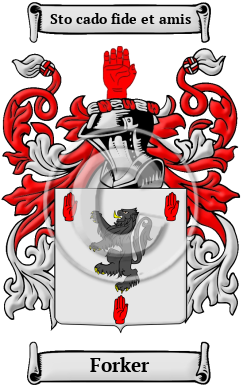
Motto: Sto cado fide et amis
Motto Translation: I stand and fall by faith and arms.
- Black, George F., The Surnames of Scotland Their Origin, Meaning and History. New York: New York Public Library, 1946. Print. (ISBN 0-87104-172-3)
- Smith, Eldson Coles, New Dictionary of American Family Names New York: Harper & Row, 1956. Print
- Smith, George (ed), Dictionary of National Biography. London: Smith, Elder & Co., 1885-1900. Print
- Filby, P. William, Meyer, Mary K., Passenger and immigration lists index : a guide to published arrival records of about 500,000 passengers who came to the United States and Canada in the seventeenth, eighteenth, and nineteenth centuries. 1982-1985 Cumulated Supplements in Four Volumes Detroit, Mich. : Gale Research Co., 1985, Print (ISBN 0-8103-1795-8)
|

 Forker migration to the United States