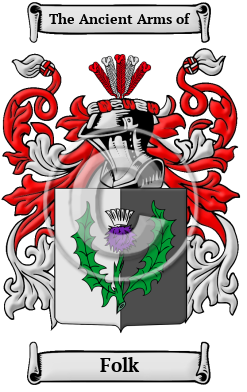
| ![Show Contents]() Folk History, Family Crest & Coats of Arms Folk History, Family Crest & Coats of Arms
Etymology of FolkWhat does the name Folk mean? The ancient and distinguished German surname Folk is derived from the Germanic personal name "Volkher," which is composed of the elements "volk," meaning "people," and "her," meaning "army." The name was popular during the early Middle Ages due to the famous Austrian epic poem "Nibelungenlied," which featured a character called "Volker the Fiddler." Both the surname and the given name could be found in many areas of Germany under a number of spelling variations. Early Origins of the Folk familyThe surname Folk was first found in the south, near the border of Austria, where the fame of the "Niebelungenlied" first reached Germany. The first recorded bearer of the surname was Conrad filius ("son of") Volkardi, who was living near Tuttlingen, Swabia in 1280. The young Folk family played a major role in the early history of the region, and contributed greatly to the development of medieval German society. Early History of the Folk familyThis web page shows only a small excerpt of our Folk research. Another 193 words (14 lines of text) covering the years 1280, 1331, 1383, 1434, 1626, 1677, 1761, 1767 and 1845 are included under the topic Early Folk History in all our PDF Extended History products and printed products wherever possible. Folk Spelling VariationsSpelling variations of this family name include: Volker, Voelker, Völker, Volkert, Folkart, Foutch, Folk, Volk, Folkerth, Fulchard, Volhard, Volchert, Folgert, Vollert and many more. Early Notables of the Folk familyMore information is included under the topic Early Folk Notables in all our PDF Extended History products and printed products wherever possible. Folk Rankingthe United States, the name Folk is the 4,855th most popular surname with an estimated 4,974 people with that name. 1
| Folk migration to the United States | + |
Folk Settlers in United States in the 18th Century- Peter Folk, who arrived in Pennsylvania in 1746 2
- Baltas Folk, who arrived in Pennsylvania in 1751 2
- Christoph Folk, who landed in Pennsylvania in 1751 2
- Joh Jurg Folk, who landed in Pennsylvania in 1753 2
- Jerig Folk, who arrived in Pennsylvania in 1754 2
Folk Settlers in United States in the 19th Century- Johanna Folk, aged 29, who arrived in Philadelphia, Pennsylvania in 1807 2
- John Folk, aged 48, who landed in Philadelphia, Pennsylvania in 1807 2
- Hannah Folk, aged 24, who arrived in Philadelphia, Pennsylvania in 1807 2
- Michael Folk, who landed in Allegany (Allegheny) County, Pennsylvania in 1845 2
- Jens Folk, aged 40, who landed in New York, NY in 1869 2
- ... (More are available in all our PDF Extended History products and printed products wherever possible.)
| Contemporary Notables of the name Folk (post 1700) | + |
- Reau E. Folk, American Democratic Party politician, Alternate Delegate to Democratic National Convention from Tennessee, 1912 3
- Michael Folk, American Republican politician, Member of West Virginia State House of Delegates 63rd District; Elected 2012 4
- Joseph Wingate Folk (1869-1923), American Democratic Party politician, Governor of Missouri, 1905-09; Speaker, Democratic National Convention, 1912 ; Candidate for U.S. Senator from Missouri, 1918 4
- Mrs. Joseph W. Folk, American Democratic Party politician, Delegate to Democratic National Convention from Tennessee, 1936 4
- Henry Calhoun Folk, American Democratic Party politician, Alternate Delegate to Democratic National Convention from South Carolina, 1912; Member of South Carolina State Senate from Bamberg County, 1933-36 4
- Frank Folk, American Democratic Party politician, Presidential Elector for New York, 1992 4
- Edward Folk (d. 1943), American politician, Mayor of Canton, Ohio, 1939-43 4
- Nicholas "Nick" Folk (b. 1984), American NFL football player
- Richard Dale Folk (b. 1950), Canadian curler, two-time world curling champion
- "What are the 5,000 Most Common Last Names in the U.S.?". NameCensus.com, https://namecensus.com/last-names/
- Filby, P. William, Meyer, Mary K., Passenger and immigration lists index : a guide to published arrival records of about 500,000 passengers who came to the United States and Canada in the seventeenth, eighteenth, and nineteenth centuries. 1982-1985 Cumulated Supplements in Four Volumes Detroit, Mich. : Gale Research Co., 1985, Print (ISBN 0-8103-1795-8)
- The Political Graveyard: Alphabetical Name Index. (Retrieved 2015, November 2) . Retrieved from http://politicalgraveyard.com/alpha/index.html
 |