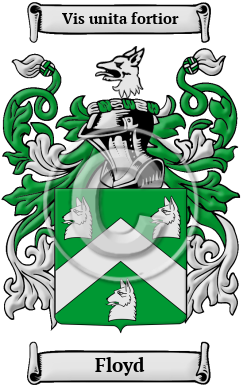
| ![Show Contents]() Floyd History, Family Crest & Coats of Arms Floyd History, Family Crest & Coats of Arms
- Origins Available:
Ireland
Etymology of FloydWhat does the name Floyd mean? The Irish surname Floyd begins was originally the Gaelic MacTuile, Ó Maoltuile, or Mac Maoltuile. "tuile" means "flood," and the names Tully and Flood were at one time interchangeable in Ireland. 1 However, some of the Gaelic names that have become "flood" may have been mistranslations, and that contained the Gaelic "toile," meaning "toil," or "will." In Ulster, Floyd has sometimes been used as a spelling variant of Flood; however, Floyd is normally a cognate of the Welsh name Lloyd, derived from the word 'llwyd,' which means ‘grey.’ Early Origins of the Floyd familyThe surname Floyd was first found in Connacht, where they could be found since ancient times, and were hereditary physicians to the O'Connors of Galway. Early History of the Floyd familyThis web page shows only a small excerpt of our Floyd research. Another 125 words (9 lines of text) covering the years 1563, 1572, 1574, 1589, 1592, 1593, 1603, 1620, 1637, 1641, 1648, 1649, 1660, 1675 and 1676 are included under the topic Early Floyd History in all our PDF Extended History products and printed products wherever possible. Floyd Spelling VariationsThose scribes in Ireland during the Middle Ages recorded names as they sounded. Consequently, in this era many people were recorded under different spellings each time their name was written down. Research on the Floyd family name revealed numerous spelling variations, including Flood, Floyd, Floode, Floyde, Tully, MacTully,Talley, Tally and many more. Early Notables of the Floyd family- Edward Floyd, Floud or LLoyd (d. 1648?), was a Catholic barrister who became steward in Shropshire to Lord-Chancellor Ellesmere and the Earl of Suffolk. 2
- Henry Floyd (1563-1641), was an English Jesuit, elder brother of Father John Floyd, born in Cambridgeshire in 1563. Father John Floyd (1572-1649), was an English Jesuit, called also Daniel à Jesu, you...
- Thomas Floyd (fl. 1603), was a Welsh author who entered New Inn, Oxford, as a commoner in 1589, and graduated B.A. on 9 Feb. 1592-1593, afterwards transferred himself to Jesus College. 2
Floyd Rankingthe United States, the name Floyd is the 406th most popular surname with an estimated 67,149 people with that name. 3
| Floyd migration to the United States | + |
Thousands of Irish families left for North American shores in the 19th century. These people were searching for a life unencumbered with poverty, hunger, and racial discrimination. Many arrived to eventually find such conditions, but many others simply did not arrive: victims of the diseased, overcrowded ships in which they traveled to the New World. Those who lived to see North American shores were instrumental in the development of the growing nations of Canada and the United States. A thorough examination of passenger and immigration lists has disclosed evidence of many early immigrants of the name Floyd:
Floyd Settlers in United States in the 17th Century- Flag Floyd, who landed in Virginia in 1637 5
- Nowell Floyd, who landed in Virginia in 1637 5
- Melchesedick Floyd, who landed in Virginia in 1638 5
- Rice Floyd, who landed in Virginia in 1639 5
- Tho Floyd, who landed in Virginia in 1639 5
- ... (More are available in all our PDF Extended History products and printed products wherever possible.)
Floyd Settlers in United States in the 18th Century- Anne Floyd, who arrived in Virginia in 1702 5
- Edward Floyd, who landed in Virginia in 1702 5
- Morris Floyd, who landed in Virginia in 1702 5
- Lawrence Floyd, who landed in Virginia in 1702 5
- Martha Floyd, who arrived in Virginia in 1703 5
- ... (More are available in all our PDF Extended History products and printed products wherever possible.)
Floyd Settlers in United States in the 19th Century- John Floyd, who landed in Baltimore, Maryland in 1811 5
- Margaret Floyd, who landed in Philadelphia, Pennsylvania in 1812 5
- Mr. W. Floyd, (b. 1816), aged 25, Cornish settler departing from Falmouth aboard the ship "Cornwall" arriving in the United States on 3 June 1841 6
- Benjamin Floyd, who landed in Allegany (Allegheny) County, Pennsylvania in 1848 5
- N J Floyd, who arrived in San Francisco, California in 1850 5
- ... (More are available in all our PDF Extended History products and printed products wherever possible.)
| Floyd migration to Canada | + |
Floyd Settlers in Canada in the 18th Century- Mr. Richard Floyd U.E. born in New York, USA who settled in Saint John, New Brunswick c. 1784 son on Honourable Richard Floyd 7
| Floyd migration to Australia | + |
Emigration to Australia included the First Fleet of convicts, tradespeople and early settlers. Early immigrants include: First Fleet - Mr. William Floyd, (b. 1775), aged 14, British settler convicted in Middlesex, England in 1788, sentenced to 7 years for stealing a clock, transported aboard the ship "Neptune" leaving in 1789 arriving in New South Wales, Australia in 1790, may have died on the ship 4
Following the First Fleet, other convicts and early settlers arriving in Australia include: Floyd Settlers in Australia in the 19th Century- Mr.James Floyd, (d. 1825), British settler who was convicted in Sussex, England for life for house breaking, transported aboard the "Fortune" on 31st October 1812, arriving in New South Wales, Australia 8
- Thomas Floyd, who arrived in Port Misery aboard the ship "Duchess of Northumberland" in 1839 9
- Elizabeth Floyd, who arrived in Port Misery aboard the ship "Duchess of Northumberland" in 1839 9
- Elizabeth Floyd, who arrived in Adelaide, Australia aboard the ship "Branken Moor" in 1840 10
- Harriet Floyd, who arrived in Adelaide, Australia aboard the ship "Branken Moor" in 1840 10
- ... (More are available in all our PDF Extended History products and printed products wherever possible.)
| Floyd migration to New Zealand | + |
Emigration to New Zealand followed in the footsteps of the European explorers, such as Captain Cook (1769-70): first came sealers, whalers, missionaries, and traders. By 1838, the British New Zealand Company had begun buying land from the Maori tribes, and selling it to settlers, and, after the Treaty of Waitangi in 1840, many British families set out on the arduous six month journey from Britain to Aotearoa to start a new life. Early immigrants include: Floyd Settlers in New Zealand in the 19th Century- Thomas Floyd, who landed in Wellington, New Zealand in 1840
- Thomas Floyd, aged 23, a farm labourer, who arrived in Port Nicholson aboard the ship "Slains Castle" in 1841
- Caroline Floyd, aged 20, who arrived in Port Nicholson aboard the ship "Slains Castle" in 1841
- Mr. Thomas Floyd, (b. 1817), aged 23, British settler travelling from London aboard the ship "Slains Castle" arriving in Wellington, New Zealand on 25th January 1841 11
- Miss Caroline Floyd, (b. 1840), aged 9 months, British settler travelling from London aboard the ship "Slains Castle" arriving in Wellington, New Zealand on 25th January 1841 11
- ... (More are available in all our PDF Extended History products and printed products wherever possible.)
| Floyd migration to West Indies | + |
The British first settled the British West Indies around 1604. They made many attempts but failed in some to establish settlements on the Islands including Saint Lucia and Grenada. By 1627 they had managed to establish settlements on St. Kitts (St. Christopher) and Barbados, but by 1641 the Spanish had moved in and destroyed some of these including those at Providence Island. The British continued to expand the settlements including setting the First Federation in the British West Indies by 1674; some of the islands include Barbados, Bermuda, Cayman Island, Turks and Caicos, Jamaica and Belize then known as British Honduras. By the 1960's many of the islands became independent after the West Indies Federation which existed from 1958 to 1962 failed due to internal political conflicts. After this a number of Eastern Caribbean islands formed a free association. 12Floyd Settlers in West Indies in the 17th Century- John Floyd, who settled in Jamaica in 1683
| Contemporary Notables of the name Floyd (post 1700) | + |
- Billie Jean Floyd (1929-2025), American politician, educator, and civic leader, Oklahoma state senator representing District 13 (1984-1988)
- Gary Floyd (1953-2024), American singer for the band Dicks and Sister Double Happiness
- Carlisle Sessions Floyd (1926-2021), American composer primarily known for his operas, regarded as the "Father of American opera," he co-founded the Houston Opera Studio for the training of young singers
- George Perry Floyd Jr. (1973-2020), African American man murdered by a police officer during an arrest after a store clerk suspected he may have used a counterfeit $20 bill in Minneapolis
- Elson Floyd (1956-2015), American educator, 10th President of Washington State University (since 2007)
- Charles Floyd (1782-1804), American explorer, quartermaster in the Lewis and Clark Expedition
- Raymond Loran "Ray" Floyd (b. 1942), American professional PGA golfer
- Malcom Floyd (b. 1981), American NFL football wide receiver from Sacramento, California
- James John Floyd (1750-1783), American pioneer of the Midwestern United States
- ... (Another 57 notables are available in all our PDF Extended History products and printed products wherever possible.)
| Historic Events for the Floyd family | + |
Cataraqui - Stephen Floyd (b. 1819), British passenger who died aboard the ship "Cataraqui" when sailing for Melbourne, Australia she struck rocks of Kings Island and sank on 4th April 1845
- Hannah Floyd (b. 1820), British passenger who died aboard the ship "Cataraqui" when sailing for Melbourne, Australia she struck rocks of Kings Island and sank on 4th April 1845
- Anne Floyd (b. 1843), British passenger who died aboard the ship "Cataraqui" when sailing for Melbourne, Australia she struck rocks of Kings Island and sank on 4th April 1845
- William Floyd (b. 1845), British passenger who died aboard the ship "Cataraqui" when sailing for Melbourne, Australia she struck rocks of Kings Island and sank on 4th April 1845
- Mr. Harold James Floyd (1896-1917), Canadian resident from Halifax, Nova Scotia, Canada who died in the Halifax Explosion (1917) 13
- ... (Another 2 entries are available in all our PDF Extended History products and printed products wherever possible.)
The motto was originally a war cry or slogan. Mottoes first began to be shown with arms in the 14th and 15th centuries, but were not in general use until the 17th century. Thus the oldest coats of arms generally do not include a motto. Mottoes seldom form part of the grant of arms: Under most heraldic authorities, a motto is an optional component of the coat of arms, and can be added to or changed at will; many families have chosen not to display a motto.
Motto: Vis unita fortior
Motto Translation: Strength united is the more powerful.
| Suggested Readings for the name Floyd | + |
- Descendants of Col. Matthew Floyd, Loyalist of South Carolina and his Son Abraham Floyd by Marjorie Dodd Floyd.
- The Box Book With McElroy and Floyd by Ophelia Richardson Wade.
- MacLysaght, Edward, The Surnames of Ireland. Ireland: Irish Academic Press, sixth edition, 1985. Print. (ISBN 0-7165-2366-3)
- Smith, George (ed), Dictionary of National Biography. London: Smith, Elder & Co., 1885-1900. Print
- "What are the 5,000 Most Common Last Names in the U.S.?". NameCensus.com, https://namecensus.com/last-names/
- Convict Records of Australia. Retrieved 4th February 2021 from https://convictrecords.com.au/ships
- Filby, P. William, Meyer, Mary K., Passenger and immigration lists index : a guide to published arrival records of about 500,000 passengers who came to the United States and Canada in the seventeenth, eighteenth, and nineteenth centuries. 1982-1985 Cumulated Supplements in Four Volumes Detroit, Mich. : Gale Research Co., 1985, Print (ISBN 0-8103-1795-8)
- Cornwall Online Parish Clerks. (Retrieved 2018, April 30). Emigrants to New York 1820 - 1891 [PDF]. Retrieved from http://www.opc-cornwall.org/Resc/pdfs/emigration_new_york_1820_1891.pdf
- Rubincam, Milton. The Old United Empire Loyalists List. Genealogical Publishing Co., Inc, 1976. (Originally published as; United Empire Loyalists. The Centennial of the Settlement of Upper Canada. Rose Publishing Company, 1885.) ISBN 0-8063-0331-X
- Convict Records Voyages to Australia (Retrieved 24th October 2022). https://convictrecords.com.au
- State Records of South Australia. (Retrieved 2010, November 5) THE DUCHESS OF NORTHUMBERLAND - 1839. Retrieved from http://www.slsa.sa.gov.au/BSA/1839DuchessOfNorthumberland.htm
- State Records of South Australia. (Retrieved 2010, November 5) BRANKEN MOOR 1840. Retrieved from http://www.slsa.sa.gov.au/BSA/1840BrankenMoor.htm
- New Zealand Yesteryears Passenger Lists 1800 to 1900 (Retrieved 26th March 2019). Retrieved from http://www.yesteryears.co.nz/shipping/passlist.html
- https://en.wikipedia.org/wiki/British_West_Indies
- Halifax Explosion Book of Remembrance | Maritime Museum of the Atlantic. (Retrieved 2014, June 23) . Retrieved from https://maritimemuseum.novascotia.ca/what-see-do/halifax-explosion/halifax-explosion-book-remembrance
 |