| ![Show Contents]() Eyre History, Family Crest & Coats of Arms Eyre History, Family Crest & Coats of Arms
The name Eyre is rooted in the ancient Anglo-Saxon culture. It was a name for someone who was a person who was well-known as the heir to a title, fortune, or estate. The name is thought to be derived from the Old French eir, which is itself derived from the Latin heres, meaning "heir." 1 2 3 Two other sources elude to the Norman influence of the name: "Eyre: is a place-name in Normandy," 4 and the name is "from Le Heir, Heres. William and Wyrnarc Heres occur in Normandy 1198 (Magni Rotuli Scaccarii Normanniae)." 5 Early Origins of the Eyre familyThe surname Eyre was first found in Derbyshire, where the ancestral home of the main branch of the Eyre family is thought to be located. Early written records of the name Eyre have been found in many counties, notably Derbyshire, Wiltshire, and Shropshire. The Feet of Fines for Essex for 1208 includes an entry for Ralph le Eir and later, Robertus Heres was listed in the Curia Regis Rolls for Cambridgeshire in 1220. In Cambridgeshire, we found Robert leyre in the Feet of Fines for 1245 and in Gloucestershire, Richard le Heyer was listed in the Hundredorum Rolls for 1274. In Yorkshire, early records show Adam le Hayre at Wakefield in 1275 and a few years later, Robert le Heir was listed at Eynsham, Oxfordshire in 1281. 6 In the early legends of the Eyre family, it was recounted that a Knight named Eyre who fought with Richard the Lionheart at the Battle of Ascalon during the Crusades lost a leg while defending his King, which is why the family still bears a booted leg in its crest. 2 Another source, mentions that the traditional origin of the name was in circumstance of a Norman knight having at the Battle of Hastings succoured (helped) duke William of Normandy and given him air when he was in danger of suffocation. 7 "The Eyres appear as witnesses to charters in the Peak of Derbyshire in the remotest period to which private charters ascend. The first of the name known is William le Eyre, of Hope, in the reign of Henry III." 8 The chapel in Great Longstone, Derbyshire contains monuments to the "family of Eyre, earls of Newburgh." 9 The Hundredorum Rolls of 1273 include entries for: Henry le Eyer, Oxfordshire; Adam le Eyr, Cambridgeshire; and William le Eyre, Cambridgeshire. 1 Early History of the Eyre familyThis web page shows only a small excerpt of our Eyre research. Another 112 words (8 lines of text) covering the years 1216, 1582, 1585, 1628, 1635, 1638, 1657, 1659, 1660, 1661, 1662, 1665, 1666, 1670, 1678, 1680, 1689, 1693, 1695, 1698, 1700, 1701, 1705, 1712, 1715, 1729, 1735 and 1768 are included under the topic Early Eyre History in all our PDF Extended History products and printed products wherever possible. Eyre Spelling VariationsEyre has been spelled many different ways. Before English spelling became standardized over the last few hundred years, spelling variations in names were a common occurrence. As the English language changed in the Middle Ages, absorbing pieces of Latin and French, as well as other languages, the spelling of people's names also changed considerably, even over a single lifetime. Many variations of the name Eyre have been found, including Eyre, Eyer, Eyers, Eayres, Eyres, Ayer, Ayers,Heyer, Ayr, Air, Aires, Hyer, Hayer, Hoyer and many more. Early Notables of the Eyre familyNotables of the family at this time include - Henry Eyre (1628-1678), was an English lawyer and politician who sat in the House of Commons between 1659 and 1678; Sir Giles Eyre (c. 1635-1695), was an English politician and judge, Member of Parlia...
- Sir Samuel Eyre (1638-1698), was an English judge; and his son, Sir Robert Eyre (1666-1735), an English lawyer, Solicitor-General and Chief Justice of the Common Pleas
- John Eyre (1665-1715), was an English politician, Member of Parliament for Downton (1698-1701) and (1705-1715); and Thomas Eyre (1670-1715), was an English Jesuit, Chaplain to the court of James II at...
- Sir Charles Eyre (d. 1729), of Kew, Surrey, was a knight and administrator of the English East India Company, President of Bengal
Eyre RankingIn the United States, the name Eyre is the 8,396th most popular surname with an estimated 2,487 people with that name. 10  Migration of the Eyre family to Ireland Migration of the Eyre family to Ireland
Some of the Eyre family moved to Ireland, but this topic is not covered in this excerpt.
Another 119 words (8 lines of text) about their life in Ireland is included in all our PDF Extended History products and printed products wherever possible.
| Eyre migration to the United States | + |
In an attempt to escape the chaos experienced in England, many English families boarded overcrowded and diseased ships sailing for the shores of North America and other British colonies. Those families hardy enough, and lucky enough, to make the passage intact were rewarded with land and a social environment less prone to religious and political persecution. Many of these families became important contributors to the young colonies in which they settled. Early immigration and passenger lists have documented some of the first Eyres to arrive on North American shores:
Eyre Settlers in United States in the 17th Century- Eleazer Eyre, who brought his family to New Hampshire in 1620
- Eleazer Eyre, who landed in New England in 1631 11
- Thomas Eyre, who landed in New England in 1631 11
- Simon Eyre, who landed in Watertown, Massachusetts in 1637 11
- John Eyre, who landed in Boston, Massachusetts in 1654 11
- ... (More are available in all our PDF Extended History products and printed products wherever possible.)
Eyre Settlers in United States in the 18th Century- James Eyre, who immigrated to Virginia in 1738
- John Martin Eyre, who arrived in Pennsylvania in 1765 11
- Joseph Eyre, who landed in Virginia in 1774 11
Eyre Settlers in United States in the 19th Century- Miles Eyre, aged 42, who arrived in Missouri in 1842 11
- Charles Edmund Eyre, who was living in New York in 1843
- Charles Edmund Eyre, who arrived in New York, NY in 1843 11
- Mr. Eyre, who landed in San Francisco, California in 1851 11
- George Eyre, who arrived in Arkansas in 1881 11
| Eyre migration to Australia | + |
Emigration to Australia followed the First Fleets of convicts, tradespeople and early settlers. Early immigrants include: Eyre Settlers in Australia in the 19th Century- Mr. George Eyre, English convict who was convicted in Middlesex, England for 7 years, transported aboard the "Baring" in April 1815, arriving in New South Wales, Australia 12
- Mr. John Eyre, (b. 1813), aged 21, English convict who was convicted in West Riding, Yorkshire, England for 14 years for stealing, transported aboard the "Bengal Merchant" on 27th September 1834, arriving in New South Wales, Australia 13
- Mr. William Eyre, English convict who was convicted in West Riding, Yorkshire, England for 7 years, transported aboard the "Aurora" on 18th June 1835, arriving in Tasmania (Van Diemen's Land) 14
- Mr. Isaac Eyre, English convict who was convicted in West Riding, Yorkshire, England for 7 years, transported aboard the "Earl Grey" on 27th July 1838, arriving in New South Wales, Australia 15
- James William Eyre, who arrived in Adelaide, Australia aboard the ship "Thomas Lowry" in 1848 16
- ... (More are available in all our PDF Extended History products and printed products wherever possible.)
| Eyre migration to New Zealand | + |
Emigration to New Zealand followed in the footsteps of the European explorers, such as Captain Cook (1769-70): first came sealers, whalers, missionaries, and traders. By 1838, the British New Zealand Company had begun buying land from the Maori tribes, and selling it to settlers, and, after the Treaty of Waitangi in 1840, many British families set out on the arduous six month journey from Britain to Aotearoa to start a new life. Early immigrants include: Eyre Settlers in New Zealand in the 19th Century- Rev. G. H. Eyre, British settler travelling from London with his family aboard the ship "Egmont" arriving in Lyttelton, Canterbury, New Zealand on 23rd December 1853 17
- Mr. Charles Eyre, British settler travelling from Liverpool aboard the ship 'Mermaid' arriving in Auckland, New Zealand on 19th October 1859 17
- Mrs. Eyre, British settler travelling from Liverpool aboard the ship 'Mermaid' arriving in Auckland, New Zealand on 19th October 1859 17
- Miss Anne Eyre, British settler travelling from Liverpool aboard the ship 'Mermaid' arriving in Auckland, New Zealand on 19th October 1859 17
- Mr. Arthur Eyre, British settler travelling from Liverpool aboard the ship 'Mermaid' arriving in Auckland, New Zealand on 19th October 1859 17
- ... (More are available in all our PDF Extended History products and printed products wherever possible.)
| Contemporary Notables of the name Eyre (post 1700) | + |
- Scott Alan Eyre (b. 1972), American Major League Baseball player
- Wilson Eyre Jr. (1858-1944), American architect
- Thomas Lawrence Eyre (1862-1926), American Republican politician, Member of Pennsylvania State Senate 19th District, 1917-26 18
- Joseph Larkin Eyre (1905-1976), American Republican politician, Mayor of Chester, Pennsylvania, 1956-63 18
- J. P. Eyre, American Republican politician, Delegate to Republican National Convention from Pennsylvania, 1856 18
- Floyd Eyre, American Democratic Party politician, Alternate Delegate to Democratic National Convention from Utah, 1940 18
- Dan E. Eyre, American politician, Mayor of Hastings, Minnesota, 1867-69; Member of Minnesota State House of Representatives, 1871-72 18
- Edward John Eyre (1815-1901), English explorer of Australia, and Colonial administrator, Lieutenant Governor of New Zealand (1846-53), Governor of St. Vincent (1854-60), Governor of Jamaica (1864)
- Charles Petre Eyre (1817-1902), English Roman Catholic prelate, Archbishop of Glasgow (1878-1902)
- Marjorie Eyre (1897-1987), English opera singer
- ... (Another 6 notables are available in all our PDF Extended History products and printed products wherever possible.)
The motto was originally a war cry or slogan. Mottoes first began to be shown with arms in the 14th and 15th centuries, but were not in general use until the 17th century. Thus the oldest coats of arms generally do not include a motto. Mottoes seldom form part of the grant of arms: Under most heraldic authorities, a motto is an optional component of the coat of arms, and can be added to or changed at will; many families have chosen not to display a motto.
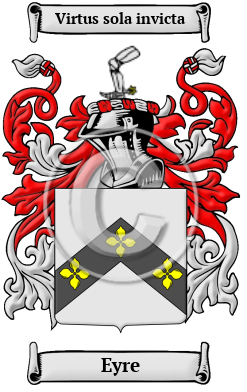
Motto: Virtus sola invicta
Motto Translation: Virtue alone is invincible.
- Bardsley, C.W, A Dictionary of English and Welsh Surnames: With Special American Instances. Wiltshire: Heraldry Today, 1901. Print. (ISBN 0-900455-44-6)
- Harrison, Henry, Surnames of the United Kingdom: A Concise Etymological Dictionary Baltimore: Geneological Publishing Company, 2013. Print
- Dixon, Bernard Homer, Surnames. London: John Wilson and son, 1857. Print
- Baring-Gould S., Family Names and their Story. London: Seeley, Service & Co. Limited, 1913. Print
- The Norman People and Their Existing Descendants in the British Dominions and the United States Of America. Baltimore: Genealogical Publishing, 1975. Print. (ISBN 0-8063-0636-X)
- Reaney, P.H and R.M. Wilson, A Dictionary of English Surnames. London: Routledge, 1991. Print. (ISBN 0-415-05737-X)
- Lower, Mark Anthony, Patronymica Britannica, A Dictionary of Family Names of the United Kingdom. London: John Russel Smith, 1860. Print.
- Shirley, Evelyn Philip, The Noble and Gentle Men of England; The Arms and Descents. Westminster: John Bower Nichols and Sons, 1866, Print.
- Lewis, Samuel, A Topographical Dictionary of England. Institute of Historical Research, 1848, Print.
- "What are the 5,000 Most Common Last Names in the U.S.?". NameCensus.com, https://namecensus.com/last-names/
- Filby, P. William, Meyer, Mary K., Passenger and immigration lists index : a guide to published arrival records of about 500,000 passengers who came to the United States and Canada in the seventeenth, eighteenth, and nineteenth centuries. 1982-1985 Cumulated Supplements in Four Volumes Detroit, Mich. : Gale Research Co., 1985, Print (ISBN 0-8103-1795-8)
- Convict Records Voyages to Australia (Retrieved 16th September 2020). Retrieved from https://convictrecords.com.au/ships/baring
- Convict Records Voyages to Australia (Retrieved 7th October 2020). Retrieved from https://convictrecords.com.au/ships/bengal-merchant
- Convict Records Voyages to Australia (Retrieved 20th August 2020). Retrieved from https://convictrecords.com.au/ships/aurora
- Convict Records Voyages to Australia (Retrieved 17th August 2021). Retrieved from https://convictrecords.com.au/ships/earl-grey
- State Records of South Australia. (Retrieved 2010, November 5) THOMAS LOWRY 1848. Retrieved from http://www.slsa.sa.gov.au/BSA/1848ThomasLowry.htm
- New Zealand Yesteryears Passenger Lists 1800 to 1900 (Retrieved 17th October 2018). Retrieved from http://www.yesteryears.co.nz/shipping/passlist.html
- The Political Graveyard: Alphabetical Name Index. (Retrieved 2015, October 19) . Retrieved from http://politicalgraveyard.com/alpha/index.html
|

 Eyre migration to the United States
  Eyre migration to Australia
  Eyre migration to New Zealand

 England
 Ireland