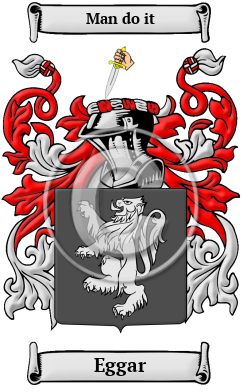
| ![Show Contents]() Eggar History, Family Crest & Coats of Arms Eggar History, Family Crest & Coats of Arms
Etymology of EggarWhat does the name Eggar mean? The Eggar family name is linked to the ancient Anglo-Saxon culture of Britain. Their name comes from the baptismal name for the son of Edgar. Baptismal names are a form of patronymic surnames, which come from the vernacular and religious naming traditions. In this case, the bearer of the surname Eggar took his name from his father's given name, Edgar. Another source claims the name literally means "happy spear" or "blessed spear." "Eádgár was one of the commonest of Anglo-Saxon personal names." 1 Early Origins of the Eggar familyThe surname Eggar was first found in Berwickshire. "Eadgar, a well-known and royal personal name among the A-Saxons. There are probably several distinct families of this designation. The Scottish family deduce themselves from Gospatrick, earl of Northumberland, temp. William I., who was a kinsman of Eadgar Atheling, and a descendant of king Eadgar, great grandson of Alfred the Great. The Edgars of Suffolk claim from a John Edgar of Dunwich, living in 1237." 2 Edgar or Eadger (944-975), was the King of the English, the younger son of Eadmund the Magnificent and the sainted Ælfgifu. "He was twenty-nine at the time of his coronation in 973 (Anglo-Saxon Chron. sub ann. 972; Flor. Wig. sub ann. 973). He was probably brought up at the court of his uncle Eadred for his name, coupled with that of his brother Eadwig [see Edwy], is appended to a charter of Eadred dated 955." 3 Edgar (1072-1107), King of Scotland was the eldest surviving son of Malcolm Canmore and Margaret, sister of Edgar Atheling, named after his Saxon uncle, was the first king who united Scottish and Saxon blood. "Canmore was slain by an ambush near Alnwick on 13 Nov. 1093, when engaged in a raid on northern England; his eldest son, Edward, fell at the same time or a day or two after. Edgar brought the fatal news to his mother, then in the castle of Edinburgh. Already enfeebled with illness she saw it in his face before he spoke, and adjured him to tell the truth. When told that both her husband and first-born were slain, she prayed to Christ." 3 Scotland records for the family were extensive and quite old. "The Edgars of Nithsdale, notwithstanding their Old English name are of Gaelic origin. Other Edgars held lands in Berwickshire of the earls of Dunbar. Edgar, son of Duvenald, son of Dunegal of Stranid (Strath Nith), held extensive lands in Nithsdale during the reign of William the Lion, and his descendants assumed the surname of Edgar." 4 Early History of the Eggar familyThis web page shows only a small excerpt of our Eggar research. Another 109 words (8 lines of text) covering the years 1860 and 1890 are included under the topic Early Eggar History in all our PDF Extended History products and printed products wherever possible. Eggar Spelling VariationsUntil the dictionary, an invention of only the last few hundred years, the English language lacked any comprehensive system of spelling rules. Consequently, spelling variations in names are frequently found in early Anglo-Saxon and later Anglo-Norman documents. One person's name was often spelled several different ways over a lifetime. The recorded variations of Eggar include Edgar, Edgair, Eger, Eager, Edzer and others. Early Notables of the Eggar familyMore information is included under the topic Early Eggar Notables in all our PDF Extended History products and printed products wherever possible. Migration of the Eggar family to IrelandSome of the Eggar family moved to Ireland, but this topic is not covered in this excerpt.
Another 90 words (6 lines of text) about their life in Ireland is included in all our PDF Extended History products and printed products wherever possible.
| Eggar migration to Australia | + |
Eggar Settlers in Australia in the 19th Century- Richard Eggar, English convict from Southampton, who was transported aboard the "Andromeda" on November 13, 1832, settling in New South Wales, Australia 5
| Contemporary Notables of the name Eggar (post 1700) | + |
- Dave Eggar (b. 1977), American cellist, pianist and composer
- Samantha Eggar (1939-2025), born Victoria Louise Samantha Marie Elizabeth Therese Eggar, an English actress, known for The Collector (1965), which earned her a Golden Globe Award, a Cannes Film Festival Award and an Academy Award nomination for Best Actress
- Katharine Emily Eggar (1874-1961), English pianist and composer
- John Eggar (1916-1983), English schoolmaster and first-class cricketer who played for Oxford University and Hampshire in 1938 and for Derbyshire from 1946 to 1954
- Tim Eggar (b. 1951), British businessman and former politician, Member of Parliament for Enfield North (1979-1997)
The motto was originally a war cry or slogan. Mottoes first began to be shown with arms in the 14th and 15th centuries, but were not in general use until the 17th century. Thus the oldest coats of arms generally do not include a motto. Mottoes seldom form part of the grant of arms: Under most heraldic authorities, a motto is an optional component of the coat of arms, and can be added to or changed at will; many families have chosen not to display a motto.
Motto: Man do it
- Harrison, Henry, Surnames of the United Kingdom: A Concise Etymological Dictionary Baltimore: Geneological Publishing Company, 2013. Print
- Lower, Mark Anthony, Patronymica Britannica, A Dictionary of Family Names of the United Kingdom. London: John Russel Smith, 1860. Print.
- Smith, George (ed), Dictionary of National Biography. London: Smith, Elder & Co., 1885-1900. Print
- Black, George F., The Surnames of Scotland Their Origin, Meaning and History. New York: New York Public Library, 1946. Print. (ISBN 0-87104-172-3)
- State Library of Queensland. (Retrieved 2014, November 27) Andromeda voyage to New South Wales, Australia in 1832 with 186 passengers. Retrieved from http://www.convictrecords.com.au/ships/andromeda/1832
 |